A Bride's Story
a review by 14ftdude
a review by 14ftdude
Caravan of Frames - An Otoyomegatari Review
This marks the end of the first volume, and as expected, it serves as an introductory arc—engrossing us in the world and letting us get to know its people. Now, let’s talk about the first wife we meet in this volume: Amir Halgal. She looks absolutely stunning, and I am totally not jealous of Karluk. Nope, definitely not jealous.
Jokes aside, we can tell from Amir’s mannerisms like going off to hunt that deer or even just her clothing that she’s not from the village. Her way of dressing is slightly different from that of the people there showing us the different cultures at play in the manga. Despite the significant age gap, Karluk is determined to catch up to her quickly, wanting her to stop worrying about him so much. Though, I will say her treating him like a child when he got sick was at least amusing to read she went into full on ‘Onee-san’ mode lmao.
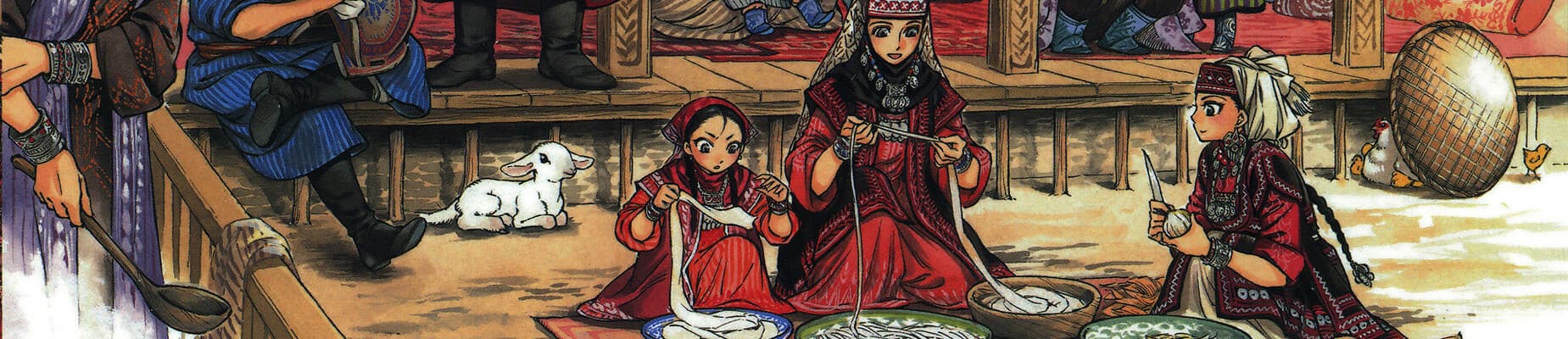
The artwork continues to shine, with incredible attention to detail in every panel. Even the smallest details, like the texture and patterns of the carpets or the intricate designs on their shoes, are beautifully crafted—something that remains a standout feature throughout the manga.
Now, for the story aspect: Amir’s family decides they want her back so they can marry her off to someone else, an arranged marriage that would benefit them more but mind you the person they are trying to marry off to next has already killed multiple other wives. We only see a brief skirmish between her brother and his men against the people who now consider Amir family—and man, that grandma is one hell of a badass, lol.
I also really love the quiet and intimate moments between Amir and Karluk in their room. The way they’re slowly but surely growing closer and deepening their bond adds a layer of depth that makes their relationship all the more fun to read as time goes on and we see more of them.
Volume 2 continues Amir and Karluk’s story, but this time, we see Amir making a new friend—and the newest addition to the waifu club: Pariya, the resident tsun. She’s frequently misunderstood by the people around her, and even her parents due to her blunt and fiesty nature, which makes it difficult for her to find a husband. However, Amir becomes one of her closest friends, reassuring her that she doesn’t need to change who she is and that she will eventually find someone.
Pariya is my fourth favorite wife in the waifu club, out of a total of eight for now. This volume also features Karluk getting adorably jealous as Amir spends more time with Pariya and the village children, teaching them how to use a bow.
One of the main themes of this manga is family, and this volume reinforces just how important that aspect is. When Amir’s family comes to take her back again, Karluk’s family and the entire village are willing to risk everything—even their own lives—to protect her. Despite having less advanced weaponry, they rely on ingenuity to outmatch their opponents, even at the cost of their homes and property. This moment strongly cements the manga’s message which is family, and that once someone is married into a family, they are fully embraced as one of their own.
We also get a deeper look at the region’s traditions. Although everyone lives in the same country, customs and cultural practices vary from place to place. However, certain traditions remain the same—such as the expectation that brides must know how to cook and sew. From a young age, they begin making their own dresses and other ceremonial clothing, with patterns and designs that are absolutely breathtaking. This adds a lot of character, and heart to the series making getting immersed in the world all the more easier. This tradition isn’t all that different from what we have even today, where brides are expected to bring household items with them when they get married. We call it ‘Jahez’, but it’s essentially the same concept. It was both weird and fascinating to see it represented in the manga.
Volume 3 marks the beginning of a completely new story featuring—yep, you guessed it—the newest addition to the waifu club: Talas. This volume focuses on her and Mr. Smith, the foreigner traveling through the region to learn more about its traditions and culture.
Before diving into Talas’s story, I want to talk about Mr. Smith for a moment. In many ways, he represents us, the readers. Like him, we are also foreigners to these traditions, experiencing them for the first time as Kaoru Mori guides us through the everyday lives of these characters. Seeing how they celebrate special occasions, and how they spend their free time it’s just wonderful to see.
Now, onto Talas and what this volume is about. Mr. Smith meets her while searching for his guide to continue his journey to India. She invites him to stay with her and her mother-in-law until he can find his way forward. While there, he learns the heartbreaking story of Talas’s past—how she has already lost five husbands, all of whom tragically passed away due to illness.
In my opinion, this is by far the saddest story in the manga, and it’s what makes me admire Talas so much. Despite all her losses, she doesn’t blame her mother-in-law or give up on life—she keeps going. Her mother-in-law suggests that Mr. Smith marry Talas and take her with him, but he needs time to think. Taking this as a rejection, the mother-in-law quickly arranges for Talas to marry some random guy from the village (fuck that guy, by the way).
In the end, Mr. Smith promises to marry Talas and take her with him once his journey is complete. It’s an incredible volume—honestly, I haven’t done it justice at all. I can’t find the right words to express just how much this story affected me, but we do see these two again later on.
Volume 4 introduces another story—this time about two very mischievous twins. This is probably my favorite pairing out of all of them, mainly because it’s a childhood friends-to-lovers story.
We quickly get to know Laila and Leily, whose unruly and bubbly personalities make them a handful—much like Pariya. However, their lively nature also makes finding husbands much harder for both them and their parents. Unlike other stories in the manga, this is the only one where we get to see the entire wedding process from start to finish.
Laila and Leily’s arranged marriage is also quite similar to how things happen nowadays—they end up marrying their neighbors’ sons. Initially, both sides are opposed to the idea, but as discussions between their parents take place and they go on test dates to decide who gets with whom, they slowly start to fall for each other. It’s honestly heartwarming to see how both twins think they got the better man—when in reality, they each found the person who was best suited to them.
What makes their story even sweeter is that their wish of always staying together comes true. Since they’re marrying into the same household, they’ll continue to live together as part of a joint family. This village is also near the sea, making fishing a viable job, which fits perfectly since both Laila and Leily love swimming.
Overall, I absolutely love this volume and the next one, where we get to see the full wedding unfold. It’s such a wholesome journey watching Laila and Leily find love. I’m definitely biased, though, because I love childhood friends-to-lovers stories.
Volume 5 picks up right where volume 4 left off, immediately throwing us into the wedding preparations. We see the villagers slaughtering animals to prepare meat for the feast. Since the village is close to the sea, fish is also a major part of their diet, but the usual staples like meat and rice are present as well.
And man, I just cannot get over how stunning the art is. Laila and Leily’s wedding dresses look absolutely incredible. We also get to witness the wedding ceremony, where the imam has the bride and groom place their hands on the Quran and recite their vows, giving us yet another glimpse into the culture.
This volume, along with the final few pages of the previous volume, carries a bittersweet undertone. Laila and Leily begin to realize that they’re finally moving away from their parents—that they’re growing up. Mom and Dad won’t be there to greet them when they wake up, and the thought of stepping into an unfamiliar home feels lonely. The manga captures these emotions beautifully, showcasing the complex feelings brides experience on their wedding day. At the same time, you can tell from the look on the husbands’ faces that they’re determined to make sure their wives never feel alone. This volume also highlights how, in this culture, a wedding isn’t just for the bride and groom—it’s a massive event for the entire family and all the guests. The brides, dressed in heavy, ornate clothing, have to endure long hours of celebration with barely anything to eat. Overall, this volume does an incredible job of blending beauty, tradition, and the emotional weight of marriage.
In Volume 6, we return to Amir and Karluk, with Amir’s family still refusing to give up on taking her back. This time, her father seeks help from the Badan tribe, a group that possesses Russian weaponry—guns and the like. However, what he didn’t realize was that the Badan leader planned to betray him, intending to take all the land for himself.
This is where Amir’s brother redeemed himself for me—he quickly caught on to the impending betrayal. Karluk’s village put up an impressive fight against the invaders, all things considered, but without Amir’s brother turning against his father, their chances of victory would have been slim. In the midst of the battle, Karluk gets injured, and Amir immediately goes into full ‘Onee-san’ mode once again.
In the end, Amir’s father is killed by the grandma as he tries to flee, desperately trying to save his own life. What I love about this volume is how it highlights the sheer power of Russian weapons, emphasizing that the people here wouldn’t stand a chance if the Russians decided to invade—unless they stick together.
One of my favorite moments in this volume was when Karluk lifted Amir off her feet, symbolizing how much stronger and more mature he has become. It was a really wholesome moment between the two. Amir’s father’s death also serves as a reminder that some people simply cannot be reasoned with, and in the end, they get what they deserve.
The final chapter delivers a heartfelt moment between Amir and her brother, where we see just how much he truly cares for her. Despite everything, he wants nothing more than for Amir to be happy.
Volume 7 is also the start of a brand new couple. Here, we get to see the life of Anis and how she’s living a pretty extravagant lifestyle, having a healthy baby and a loving husband. She still feels as if there is something missing from her life, and so one day, she asks her husband if she can go and visit the bathhouse, where all the women in the area gather and gossip. Essentially, her part of the story focuses mainly on the females of the society and how conservative they are, unlike the other ones we’ve seen, like Laila/Leily or Amir. Here, it’s expected for the women to not show their face at all and be completely covered when going out.
This is also where we are shown that polygamy is accepted, and that if the man can provide for them, he is allowed to have up to four wives. Anis also finds out about “soul sisters” or “sworn sisters” in the bathhouse by the various people there, and she is very intrigued by the idea. Since she usually doesn't have a lot to do in the house and her husband is away most of the time, the only one that she can really talk to is their housemaid. Her feeling of loneliness eats away at her, but the interactions with the other women in the bathhouse, and finally her meeting Sherine — another woman in the bathhouse who captures her eye — allow her to fill that hole she feels in her heart. Meeting her also shows both of them how much they enjoy talking with each other and being around each other, so they decide to become “soul sisters,” basically being bound for life, like marriage vows.
But one day, Sherine’s husband tragically passes away, and since they weren’t really well off to begin with, she stops coming to the bathhouse a lot. When Anis finds out, she wants to do anything she can to help her “sister” so she asks her husband if he’d be willing to marry Sherine as well. He readily agrees (who wouldn’t, bro, fr) but asks her to wait till the “mourning” period is over, which is basically a tradition where a recent widow cannot be seen by a man or go out of the house for some amount of time after they are widowed.
Once they do get married and Anis has one more person in the house to share her time with, that hole in her heart is fully fulfilled. This is also one of the stories which is like yuri but not really, since the two wives really, really love each other. And dang, Sherine has a massive rack! That guy is seriously lucky, lol. It gives us a good perspective of how polygamy can be made to work if all the parties consent and agree. I really enjoyed this aspect of it.
I'm doing this one a little differently—volumes eight and nine are essentially the same arc, so it makes sense to talk about them together. Much like the Laila/Leily arc (my bias is showing lol), these volumes follow directly after the attack on the village by Amir’s father and the rival tribe. The aftermath is devastating; nearly the entire village is in ruins, homes destroyed, and lives upended.
At the center of the destruction is Pariya’s home and her father’s workshop. All the clothes and fabrics they had been preparing for her wedding; destroyed. This pushes her wedding even further into uncertainty, which is heartbreaking for her. Pariya was already considered “old” by societal standards, and just when she’d found someone she genuinely liked and the feelings were mutual, she’s now terrified that he won’t wait for her—that he’ll find someone else and she’ll be left alone forever. (Don’t worry Pariya, I’ll marry you fr.)
Pariya and her family move in temporarily with Karluk and Amir, and that’s where the magic starts. Their badass grandma steps in and teaches Pariya how to sew. She struggles at first, but eventually starts to create some truly beautiful pieces. The turning point was sewing while thinking about someone she deeply cares for—her to-be husband.
These volumes highlight just how much Pariya is willing to grow and change for love. All her classic tsundere moments are still there (which I love), but now we see this deeper, more vulnerable side as she pours herself into something she’s not particularly good at. Her improvement in embroidery is more than just a skill—it’s a symbol of how love can truly transform someone.
Pariya is an absolute joy to read. Endearing, stubborn, honest, and quietly determined.
In Volume 10, we see Karluk and Amir again, but this time they are separated. Karluk is staying with his brother-in-law because he wants to get stronger so that he’s able to protect Amir when the time comes. He asked her brother for help with this.
Man, the art in the manga just continues to impress me—the level of detail that was put into drawing that hawk is just mind-boggling. Volume 10 shows us the depth of the resolve the two have and the love they share. Amir can’t bear to live apart from Karluk, but Karluk, having the urge to protect her in the future, must become stronger. He even tells her not to meet him every week, but rather every month. It’s beautiful to see their relationship evolve with this.
Karluk also gets to know his brother-in-law and his friends properly. They might have been enemies not long ago, but all that’s in the past—he’s still her brother. This volume also shows us many other facets of the nomadic lifestyle, like training hawks and then setting them free later on in their life so they can start a family, and make more stronger hawks, and the circle of life keeps going.
Another reason Karluk really wants to get stronger is the looming threat of Russian invasion. When the time comes, he wants to be there to protect his beloved wife and family, instead of being the one who is protected. It’s just a great volume, showing us how harsh the weather can be when you’re living the nomadic life as well.
In Volume 11, we go back to Talas and Mr. Smith—and man, I love these two so much. Especially Talas, and how strong she is emotionally. Having lost every husband she married, she still longs for love and the warmth that comes with it, and is willing to throw everything away to be with the person she loves.
After Mr. Smith had decided to move on with his journey, Talas was married to someone else. But on the night of their wedding, she wept—because it wasn’t the marriage she wanted. And the person she was married to, being the absolute chad that he is, promised to take her to Mr. Smith, since she had a vague idea of where he might be.
When she reunites with Mr. Smith, you can literally feel the emotion—the joy and happiness oozing out of the pages. They decide that her “husband” will go back and spread the news that she died while on the journey, so that no one comes looking for her. And though she’s sad that this will deeply upset her mother-in-law back home, she just wants to be with the person she loves, letting her emotions rule her completely.
Mr. Smith, now still touring the area, has an encounter with Russian troops and is essentially forced to go back home—taking Talas with him, since she wanted to stay with him no matter what. Talas, like I said before, is just such a strong woman mentally. She just wants happiness after all the sadness she’s gone through, and she’s willing to go to the ends of the earth to get it—letting her emotions run wild and guide her.
Volume 12 and 13 are sort of recap-type volumes for Anis/Sherine and Laila/Leily—not just them, but the other couples too—showing us what’s happening in their lives now. So there isn’t really much to say for these two volumes, other than some events that happen, like Anis teaching Sherine how to read and write, and Sherine wanting to pass that knowledge on to others. It just shows how good-natured and kind Sherine is.
Laila and Leily get a new home and start thinking about how they’d host someone if a guest ever came over—and lo and behold, Mr. Smith does. At first, the whole village is afraid of letting them host him, but they prove everyone wrong and turn out to be brilliant hosts.
All in all, these two volumes were also very nice. It was a refreshing change of pace compared to the others—just following their lives without anything major happening, like a marriage. Just calm, slice-of-life moments that add depth to the characters we’ve grown to love.
Volume 14 is the final volume that I read—though only part of it, just the chapters that were officially TL’ed, and damn we meet what I’d say are probably some of the most badass wife in the entire series.
This is also the volume where Karluk finally comes back home. Now, with the looming threat of Russian invasion, some of the tribes are considering forming an alliance. And what better way to do that than through a bond that ties families together—marriage.
But first, the Halgal men need to prove themselves in a horse race against the Jandiq women. Azel and the other men of the Halgal clan actually win—and damn, do they bag some beautiful wives. Especially Azel. She is so badass and beautiful. I can’t stop gushing about how stunning she looks.
One of those wives, Ryazat, is such a tease and a joy to see on screen—I need more of her. Then there’s Aigul, who came back to the clan after a divorce because her chosen husband was a complete piece of work—violent, and he even dropped a kettle of boiling water on her face. Now her face is partly burned, and it’s become extremely hard for her to find a suitor. But one of the three men from the Halgal clan chooses her, which I love—because she definitely deserves happiness as well.
The wedding and its details are then hashed out, and after the ceremony, we’re shown how the men try to treat their wives, and the different dynamics that each couple brings. One is a pair of the two strongest people in the clan coming together. Another is a cheeky, playful wife with a shy husband. And the third is a scared and scarred wife with a gentle and kind husband.
It’s nice to see the contrast that all three relationships offer.
Finishing Thoughts:
I absolutely fucking loved this series from start to finish.
The way it depicts the culture and traditions of various people and villages, the stories it tells about love and the lives of people living under the constant tension of the Russian invasion—it’s all just incredible. And don’t even get me started on the absolutely stunning and beautiful artwork. Every page is a masterpiece.
The characters I fell in love with basically immediately. Especially all the wives—and how the common thread between all of them, even while being in arranged marriages, is love. The way love triumphs over all is just brilliant.
The only character I truly hated was Amir’s father—and honestly, I feel like that was very intentional on the author’s part. He’s the perfect example of someone who can’t change, who can’t see the world from any perspective but his own. And in a story that’s all about growth, understanding, and moving forward, people like that just don’t fit. Everyone moves on, and they get left behind.
I really, really wish I could wipe my memory and read this manga again for the first time—because boy, was it a joy to read. It’s easily made its way into my top 3 manga of all time. And honestly, if I hadn’t read Girls’ Last Tour, it would very well be my favorite manga ever. I would love to see an anime of this animated by KyoAni.
Score: 10/10
30.5 out of 31 users liked this review
