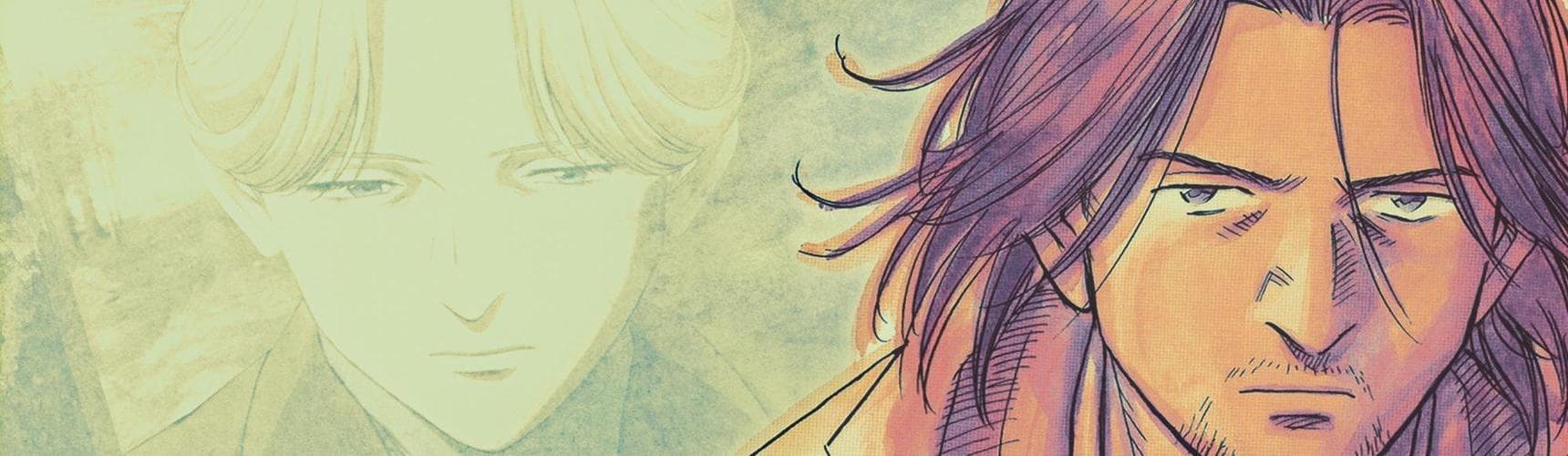

Stuck between its divine visual flow and aggrandizing mythos of morality, humanizing vignettes succumb to lofty narrative ambitions. I'm more impressed by Urasawa's mechanical artistry and sporadic characterizations, making the setting feel alive and textured, than the main two anchors. The wealth of characters, which would usually be a distraction, ironically becomes its only saving grace once you realise how uninteresting the main strife is. Everything after the first volume is shallow intrigue building on its Byzantine plotting until it all eventually leads to a pristine moral victory for the protagonist. By the halfway point it becomes clear that Monster's purported complexity operates on a purely textual level, with thematic insights and intrigue being merely repeated from Vol. 1. Johan is treated more as a concept than a character, literally being referred to with monikers like "monster" and "devil", a preternatural force wreaking (rather tame) havoc by orchestrating supposedly complex machinations (we never see the design of these) that work purely based on charm, appeal and some other prenatal gifts, until a final act of forgiveness and grace radically humanizes him in one fell swoop. It's charming on paper, but the level of self-seriousness this operates on feels unearned given how contrived and melodramatic its insights are. Even in the first volume, Urasawa's grotesque use of black and white morality is evident in almost every panel; from foxy faces to droopy eyes. The contrast between these visual cues and Tenma's straight-faced demeanour is jarring. Love is a transcendent force, Urasawa purports, yet the narrative conceived around this notion doesn't give it any real grounding. There's no moral reckoning that provides any actual psychological probing. Characters feel like changing on arbitrary instances—which, while true to life, provides little narratological value in a story.

The work's philosophical conflict, freedom vs predestination, free will vs the world is as it is, arises from Eva and Tenma's conflict rather than with Johan's. Johan merely inherits Eva's social understanding of inequality (hierarchies, haves and have-nots) and moulds it into a metaphysical axiom (humans are all equally meaningless; we're only equal in death.) This weakens the main dynamic of Tenma and Johan, contextualizing the moral tension as one of chance (Eva's value system leading Tenma to rescue Johan, who happened to be at the specific hospital at a specific time) rather than something born from the dynamic itself.
Tenma's framing of moral exceptionalism is also brought into question of even being exceptional at all. Initially he emerges defiant of the system of corruption and institution, but every subsequent act framed as heroic or exceptional merely follows the expected medical oath doctors take. Tenma's character is then of total stasis, firmly believing in his thesis till the very end. His strength of heroism does not follow any moral conflict or human uniqueness; hence, the villain becomes his source of heroism, i.e., exceptionalism. Yet any real influence these two enact on each other happens in the first volume when Tenma saves Johan's life and Johan kills a patient (his only act of villainy that is both shown and is generally enticing to watch). Their conflict effectively doesn't exist; Tenma doesn't attack Johan and Johan doesn't attack Tenma. One follows the desire to prove the equality of people (doesn't happen, because of course it doesn't. It's just plainly not true.) and the other seeks to find actualization of sorts (does happen, in a way). In the end, Lunge and the drunken father contribute more to Johan's capture than Tenma; the last man ends the ubermensch. And while it affirms the premise of Monster—the inherentness of evil within us and the need for community to absolve that part of us, which is why Tenma, in repayment to the drunk, operates on Johan and (presumably) saves his humanity—it does not in any meaningful way reconcile the work's lack of any real developmental and dramatic weight.

Johan's celebrated psychological depth is also practically non-existent. If we consider evil to be a state akin to darkness and goodness akin to light, i.e., evil is the absence of good, then his character would thematically register as one devoid of light, which explains, outside of aesthetics, why he is literally shrouded in darkness in multiple key panels. He's an entity first introduced as the purest form of evil, then reaches a point of internal confusion because of memory fog, then finally gets humanized as a remnant of eugenics and brainwashing, a symbol of human monstrosity. Each succeeding revelation makes him lose power as a villain and as a character. His character development, though textually complex, is at once a stream of successive depictions of ad hoc, ethereal forces shaping, explaining and justifying his evil. Unlike, say, Raskolnikov, whose moral and psychological torment grows out of his own agency and guilt, Johan does not achieve any development through his own actions; he does not react or respond to his treatment in any definitive way except trying to understand why people would create a monster out of him (which acts as justification, contradicting the thesis of freedom and antithesis of predestination), which strips him of agency as a person, a villain and as a concept. The committed acts of evil are then pinpointed on one person, whose intentions are still vague and justified through repentance. All of this makes representations of both evil and good trivial. "Villains and their motivations are supposed to be enticing and thought-provoking by way of their personal birth—a purpose and conviction that, no matter how repulsive, is still born from human emotions to be terrifyingly empathetic—where the psychological or philosophical value of a villain lies in their ability to say something larger and ponderous about the human condition as opposed to the singular condition of one thoughtless and contrived individual." What does Johan have to say? What does Johan represent? The ills of society? Seriously?
In this way, since Tenma and Johan both lack substantial development and their moral links remain weak, the absolute, parallel moral dynamic becomes its own undoing, effectively stripping any sense of depth that could be implied outside of the immediate surface text. (You'll see loads and loads of posts highlighting the intricacies of its plottings and symbolisms, which is all fine and dandy, but it also proves how easy it is for an author to escape scrutiny of his theming under the guise of complexity and mechanics. The story is the way it is because it was "designed that way", and hence any attempt to challenge its notions is met with "that's the point!" or "it's not trying to do that!" or "you just don't get it." There is no introspection, only broad gestures to patently obvious things and didacticism, and people look at you weird when you don't care for any of it.)


This also reflects one of the more amateurish understandings of human psychology in Monster: that humans are only capable of thoughtless evil if they've been conditioned into it. Every other act of vice committed by people is shown alongside empathy and reconciliation of sorts, suggesting that evil or moral fatigue is always deterministically bound, with no internal agency. However, it does the inverse with Grimmer, responsible for the only potent sequence in the story, who is the only character I'd consider legitimately well-written and affecting (embodying conscious unlearning of learned inhumanity, which is a level of delicate and naturalistic probing the narrative never again attempts.) The story ultimately remains almost improvisational and thematically unelaborated. Its ethical and philosophical premises are given no real resolution, even implicitly. Tenma's final act could easily be seen as fate and Johan's nihilism is undermined by the stream of causes and justifications the story provides for his actions. The philosophical conflict never coheres into a meaningful or even interesting thematic conclusion. It's essentially a mystery soap opera in spirit (Twin Peaks but didactic to an unbearable degree) that, for some reason, has this grandiose reputation of being the most highbrow story ever told. It's weird how people talk about this like it's drenched in impenetrable intellect when in actuality it's more blunt than a baseball bat to your face.
I'm not entirely sure what I feel about this in totality. I was mostly hooked by the first volume, which felt somewhat grounded in institutional and moral exploitation. Urasawa utilization of mystery box intrigue is remarkable and the first volume remains my favourite precisely because his penmanship excels at withholding just enough information to keep things shrouded in mystery. But then it mostly loses me in its long slew of characters entering, mouthing plot points, becoming sympathy anchors, then vanishing—a formula that repeats right until the very last volume. Its thematic pretensions are always a few steps behind the plotting.

It then footnotes the entire thing in maybe the most egregious ad hoc way by implicating the mother as having a hand in Johan's arbitrary evil, introducing a completely new and cliche ethical problem into an already failing story. Whatever.
50 out of 82 users liked this review
