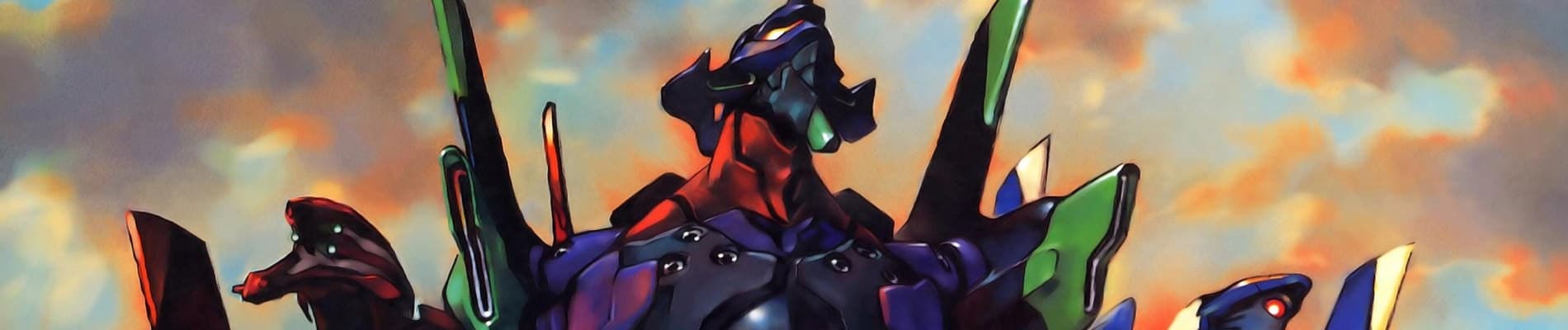
Evangelion trades the typical sleek, engineering-focused mech narrative for a study in intense personal anguish. The giant robots are presented less as perfect machines and more as imperfect, visceral extensions of their pilots' own inner turmoil. It's rough, uneven, and often attempts more than it can handle. Some episodes made me genuinely want to shout at the TV - not because they were bad, but because they hit way too close to things I recognize. I’m still pretty new to anime, but this series had been on my list for years: the daunting one. The "Important" one people write essays about. So, naturally, my expectations were completely warped. So does it deliver? Mostly. You can spot the flaws right away, and a couple of choices definitely broke my immersion, but it has such a specific, personal voice running through it that it landed harder than almost anything else I've watched.
I didn’t come into this looking for a Saturday morning mech cartoon. The reputation that precedes Evangelion is that it is the. deconstruction, the one that made the genre grow up, the show that gets inside your head. I can’t really speak to how it plays against classic mecha tropes - I’ve never seen Gundam or its classmates - but it absolutely works as a piece of psychological horror in a giant robot suit. It starts as watching kids pilot biomechanical war gods to fight mysterious Angels, and slowly mutates into a group of profoundly broken people barely holding it together while the world quietly ends in the background.
What really hooked me was the slow build of the wrongness. You can tell that something is off from episode one. But it’s not really because it's setting up for some huge twist; it's just a constant, low-level pressure that refuses to ease up. Tokyo-3 is both a sleek future city and a raw wound from Second Impact, always waiting for the next blow. NERV is strange in a way you can’t quite name - not military, not corporate, but maybe a cult with a substantial budget. Everyone seems to be in on a secret except the kids who actually have to pilot the Evas. Gendo treats Shinji like faulty equipment. People talk about Rei like she’s just part of the hardware. No one has to explicitly say what they are doing feels strange and maybe even wrong. The atmosphere makes it obvious.
It’s that suffocating vibe that Evangelion absolutely nails. Every scene feels like there’s a weight pressing on your chest. People joke, flirt, go to school, drink beer in messy apartments, but underneath all of it there’s this quiet, shared despair that no one has the language - or courage - to bring up. Nowadays, it really can feel like we’re all not okay but we just resign to powering through and not talking about it - so the energy strikes uncomfortably familiar. The show weaponizes that feeling.
The characters are what push the show from really good into amazing territory. Evangelion isn’t actually about robots fighting Angels so much as it’s about what it feels like to drag around trauma, self-loathing, and the constant fear that if anyone ever sees the real you, they’ll walk away.
Shinji’s the center of the whole mess, obviously. He’s passive, he waffles, he’s always one bad day away from just walking out. I get why he grates on people. But he also feels like what you’d realistically get if you handed a chronically anxious, emotionally neglected 14-year-old the job of saving the world. He’s going to stall out, avoid things, lash out at the wrong time, then collapse in on himself. And the show just lets that happen. It doesn’t try to sell him as a hero or a villain. It just keeps watching him long enough that you see how that mix of abandonment and impossible expectations completely scrambles his sense of self.
I was surprised by how seriously the series handles the characters around Shinji. Asuka arrives like a siren - loud, braggy, always performing. But soon, the cracks appear, and that performance starts looking like a shield protecting a deep fear of being ignored or thrown away. Rei first reads as deadpan and emotionless. The longer you spend with her, however, the more her emptiness feels manufactured, not chosen - as if she was never given the chance to develop into a full person. Misato ended up affecting me the most. On the surface she's a chaotic, fun disaster: beer and instant noodles, clutter, a joke for every situation. Yet beneath that, she seems like someone frozen the moment her childhood exploded - trying to outrun grief with work, alcohol, casual relationships, and this hesitant attempt at being a parent to a kid who triggers all her unresolved trauma.
The series is stubbornly dedicated to just sitting with these people. Entire stretches of the show pause the plot so we can watch someone alone in a room, stuck in their thoughts. Staring out a train window. Standing in an elevator where nothing happens. We get flashbacks, inner monologues, and lingering shots held long enough have you wondering if they'll ever end. It can be subtle as a brick, yes, but that blunt approach suits a story so upfront about everyone's misery. That slow buildup is why, when things finally do crack - like Shinji’s awful, inhuman scream after the event with Toji - it doesn’t feel like cheap shock. It feels like the only possible way for all that bottled pressure to finally release.
On the technical side, I understand its reputation. “A Cruel Angel’s Thesis” is an all-timer opening that has you humming it while washing dishes after only a few episodes. The music expertly goes big and chaotic for the Angel fights, then fades into something thin and lonely for the quiet scenes. Visually, it’s almost thirty years old, and it holds up far better than I anticipated. It doesn't feel modern, but the choices are strong enough that it registers as classic rather than dated. The shots that stuck with me weren't even always action scenes; they were static frames that refused to cut away, or small repeated sequences that compel you to sit with the immediate aftermath. You can definitely see where the budget disappeared, but that roughness ultimately feels like part of its texture, not a dealbreaker.
Under all the spectacle, the storytelling is weirdly relaxed about worldbuilding. You don't get some big lore dump explaining Second Impact, NERV, Seele, the Angels, the Evas. You get scraps. Offhand comments, background details, stuff you're supposed to piece together yourself - kind of like reading item descriptions in a Souls game rather than flipping through a manual. Meanwhile, themes keep stacking up quietly: using other people as mirrors to figure out who you are, the terror of actually being seen, the hedgehog's dilemma (closeness always risks mutual harm). The worldview is genuinely bleak. But buried in all that cynicism is this fragile little thread: maybe existing as yourself, separate but still willing to reach toward someone else, is worth the pain.
Where Evangelion loses some ground for me is in two main areas: the way the TV ending handles everything, and the fanservice.
Those last two episodes have a myth attached to them, and once you see them, it’s obvious why. You can practically feel the production problems in the form of reused shots, long stretches of still images, and that almost slideshow-like presentation near the end. But taken on their own, they’re also one of the stranger, gutsier choices I’ve seen a show make. Instead of building to some giant external showdown, Evangelion hits the brakes and dives completely into Shinji’s head. The narrative turns into this jumbled, therapy-adjacent collage about self-worth, isolation, and the terror of letting someone actually know you. On that level, I found it really compelling. Watching Shinji slowly pick apart the stories he’s been telling himself and inch toward something like “maybe I don’t have to hate myself” is genuinely moving - especially if you read it alongside what we know about Anno’s own mental health at the time.
The trade-off is that a lot of the external story just gets shoved offstage. As a wrap-up to the plot the show’s been building for 24 episodes, it’s pretty all over the place. The big questions - Instrumentality, what Gendo is actually trying to pull off, how Seele’s plans differ, what physically happens once the final Angel is gone - mostly get implied instead of shown. The series hits this huge turning point and then basically refuses to cut back to the larger world. I don’t need a clean final battle or a feel-good epilogue, and I'm honestly fine conceptually with weird, internal endings. But here, the focus tips so far inward that the bigger narrative never quite finishes coalescing.
That hard pivot inward also means almost everyone who isn’t Shinji gets pushed into the background. Up until then, it really does feel like an ensemble - Asuka, Rei, Misato, Kaji, the bridge crew - each of them with their own arc slowly taking shape. In the last two episodes, most of them only appear in quick mental snapshots, little reminders that they’re hurting too, without actually following through on where their stories were heading. Rei especially feels shortchanged. She’s one of the most interesting parts of the whole show, and even after we get some answers, her arc still feels half-obscured. Asuka and Misato come out a bit better, but even they don’t quite get the payoff their setup seems to be aiming at. By that point, Shinji - who we already understand better than anyone - basically fills the whole frame.
So I'm in a strange middle ground: I respect what the ending attempts, and I found specific moments in those final episodes incredibly impactful. But as a complete conclusion, it just doesn't quite work. Finishing the show meant End of Evangelion immediately jumped to the top of my watchlist, purely to see the more concrete events that the TV run hints at but never actually shows.
The other major issue is the fanservice, which is annoying to acknowledge but impossible to ignore. I’m not against sexual elements in media, but the way the show lingers on its characters - especially the 14-year-old pilots - feels genuinely gross. The slow camera pans, the dumb breast jokes, the casual nudity, that one episode built on what feels like one specific fetish... all of it clashes hard with the serious, emotional weight of the rest of the show. I can try to file some of it under 90s anime industry nonsense, but that doesn't excuse it. It adds no depth and tells us nothing new about the characters. Instead, it yanks me out of the story and turns a series I'd otherwise recommend to anyone into one I have to preface with a strong warning.
Even with all of that, Evangelion hasn’t really left my brain since I finished it. It’s the kind of show that practically invites you to go down rabbit holes - essays, video breakdowns, forum arguments, wildly different takes on what anything means. I really latch onto art that feels like someone working through their own mess in public, and Evangelion has that vibe all over it. You can tell someone poured way too much of themselves into this thing and didn’t bother sanding down all the weird edges.
What I keep thinking about is the loneliness - that specific kind where you're always anxious and uncertain, even surrounded by people who are probably just as emotionally wrecked as you are. The whole cast keeps colliding, keeps wounding each other, but keeps fumbling toward something like connection anyway. Pull the robots and the end-of-the-world stakes out of the equation and you're left with something pretty simple: a story about how hard it is to exist as yourself, and how in spite of that, showing up honestly - even when it costs you - might be the only thing that really means anything.
Not every choice works. Some parts are obviously dated, some ideas feel half-formed, and the TV ending left me wanting a clearer picture of what actually happens after. The fanservice is a real strike against it. But even so, I think it earns most of the praise. Prickly, emotionally raw, relentlessly inventive, and surprisingly tender underneath all the cynicism and horror.
If you can deal with some strangeness, a lot of introspection, and a not-insignificant amount of ’90s baggage, I think Neon Genesis Evangelion is absolutely worth checking out. It’s far from perfect, but it hits in a way most shows don’t, and that impact sticks with you long after the last episode.
39.5 out of 42 users liked this review