I honestly don’t even know where to start with this movie. The End of Evangelion might be the most aggressive, draining, and flat-out upsetting animated film I’ve ever sat through. It feels like a film that beats you down and then, somehow, still argues that being alive is worth the trouble. I went straight from the series’ “Congratulations!” into this, expecting some kind of external, plot-level payoff after the show’s more inward-looking finale. Instead I got a full-on nightmare: sudden visual detours, harsh psychological interrogation, a cruel streak I wasn’t ready for, and an ending that made me actually say out loud, “...what?”
When Netflix dumped me back on the home screen, my gut reaction was mostly negative. I felt grossed out, blindsided, and confused in a way that didn’t feel deep or clever - just pushed away. It was like watching Hideaki Anno crack his skull open on the table and tell me to keep up or get lost. All the trippy imagery and relentless psychological prodding didn’t initially read as masterful filmmaking to me. It felt more like watching someone’s latest bad trip. I’m pretty new to anime in general, definitely not an Eva expert, and a lot of the symbolism just bounced right off.
But then I did what you basically have to do with this movie: I fell down the rabbit hole. Essays, ancient forum threads, hour-long video essays from people who've clearly been carrying Evangelion around in their skulls for decades. I won't pretend all that reading didn't change how I felt - it completely did. Strictly on first viewing alone, this would've stayed in my "I respect the ambition, but I hated sitting through it" pile. What happened instead was weird: over the next few days, scenes kept replaying themselves uninvited. Connections started forming. The film kind of rebuilt itself in my head without asking permission. You might even call it... The Rebuild of Evangelion.
I also don’t think that kind of baffled reaction is stupid or shallow. If you bounced right off this film, it doesn’t mean you didn’t get it or aren’t smart enough for Evangelion. The movie is intentionally murky. It hurls lore, symbolism, and psychological warfare at you with almost no guidance. For something in a medium that’s usually pretty approachable, the effort required to really grasp what’s happening is unusually high. I'm not begging Anno to make crowd-pleasers. I'm just acknowledging that this thing demands a lot from you. Some people aren’t going to want to make that climb. Totally fair.
In terms of story, I’d always heard EoE pitched as the outer ending to the show’s inner one: the series finale lives inside Shinji’s head, and the movie supposedly shows what’s happening in the real, physical world. It does kind of do that - just in the most sideways, Evangelion way possible. Instrumentality goes down, but not how SEELE or Gendo intend. Rei seizes control, steps out of her role as Gendo’s tool, and hands the fate of humanity over to Shinji. On a thematic level, I love that. But the actual sequence of events and imagery doesn’t do much for me emotionally. The angels, the gigantic Rei, ands the orange LCL oceans are all visually wild, but that’s not what ended up hitting me hardest. Like the series, the real impact is buried under the spectacle, in the messier character stuff.
That kicks off right away with what might be the most deliberately gross opening scene I’ve ever watched.
That hospital scene is... something. Shinji pulling back the sheet, getting off on Asuka while she’s out cold, then just staring at his hand and saying, “I’m so fucked up” - it’s revolting, and it’s clearly meant to be. As a way to start a movie, it plants a flag: this is not Shinji the hero. This is not a story where everyone grows neatly and hugs it out at the end.
What saves it from feeling like cheap edginess is what it says about him in almost no time at all. He’s empty, desperate for any kind of connection, and so twisted up he can only reach for it in the worst possible way. Shinji isn't a pure, sad boy protagonist anymore. He does actual harm, and it's the kind you don’t just forgive because he’s having a rough time. I hated every second of it... but I also kind of think the rest of the movie doesn’t work without that line being crossed.
That hospital scene sets the stage, and from there, the movie actually delivers something I felt the show was missing: Misato and Asuka finally get endings that feel definitive and concrete.
Misato's always been a walking mess - it's like three different people are jammed into one body: the half-functional adult, the complete disaster roommate, and the commanding officer who keeps dropping the ball in every single role. Her death scene shoves that whole mess over the cliff. She’s dragging a completely catatonic Shinji down the hallway, suddenly just snaps, slams him against the elevator door, and then gives him a deeply messed-up kiss, throwing in the line, “We’ll do the rest when you get back,” as if that’s a totally normal thing to say.
Her final act is both heroic and deeply wrong. She's genuinely trying to save him and the planet, but the only tool she knows how to reach for in that moment is this warped intimacy. That’s what made work for me: she doesn’t get a tidy hero moment where everything about her suddenly makes sense. She dies mid-mess - still confused, still bad at being what Shinji actually needs, but trying anyway. That’s way more painful than if she’d gotten some neat, triumphant curtain call.
Asuka finally gets an ending that feels as loud and raw as she is. All through the show she’s been unraveling - terrified of being replaced, convinced her value starts and ends with beating everyone else. When she realizes her mother’s soul has been inside Unit-02 the whole time, protecting her with its A.T. Field, everything snaps into place. In this one awful, triumphant moment she gets it: she was loved, she wasn’t tossed aside, she’s not just another pilot on the roster. I totally missed that beat on my first watch - the movie barely holds your hand with it - but once it clicked, the whole fight looked different. Her sudden rage, the way she absolutely tears through the mass-produced Evas, stops feeling like a random power-up and starts reading as the one time in her life she actually feels held.
Of course, Evangelion being Evangelion, it doesn't last. The Evas revive and rip her and Unit-02 to pieces in some of the most brutal imagery in the franchise. Weirdly, though, I read that as the happiest ending Asuka was ever going to get. For once, she got to feel loved. She got to be extraordinary on her own terms. It's cruel and excessive and completely in line with the show's grim worldview, but emotionally, it lands as something almost like victory.
Rei is the one character I still feel a bit shortchanged by. On paper, I love where she ends up. She finally makes a decision that isn’t driven by Gendo or by her function as a manufactured tool - she rejects his plan, merges with Lilith, and hands the decision about humanity’s future to Shinji. That’s a huge step for someone who started out basically as a human-shaped instrument. Conceptually, it’s great. But emotionally, it doesn’t always land for me. Rei doesn’t get quite enough grounded, personal moments to really sell the jump from blank, obedient figure to someone capable of choosing betrayal on that scale. The big beats are there, but the smaller, more intimate pieces that would make that choice feel crushingly earned just aren’t. For me it’s less that the writing completely fails her and more that I wanted more time with this version of Rei than the story gives.
Even with all of that, it still feels like we’re just warming up compared to the two parts that really knocked me flat: Shinji’s decision during Instrumentality and the beach scene at the very end.
The middle of the movie feels like someone took the show’s final episodes, turned off the lights, and hit remix. We’re back inside Shinji’s head again, wading through his fear, his self-hatred, his craving for connection. The twist is that this time the actual end of the world is riding on whatever he picks. Everyone else has melted into one big shared mind, and Shinji’s stuck with the question: do we stay fused together forever, or do people get to come back as separate, fragile selves?
He chooses life. He turns down the safety of total unity, the easy promise of no more pain, and basically says “I want a world where I can be hurt and hurt others, but maybe also be loved.” In a more typical movie, that would cue swelling music, bodies reforming everywhere, and a big group hug on a sunlit hill.
End of Evangelion wants no part of that lie.
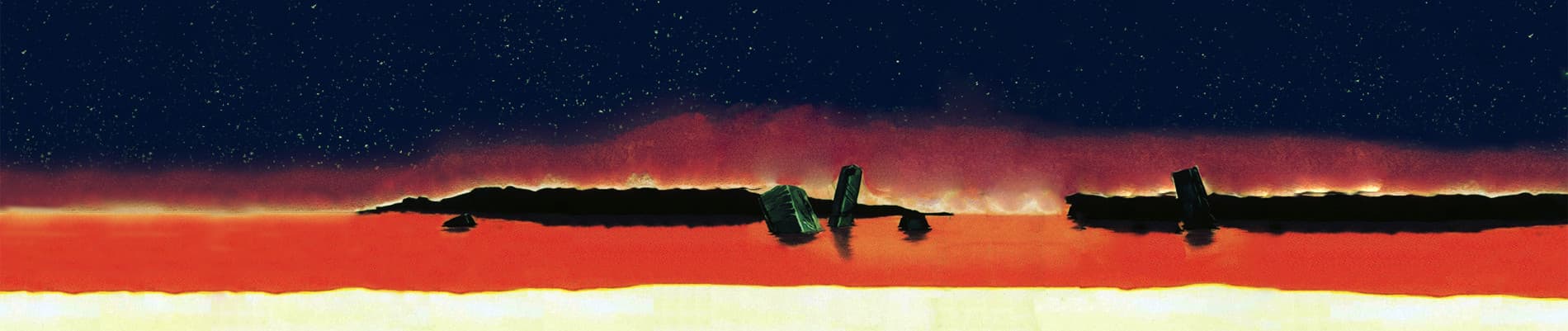
Instead, we get a wrecked planet. An endless sea of LCL, a gigantic Rei head decaying on the horizon. Only Shinji and Asuka are there. No choir, no crowd, no hopeful feeling that Earth will rebuild. Just two traumatized teenagers alone at the end of the world. And Shinji’s first move when he sees another person again isn’t relief or gratitude - he climbs on top of Asuka and starts choking her.
My initial reaction was nervous laughter, honestly. It felt like the edgiest possible way to roll credits. But when I sat with it and tied it back to the hospital scene, it fell into place in a really bleak way. Choosing life didn’t magically fix Shinji. He didn’t suddenly resolve his issues or become less selfish. He’s still that same miserable, ashamed kid who violated Asuka earlier - only now he understands just how monstrous that behavior is.
Asuka’s just as shattered as he is. She’s seen inside his mind during Instrumentality. She knows what he’s done, what she stands for in his head, how he swings between desperate need and genuine cruelty. And even with all of that in her, while he’s choking her on the beach, she doesn’t punch him or scream. She slowly reaches up and brushes his face.
That tiny gesture absolutely floored me. It’s not some neat romantic payoff, and it’s definitely not clean forgiveness. It feels more like she's saying without words “I see you. I know how ugly you are. I know how ugly I am. I know this world is unbearable. And I’m still here.” That touch shatters him. He breaks down, sobs, and lets go.
Then there’s her last line: “気持ち悪い.” My version translated it as “Disgusting,” but it can also mean “I feel sick,” “This is gross,” stuff along that line. It’s brutally straightforward. She’s clawed her way back into existence, immediately gets assaulted, and her honest response is basically, “This is horrible and I hate how it makes me feel.” But what matters is that she came back anyway. So did he.
If EoE has anything you could call a message (and I’m not convinced it cares about having one), it’s definitely not “life is beautiful” or “everyone deserves a hug.” It’s that life is disgusting. People screw each other up. You will, too. There’s trauma, misunderstandings, and here, an actual apocalypse on top of it. And even with all that, it nudges you toward choosing that mess over the blank safety net of Instrumentality.
What makes that hit is that it never sugarcoats what you’re picking. It drags you through every rotten bit of it, then basically asks, “This is it... do you still want this?” It’s grim, and it clings to you afterward. But buried somewhere in all the sludge, there’s a tiny, stubborn sense that choosing to exist anyway counts for something.
On a technical level, the movie is frankly ridiculous in how well-made it is. The fight between Asuka and the mass-produced Evas is an all-timer. The imagery during Instrumentality veers into something that feels half-religious and half blasphemous, and it’s impossible to forget. The sound design and music keep everything feeling huge and cosmic while still weirdly intimate. For me, though, all that incredible craft is in service of something pretty small and human at the core: the emotional punch of choosing to live while fully aware of how ugly life can be.
Do I still have issues with the movie? Definitely. It's dense to the point of alienation. Rei deserved more room to breathe. And I'm not going to pretend I could have pulled half my interpretation from a blind first watch. I needed other people's work and analysis to see what this film was actually doing. That’s a flaw and part of the experience.
After letting it rattle around in my head for a while, I’ve ended up just kind of awestruck by it. It’s harsh, deeply uncomfortable, and flat-out miserable to watch at points, but it feels honest in a way most things, especially big franchise stuff, rarely are. It drags Evangelion’s core depressive spiral all the way to the edge and still manages to mutter, in its own broken voice, “Live anyway.”
I can't quite say I enjoy The End of Evangelion in the conventional sense. It's certainly not a comfort film to throw on after a long workday. But it’s become one of those rare pieces of media that really makes me think... and the more I think about that final choice - to come back, to be separate, to suffer on purpose - the more it means to me.
Once the initial shock wears off, and you start digging into the wider fan analysis, that's when the film truly reveals itself. What finally hits you is anything but warm or reassuring. Instead, buried beneath the apocalypse and all the visceral horror, I found a tiny, ugly, stubborn piece of hope. It's that strange, difficult feeling that ended up resonating with me the most.
38.5 out of 40 users liked this review
