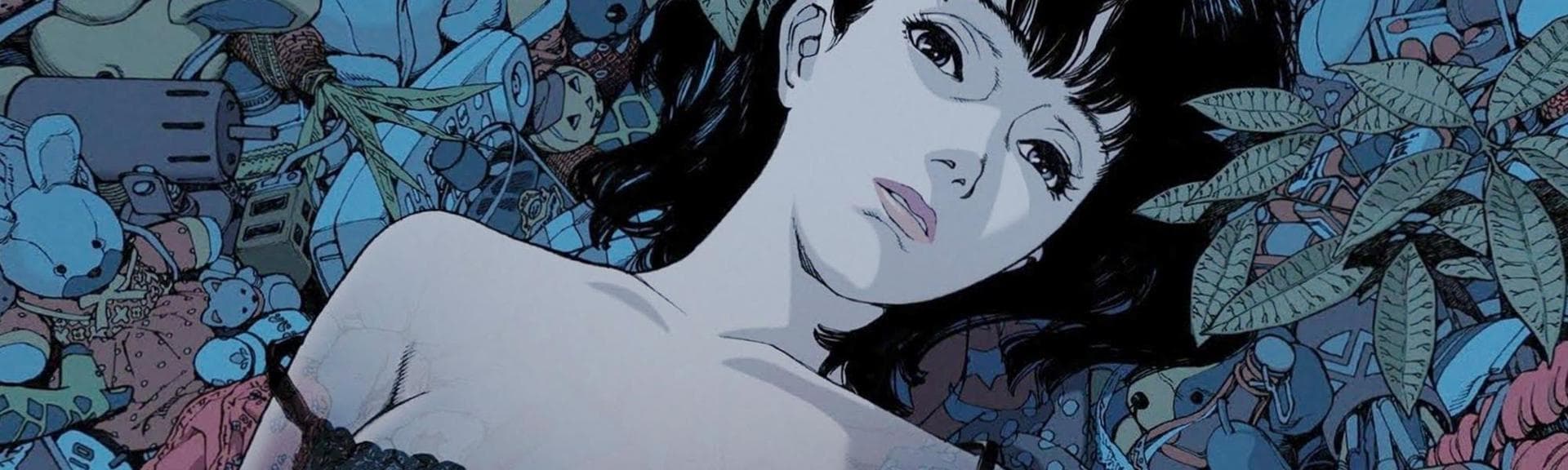
Note: There will be spoilers scattered throughout my in-depth synopsis as I can't see another way to explain/illustrate the symbolism I found during my experience while watching Perfect Blue.
Originally written in 1991 by Yoshikazu Takeuchi, Perfect Blue: Kanzen Hentai was a groundbreaking take on classic American slasher films. (My first thoughts being vaguely reminiscent of American Psycho or The Shining.) The Kanzen Hentai containing a dual translation meaning either “complete metamorphosis” or “total pervert”. During this tale of mental psychosis and identity crisis we learn these elucidations are deeply rooted in the context of our film.
We begin our story centerstage as Mima an up-and-coming pop star makes a life altering career change into the world of acting. Split by her agent's opposing opinions, Tadokoro wanting to encourage an image change in acting and Rumi believing a life singing on stage with CHAN (Her group) is what's best, she must decide which future feels right. Although I was unassuming at this stage, the first piece of the puzzle was laid here, as subtle as she may be. For the duration of the film, we agonize over the pitfalls of a naive, young actress being taken advantage of. Sequentially leading to our titular character doubting her own existence via a delusional, stress induced existential crisis concerning a life left behind and a future filled with doubt.
Note: Here's where I get into the meat and potatoes! Ahh Where to start!
Clue 1: A Dream That Once Was
We're gonna jump back to my aforementioned reference to Rumi in the paragraph above and I apologize if my thoughts come across jumbled. A brief backstory on Rumi is that she was once a pop idol similar to Mima. Rumi strongly urges Mima to reconsider her industry transition into acting as singing is "her lifelong dream". Wow red flag! It's here that we can begin to grasp the perception Rumi could be living vicariously through Mima, especially since her own chance at stardom was dashed at a young age.
Clue 2: Tattered Realities
We set the stage as Rumi begins her acting career, having underwent a few film takes by this point in the story. Tadokoro (Mima's male agent) pleads with the studio to script more lines/scenes to bolster her public image and help break out of the pop idol image she's accrued. Our negative result is the casting of a rape scene, which sets fire to our main character and protagonists' psyche for the future to come. As Mima is filming her rape scene (Which had 2 takes!) we pan to our agents as Rumi, eyes wide begins crying and pulling her hair, ultimately storming out of the studio. Let's focus on this last sentence and break it down. Rumi was forced to watch an "image of herself" she's seen up to this point, reach rock bottom and essentially be defiled by a group of random strangers. Her mental image was shattered and her perfect reality crumbled before her eyes. It's not far off to say our protagonist saw herself being raped as her idol career slipped forever ever out of reach in an instant.
Death 1: The Director
By this point our stalker Me-Mania has been introduced and is nothing more than a ghost trading passing glances. However, he's created a website detailing the precise activities, habits, and nuances of Mima's daily life. To which Rumi WRITES OFF as a joke. My take is that Rumi has connected with Me-Mania by this point and they're working in tandem. This is only furthered when our show writer is murdered, both Rumi and Me-Mania having the motive to do so. And thus, our clock is set forward into motion propelling a stream of connected murders centered around Mima.
Death 2: The Photographer
A photographer known for smutty publications hosts a session for Mima as she strips down to her skin, graphically revealing uncensored nude positions accentuating both breasts and pubic hair. When the Anilist description states "As her stalker closes in, in person and online, the threat he poses is more real than even Mima knows". We should be aware that the true change in our stalker's nature begins here. Buying up all the publications, tearing magazines from civilian's hands, and developing his own persona of Mima as a pop sensation. The toll of witnessing his idol publicized in this light drives Me-mania to completely separate the two figures as if Actor Mima is a different person from Singer Mima. In a sense this means only one can remain and it will be what both he and Rumi consider Mima's perfect self. Oh, and by the way, the photographer dies. Our plot thickens from this point on! Hallucinating/projecting her past likeness, Mima has begun to suffer dramatic symptoms only categorizable as identify or multiple personality disorder. Transposing an old image of herself into reality in which she converses, argues, and struggles to understand. When she finds the bloodied clothes worn by the perpetrator in her closet, she can only assume she herself committed the crime, but would she really do that? Does she even know herself anymore? What is reality but the occurrence of bygone days blurred by the lines of acting and visions of madness endured.
Death 3: The Agent
I was pretty confused here but my guess is that Me-Mania survived the initial blunt force attack after his shuffle with Mima and from there leaves to attack Tadokoro. In his weakened, off kilter state, Tadokoro was able to fight back to the extent of trading blows, resulting in the simultaneous death of both characters. We should examine Rumi and Mima's relationship up until this point. At this time in the story every tragedy is dealt with swift reassurance from Rumi as a coincidence as the nurturing motherly mask is dawned.
Conclusion: The Big Reveal - Part 1
_Mima is contemplating existence in her room as the other self appears where Rumi was supposed to be. A moment of clarity punctuates Mima facial gesture as "Dark Mima" attacks and it's revealed to be Rumi dressed in her old group uniform. A scuffle breaks out as Mima is stabbed with a screwdriver and an umbrella during a high intensity chase sequence involving running across rooftops, mantling beams, falling into trash and reaching dead end alleys occurs. At the same time as our alley scene proceeds, Rumi's "Mima Wig" is knocked off, and we see her composure shift to a panic as we realize her personality shifted in that instant. Rumi stumbles into the street only to be rescued a split second before a passing truck collides. _
Conclusion: "I am me" - Part 2
My favorite use of symbolism falls within our final scene. Mima (an accomplished actress by this point) visits Rumi in a psychiatric hospital where she's been diagnosed with multiple personality disorder. Presenting her with flowers, Rumi walks up to a mirror, clouded and with the image of someone other than herself in the reflection. Coming to terms with herself as she is now, Mima says "Thanks to her I am who I am today" representing the metamorphosis of a character uncertain of the "who" she was, into someone confident in the person they've become and are now. This is further symbolized by our car scene where we see a similar glint framed behind Mima and a clear image of herself in the front mirror with clear blue skies ahead. I personally believe this symbolized her trauma and self-doubt as being in the past, and a fresh new beginning ahead as the "real Mima".