

_"Nothing has a stronger influence psychologically on their environment and especially on their children than the unlived life of the parent.” —Carl Jung_
From an exterior, it can be easy to determine what makes a sustainable family from an objective perspective. Whether it'll be having a stable job, a home that's comfortable to live in, means that can be easily reached, and the presence of the parents within the life of the child when growing up. But there is a factor that comes within—a trait that's difficult to point out until you're faced by the very issue—and that is love. It may be easy to say, and people have different definitions of what love is, but to put it simply, it is an act to be presently caring, and yet, but it's also an act that's difficult to translate, as each person—including children—have different means of feeling what love is.
If by circumstances, what would happen if there’s a family who has the means to live comfortably, yet do not have the emotional capabilities of caring at the present? Then, you'd be raising your offspring as a half-filled husk, unsure of what's missing with them, unsure why they struggle to understand the world, and for worse of them all, carrying that empty feeling like it's hereditary.
It's a quietly screamed, dragging process of deteriorating the hearts of the victim, and would lead a trail of blood onto its tracks.
***

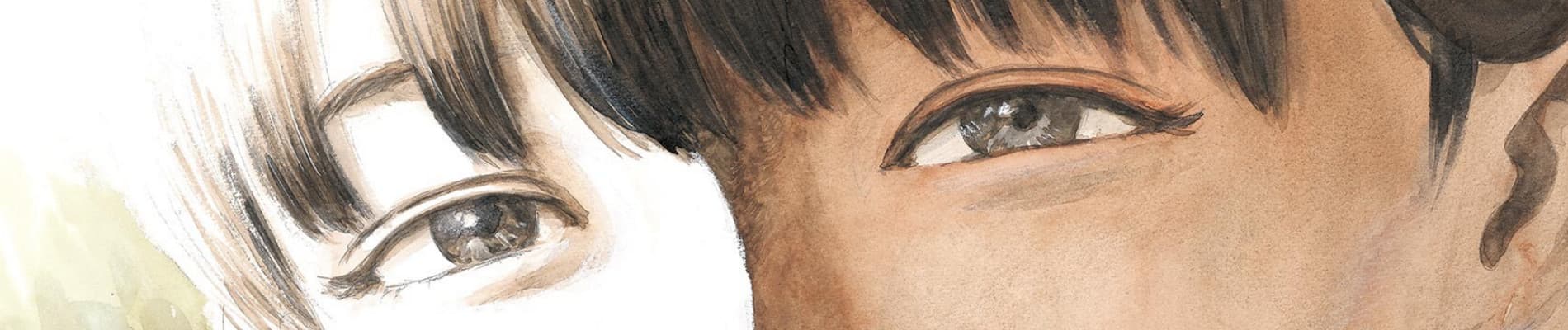
Blood on the Tracks is a series created by Shuuzou Oshimi whose known in other famous mangas such as Flowers of Evil, Inside Mari, and many more—tackling the anomalies of the human psyche and the extent it can damage a person, and in this series in particular, we follow Seiichi Osabe, a young boy who's under the submission of her mother Seiko Osabe, and his journey in navigating through the mixed signals, hidden abuses, and it's willful ignorance of the false-love that was given by her mother.
One thing’s for certain is that this series is insanely uncomfortable from the story it wants to tell. It doesn't rely on the physicality of the horror with ghouls or demons, but telling that the greater horror might just be from the person you believed your entire life that you've been taken care of, especially in the mind of a child whose mind was skewed from the beginning, facing selective truths and obscured lies for the convenience of the controller.
***

To first understand the sequences in the manga, we must understand the motivations of the characters in the series with the idea that these characters are in need of psychological intervention. Though I do not condone diagnosing individuals from the basis of limited information, but just for this one—alluded that these are fictional characters—we can assume.
In the case of Seiichi Osabe, he exhibits patterns of a person who is bound by trauma towards his mother. He looks forward to the assurances and love that her mother gives, but in order to get there, he has to suffer from the abuses Seiichi is blinded to see. This is followed by her mother Seiko Osabe who is exhibiting symptoms that correlates to a form of a personality disorder, according to the Diagnostic Statistical Manual of Mental Disorders (DSM), in which one of the closest is Borderline Personality Disorder (BPD), which exhibits unstable relationships, fear of abandonment, emotional instability, and inappropriate anger, all of which are present to Seiko.
Though what I have mentioned above is mainly through my speculation, it is important to understand character’s actions and reactions. As you keep reading the series, you might be annoyed with Seiichi and his decisions, but within the context of an underlying condition, it absolutely made sense. All throughout Seiichi’s life revolves around her mother, from the movements and the psyche. Letting go basically means your life will be over. Seiichi's bruises are caused by her mother, in which she also patches over. A cycle of doubt and assurance, where a false image of love takes the stage—even at the final chapters in the manga, where Seiichi falls the obligation of taking care of her mother, because deep within Seiichi, there's still a thin thread of trauma-influenced sympathy towards her mother.
Seiichi is not like this when he's born, but he was molded to be—by her mother. Seiko has an authoritative, yet caring nature. Aggressive, yet calm, Protective, yet dismissive. An unpredictable cycle of emotions that stiffens the reader of what she'll do next. Her presence alone scares Seiichi, yet finds love behind the iris. It's a cycle of love and hurt for Seiichi and Seiko, and will continue to do so until “that” breaking point in the manga.
Blood on the tracks challenges the notion that true horror will always be led by the mind as it screws your perception of reality, controlled by the puppeteer, and face the truth that real horror comes within the mind. No amount of thrillingly horrific music can change the mood of a scene compared to psychology-driven horror. A horror that masquerades as comfort.
Though there will be some audiences who will be reading this manga and question themselves “if im in this situation, i wouldn't do that” but that's not the point of the manga. It is a showcase of the horrors when one family is not intervened with their past traumas, and how they transfer their trauma in new forms towards their offspring. A gut-wrenching presentation of what’s already present in most families—though not as extreme—yet garners the same feeling. Even if you tell yourself that you’ve moved on from the trauma that was instilled to you, fragments continue to remain.
***

Blood on the Tracks is a triggering experience for the many, and an insightfully uncomfortable read for a few. An intriguing tale of a broken family if left unchecked, where traumas are left unnoticed, and actions continue to stab deeply. I highly recommend this manga for those who want to experience true horror in a form of instilled fear and disgust from the one who's supposedly giving us comfort. ***