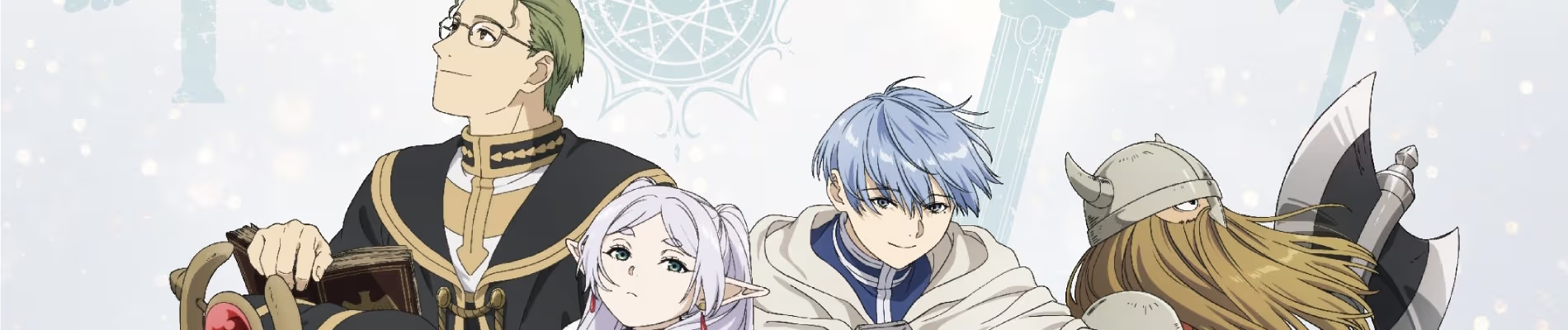
Every once in a very long while, something comes along that makes all your usual ways of talking about “good” or “great” media feel completely useless. Frieren: Beyond Journey’s End isn’t just “really good” or one of the better anime I’ve seen. It feels finished in a way that makes the word flawless not sound ridiculous when talking about it. When I wrapped up the season, I sat there trying to nitpick it - looking for anything I’d tweak or cut. Nothing came to mind.
I once again feel obligated to share that I’m not exactly deep in anime culture (yet!). My watch history is four things: Cyberpunk: Edgerunners, Madoka Magica, Evangelion, and now this. So mostly heavy, psyche-breaking stuff, people having meltdowns while the universe caves in, that kind of thing. Tragedy, existential dread, weird brain horror - that’s my usual drink of choice. The pitch for Frieren - a slow fantasy adventure about an elf running errands and learning spells - sounded, frankly, like the type of cozy, slice-of-life media that I was conceptually uninterested in. I only clicked because the ratings were absurd and I’m a sucker for seeing if the hype can actually land.
On a whim, I turned it on, expecting to bounce off quickly. Then, ten minutes into episode one, I found myself tearing up over a meteor shower. With characters I’d only just met.
That first episode is basically a mission statement for the whole series. You get a fairly generic fantasy endgame: the hero’s party returns home after defeating the Demon King. Except that’s not the story - it's only the prologue. The actual story starts after the credits should’ve rolled, when the celebrations are over and time just... moves on. You’ve spent maybe ten minutes with Himmel and his party when the show suddenly starts skipping forward: ten years, then more, and you feel this mounting weight of years passing in the quietest way possible.
Then you get that scene. Himmel and Frieren and the rest of the party, watching the meteor shower over the lake. The orchestra swells, the colors soften, and the direction gently frames this moment of beauty. And somehow, despite barely knowing these people, it already hurts so good. The show lays out its entire emotional thesis right there: the adventure is over, the world is saved, and what lingers isn’t the boss fight, it’s this quiet, fleeting moment they shared that Frieren didn’t understand the value of until it was too late.
That’s Frieren’s magic trick. It doesn't need to be loud to make you feel things.
What makes Frieren work - what makes it special - is the characters. Frieren herself is fascinating because she’s not designed as an immediately warm protagonist. She’s aloof, blunt, almost casually cruel in that fantastical way long-lived beings can be when human lifespans are basically blinks to them. She was physically present for the party's biggest heroic moments, of course, but she didn't truly understand her companions until they were gone. The entire story hinges on watching her slow, almost reluctant realization: those years she dismissed as insignificant actually meant everything.
Then there’s Fern. Frieren and Fern’s relationship might be my favorite thing in the whole show. It’s this beautiful, understated mentor/student relationship where Frieren’s technically the teacher, but half the time it feels like Fern is the one keeping her grounded. You can see the echo of Flamme - Frieren’s own mentor - in the way Frieren tries (and often fails) to guide Fern, and that generational chain of people trying to be just a bit better than the ones who raised them is such a powerful throughline.
Stark slots into their little found family so perfectly, too. On paper, he’s a strong but anxious guy who may or may not have a crush on Fern, but the show never lets him be just a gag. He gets to be insecure, brave, petty, thoughtful, deeply sincere. His dynamic with Fern feels like a believable teenage romance - not some melodramatic soap opera, but awkward, quiet, occasionally dumb, and incredibly sweet. His interactions with Frieren sit in that space where you tease someone you respect because you know they’ll never say how much they care out loud. It all feels weirdly real.
That sense of realness extends to the side characters too, which is sometimes where shows fall apart for me. Kanne and Lawine could've been nothing - just comic relief filler - but they end up having sweet moments and being memorable. Denken and Richter get maybe one arc and still feel like people with actual lives outside the frame. Sein joins the party later and immediately slots in like he was always supposed to be there. The whole world has this quality where you believe it keeps going when nobody's watching. Most fantasy doesn't pull that off.
One thing I love is that the show mostly dodges the tragic backstory arms race. There is pain and loss here - this is still a world with demons and war and death - but it’s not obsessed with stacking trauma on every character as a shortcut to depth. A lot of them are just... people. Flawed, kind, stubborn, petty, hopeful. They definitely carry their baggage, but the show's tone never sinks into grimdark misery. What you see is people quietly dealing with their issues, constantly trying to move ahead. This approach is emotionally honest in a way most narratives just aren't.
What really surprised me is how something this gentle never once put me to sleep. Whole episodes go by where the group just kind of exists in a town. They practice magic, help with some local issue, wander around. If you wrote it out as bullet points, it would sound like nothing even happened. But I was glued to my screen anyway. Not because I was worried about who might die or what twist was coming. I just... wanted to be there. With them. In their world. As someone who usually chases high-intensity, twisty narratives, that’s not normal for me.
It helps that when the action does come, it's phenomenal. Frieren doesn’t need big fights to work, but when it arrives, it absolutely slams. Madhouse really went for it. The battles don't devolve into generic magical laser beam fights - they play out like little strategy problems. The magic has rules, everyone has things they’re good and bad at, and every clash becomes this question of who’s reading the situation better, who’s hiding the right trick, who’s about to get completely outplayed.
That mana reveal in episode 10 is absolutely unforgettab;e. The show spends so much time carefully setting up how people perceive Frieren, how she deliberately undersells herself, how the world's whole framework for understanding power has shifted over the centuries - and then it finally lets the mask slip. You can feel it coming. They can feel something's wrong. And when it lands, it's one of the most satisfying "you have no idea who you're talking to" moments I've ever watched. Not just hype. Earned hype. The kind that only hits because they were patient enough to build to it.
All of this is built on production quality that's almost unfair. The visuals are gorgeous but never showing off. Every frame just has this quiet confidence to it. Towns feel lived-in without looking like theme parks. Forests and ruins and old roads carry this gentle sadness that matches the whole bittersweet vibe perfectly. The animation goes off during fights, sure, but what got me just as much were the still moments - a long shot of the sky, someone's hand brushing an old keepsake, the way light falls across a room during a conversation that doesn't seem important.
The music is ridiculous in the best way. Evan Call’s score feels like part of the cast. The big orchestral hits - like during the meteor shower - do exactly what you’d expect, but the smaller stuff hits just as hard. Those tiny piano phrases that show up when Frieren thinks about Himmel. The soft strings underneath Fern and Stark being awkward around each other. The quieter tracks that make the world feel like it’s taking a long breath. Half the time I didn’t consciously register the music, I just noticed that my chest was tight at exactly the right moment.
The voice work is unreal too. This is the best Japanese cast I’ve heard so far. And it’s not just about the big emotional scenes. It’s the throwaway lines. The way Frieren mutters to herself. Fern’s tired little sighs when she’s done with everyone’s nonsense. Stark tripping over his own words. The half-laughs, the noises people make while listening instead of talking. All those tiny choices pile up until they stop feeling like performances and just read as real people.
Thematically, this thing hit me a lot harder than I expected it to, given who I am and where I’m at in life. On paper, an ancient elf processing human mortality and the weight of centuries of regret shouldn’t be my hyper-specific emotional kryptonite.
And yet.
At the center of Frieren’s story is this awful, quiet idea: you were there for the most important moments of someone’s life, but you weren’t really present, and now you don’t get a do-over. That’s a brutal thing to sit with, and the show never shouts it at you - it just lets it sink in. I’ve definitely coasted through parts of my own life on autopilot, assuming I’d always have time later for the people and things that matter. The series keeps coming back to Frieren's tiny memories of Himmel doing something kind, or dumb, or quietly thoughtful - stuff that barely registered at the time. They're beautiful, painful reminders that the small, mundane stuff is what really survives in your mind, perhaps even more than the big heroic headlines.
The message Frieren expertly conveys, without ever feeling preachy, is pretty simple: slow down. Look at who you’re traveling with right now. The wasted afternoons, the dumb running jokes, the throwaway conversations - those are the bits you’re going to remember once the "main quests" of your life blur together. The last time you saw someone might not feel like a last time when it’s happening. You only realize what it was years later, if you’re lucky. Frieren is about that realization hitting centuries too late.
If I try to put my fan-brain aside for a second and be objective about it, any problems I can think of are basically just matters of taste. The pace is unhurried. The tone stays calm and gentle most of the time. If you need constant twists, ever-rising stakes, and mountains of lore to stay interested, this might not be your thing. But calling that a flaw feels off. The show knows exactly what it’s doing and nails that vision so completely that complaining it isn’t something else is kind of missing the point.
I started this thing pretty wary, fully aware of how hyped it was. I expected to like it at best and roll my eyes at the fandom at worst. Instead, I finished it feeling like the internet somehow undersold it. It’s not just great for an anime or great for a fantasy show or great if you want something cozy. It's absolutely amazing, front to back - emotionally, structurally, visually, thematically.
If there’s one idea I’m walking away with, it’s this: the journey doesn’t really wrap up when you beat the big bad. It winds down in a hundred tiny, stupidly ordinary moments you barely register at the time - a shared meal, a running joke, a walk through a nameless town, a meteor shower you think is just a nice view. Those are the points where things actually end. The show is basically about learning to notice those while you’re living them, instead of decades later when everyone’s gone and all you can do is replay them in your head.
And if an animated fantasy about an emotionally constipated elf can make me sit on my couch and seriously rethink how I’m spending my limited time with the people I care about - that feels like more than just good storytelling. That feels like a gift.
71.5 out of 81 users liked this review