Made in Abyss
a review by 98Griffin
a review by 98Griffin
Made in Abyss rules, and I say that as someone who went in specifically because everyone kept saying “it gets fucked up” like they were warning me about a cursed VHS tape. It had been on my radar for a few months, and as someone relatively new to anime but not new to stories that wear a cute mask and then slowly slide the knife in, the pitch was basically irresistible. A friend - whose taste I’ve come to trust - called it his favorite and immediately followed that up with heavy caveats about how dark it gets. Which, for me, is the bat signal.
I went in expecting nonstop misery: torture porn, constant death, relentless psychological punishment. And yeah, it absolutely has teeth. The warnings weren’t exaggerated. But what surprised me, and what actually hooked me, was the sheer audacity of the world.
The Abyss is one of the coolest, most creatively realized settings I’ve seen in a long time, period - less a backdrop and more a foundational character. It’s a colossal, ancient chasm that functions like gravity: everything in Orth orbits it. The town didn't just happen to sprout up nearby, it’s built around it spiritually, economically, culturally. Adults descend for relics and glory and die trying. Kids are orphaned by the job and then trained into the same path. Everyone accepts that at a certain depth, you simply don’t come back. And what makes all of that feel especially haunting is how normalized it is. People say goodbye like it might be forever and nobody really blinks. There’s something quietly horrifying about a society that treats a one-way descent into oblivion as a respectable aspiration - but the show never lectures you about it. It just lets you sit with the implications: obsession as tradition, generational toil, resource extraction, sacrifice, maybe even a little capitalism humming under the floorboards. It’s there if you want to read into it, but it’s also just serves as a near-perfect adventure hook.
That normalization is also why Riko works so well as a protagonist. Her drive to reach the bottom isn’t framed like reckless suicidal ideation - it’s treated as an inherited calling, almost a cultural inevitability. That distinction matters. Her friends push back because they’ll miss her, not because the world thinks she’s insane. In this universe, going into the dark is the default. It makes her choice feel earned and tragic in a way I didn’t expect.
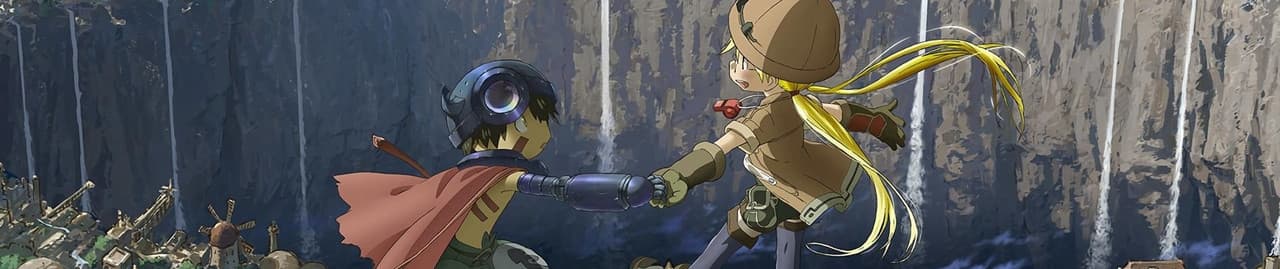
Then there’s Reg: a walking mystery box, but a good one. The show plants seeds about him constantly - his unclear origins, his connection to Riko’s mother, the overall shape of the Curse - without turning into a riddle-box that feels like it’s stringing you along. I don’t have a confident read on what he “is,” and I definitely don't buy “robot” as the whole answer. He’s powerful in a way that should break the story, yet he’s also obviously just a kid. Emotional, earnest, protective, terrified, and frequently out of his depth. That contrast is the secret sauce: it keeps the adventure from feeling like a power fantasy and makes it feel like what it really is - two children pushing forward into something vast and indifferent, clinging to each other because that’s all they’ve got. The tenderness between them ended up being the emotional spine of the season for me. The quiet moments of care hit harder than a lot of the violence.
Also: the soundtrack is ridiculous. I know “the soundtrack slaps” is the most default anime compliment imaginable, but Kevin Penkin really earns the hype. The OP being this bright, bubbly little earworm while the show is quietly loading a gun in the next room is honestly kind of mean, once you realize what you’re in for. The real magic for me was the ambient stuff, though. When the needle drops on “Underground River” in episode one, it’s an immediate signal that you’re in special hands: high-fantasy adventure energy with a hesitant, melancholy undercurrent, like wonder and dread holding hands. And that feeling never really lets up. Even simple exploration scenes start to feel like you’re trespassing somewhere sacred and dangerous at the same time. The score amplifies the vibes so hard that the Abyss feels even more alive.
Visually, I’ll admit I judged it by its cover at first. The promotional art didn’t grab me; the proportions and character shapes felt kind of... off. In motion, those concerns mostly evaporated. The animation is expressive where it counts, and the show knows exactly when to shut up and let you stare. The environment design is the real flex. Every layer has its own identity, like you’re dropping into a totally different biome with new rules, new textures, new little threats hiding in the corners. Those wide shots of Riko and Reg trekking through these massive spaces are some of my favorite moments of the season. It’s the kind of setting that could sustain an entire franchise - films, games, spin-offs, field journals full of sketches - because you can tell you’re only seeing a fraction of a fraction
I do have one “taste” gripe that kept popping up: Nanachi. I love her character and backstory, and her dynamic with the duo is a huge emotional win. But conceptually, her design drifts into furry-bait territory in a way that gave me a mild ick. There’s a specific tail-related moment that made me physically cringe a little. Not a dealbreaker, not a moral argument, just me being honest about the one time my brain went “okay, anime, I see you.” Your mileage may vary.
Now, the darkness. I was fresh off Evangelion when I started this, so I thought my tolerance was calibrated. For a while - like, eight episodes - I was waiting for an infamous “this is where it gets fucked up” moment and wondering if the reputation had inflated into meme status. And then the Orb Piercer sequence happens, and the show goes from pretty and largely atmospheric to "wow, they went there."
That whole stretch is brutal, visceral, and almost unbearable to watch. What's most impressive about it is that despite the initial instinct to think it gratuitous, it's not at all. It's completely earned. The series spends so long laying pipe about what ascending does to you, about how the Curse isn’t lore but physics, biology, inevitability. So when it finally cashes that check, it doesn’t feel like cheap shock value. Riko’s suffering is awful, but what made it hit me hardest was Reg’s panic - the raw, childlike desperation of someone strong enough to fight monsters but not strong enough to stop a friend from dying in his arms. I watched parts of it through my fingers. That’s the show at its best: using horror to expose the emotional core, not replace it.
For most of the season, I was deeply engaged but not fully emotionally wrecked. I liked Riko and Reg, I wanted them to succeed, and there were genuinely sweet moments - their friendship, the bittersweet goodbye to Marulk - that landed. But I wasn’t crying. Then Mitty’s story happened and all bets were off.
From the second you meet Mitty, you know something is wrong. The reveal of what happened to Mitty and Nanachi is horrific in the truest sense - not just violent, but deeply, fundamentally wrong. Children reduced to experiments, suffering treated as acceptable collateral by someone chasing knowledge with no moral brakes. Nanachi escaping with what’s left of Mitty and trying to build a soft pocket of peace around a reality that can’t be fixed is devastating. The image of Mitty’s bloblike form lying in flowers surrounded by stuffed animals is where I finally cracked. Not because it’s sad anime stuff, but because it’s such a painfully human impulse: if you can’t save someone, you try to make their suffering smaller. And then the show actually gives you catharsis - quiet, understated, but satisfying - without cheapening the tragedy. For an arc that basically detonates and resolves in about an episode, it’s paced and paid off with insane confidence.
The finale does something I really appreciate: it widens the scope without undermining what came before. After spending so much time making the Abyss itself feel like the ultimate threat, the story pivots into a nastier question - what if the scariest thing down there isn’t the monsters or the curse, but the people who learned how to use it? Introducing Bondrewd as a human-shaped horror reframes the entire journey in a way that’s genuinely exciting. It turns the stakes from man vs. nature into man vs. man, and it’s a hell of a hook for what comes next.
My one persistent execution gripe is Ozen. I understand she’s a fan favorite, and conceptually I get what she’s meant to be - imposing, unsettling, a test disguised as a mentor figure. But the voice direction just didn’t land for me. The intonation kept pulling me out; she felt less intimidating and more like she had a sock in her mouth. It’s clearly intentional, but it worked against my immersion, and that whole Seeker Camp stretch ended up being the one time the show’s ideas felt stronger than the moment-to-moment execution. Still important structurally, still interesting worldbuilding, just slightly off compared to how locked-in everything else is.
Even with that little hiccup (and my mild Nanachi design side-eye), I’m really glad this show exists. It doesn’t play it safe. It’s weird and sincere in a way that feels increasingly rare - like somebody had a very specific vision and refused to sand off the sharp edges to make it more marketable. The pacing across thirteen episodes is surprisingly clean, the mysteries pull you forward without feeling like they’re dangling keys in front of you, and the creature/world designs stay consistently inventive. And the soundtrack is doing absurd work to punch everything up emotionally. When the show goes dark, it isn’t doing it to feel edgy or smug about it. It’s doing it so the beauty has teeth - so the wonder comes with a threat attached. It makes the gentle moments feel fragile, and it makes the danger feel earned.
If anything stuck with me, it’s this: Made in Abyss gets that curiosity is not purely noble. It’s a virtue and a compulsion and a trap you willingly walk into, all in the same breath. The show makes you fall in love with the urge to see what’s over the next ridge - and then it forces you to look at what that hunger can cost. It’s gorgeous, it’s disgusting, it’s weirdly intimate about human impulses, and it shouldn’t work as well as it does, but it does. And despite everything - despite knowing better - I still ended the season wanting to keep going down with them. The movie and season two are already lined up. I have to know what’s at the bottom.
30.5 out of 31 users liked this review
