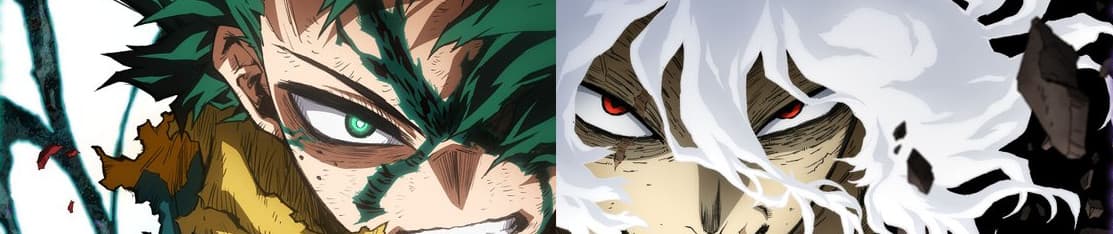
During its 9 year run My Hero Academia attracted all kinds of people. At first it was either people who were curious about some of the newer offerings from shonen jump or simply people who thought it looked interesting, but over time it began to gather passionate fans from all around the world. Along the way a really large fandom was born (as it was often the case with a ton of popular media from that era), and some people who weren't into the show began to look away and chose to avoid it as a result. Not because of the show itself or the fact that it had dedicated fans now, but because of their perception of the show through the lens of online fandom culture.
My Hero Academia (from now on MHA) used to be cool, fun and easy to mention, but then as time went on it eventually became "cringe". Mentioning other shonens like Jujutsu Kaisen was likely to elicit a friendlier response from people, and if you mentioned something like Attack on Titan then you were MUCH more likely to get passionate responses from anime fans and more casual watchers alike.
I don't want this to feel as if I'm about to start rambling about how online fandoms "ruined MHA forever" or some weird shit like that, no. My point is that I think MHA is starting to feel cool again thanks to these high quality adaptations we've gotten for the last couple seasons, and that makes me super happy, as someone who has been here since 2016. But I also think there's worth in exploring a work's historical context in order to better understand it, so I hope you will bear with me for a little longer as I thread on this some more.
The first 3 seasons of this show were great. The start was solid enough to the point where the first season works well even as a self contained experience, and the whole thing felt quite promising in many fronts (one of them being that this was an insane adaptation for a shonen back then. It wasn't normal to have a new big shonen start with a 13 episode first season, which meant that things like its animation stood out). The second season is when I feel like it started to get really popular, and it's where a lot of iconic moments (such as Todoroki vs Deku's fight) took place. By this point people were already sold on the chance of it becoming one of the new pillars of shonen, and when the first half of season 3 came out it felt as if we had just seen a glimpse of the next big shonen jump poster child. One for all versus All for one made waves, and it's to my mind the peak of this show even to this very day, but things didn't work out as expected.
MHA is arguably the last big bastion of the more classical style of shonen that is so reminiscent of the big three. Why is that? Well, shonen as a genre has gone through a period of stagnation and eventual evolution these past few years. You see, nowadays there's this "darker" style of shonen that is much more common and popular with people. Chainsaw Man is at the peak of its popularity right now, and we have had other series like Hell's Paradise or Jujutsu Kaisen. Understanding how this style of shonen has become more widespread and common is of importance, because it allows us to be aware of the state of a genre of manga that had been struggling in terms of evolving beyond what those that had come before did.
Back in 2018 many fans of shonen (such as myself) felt as if most new series were just trying to copy what made Naruto successful without really trying to do anything new or interesting with it. My Hero Academia had a lot going on for it and it was really close to being the next big thing, but it struggled to keep up the momentum that the first half of the third season had created, and it didn't manage to feel as groundbreaking or fresh as we were expecting it to. There's also Black Clover (which I bring up because people would compare these 2 all the time, being that both felt like a result of Naruto's influence on the genre to some degree) which had a really mediocre start, but thankfully that changed over time, since Black Clover eventually found its footing and Yuki Tabata showed everyone that he was in fact someone able to put his own twist into the formula, with interesting stories to tell. But that took years, and back in 2018 he was still not really there yet, at all. Which made MHA feel the most likely runner up for the title of "newgen king of shonen".
This is also an important part in shonen history because it's pretty much the point in which studios realized that the old model of anime production for shonen anime was no longer up to modern standards (which was all about pumping out weekly episodes and keep these franchises generating money through their adaptations for years to come with as few pauses as possible. This is why filler was so common back then: they would start adapting a manga and wouldn't stop unless the show got cancelled. If you were close to catching up with the manga, which happened often, you would introduce anime original, filler arcs and that would be it). This is when big shonen anime began to be released in 12 or 24 episode formats and with a year or more of wait between each season, with Black Clover being the last show to attempt this format (without counting One Piece, since that's a special case because it's still running form the big 3 days).
So you see, for a bit MHA did feel like the most likely successor to Naruto, but it was struggling to get there, and then this darker style of shonen gained popularity and completely changed the landscape for everyone. Jujutsu Kaisen appeared and completely overtook MHA, as did Chainsaw Man, and the rest is history.
But then, what has happened with MHA ever since this switch happened? at first not much. It simply lost popularity, but it kept being one of the main shonen offerings regardless and the anime adaptations never really stopped being everything they were known for (great animation, great music, good pacing for this particular style of shonen, etc).
The start of the fourth season (and that whole first arc) was great, but you could already feel the show's popularity starting to decay back then, and this was arguably the last big "hype point" for a really long time.
I'm of the opinion that the second half of the third season and the second half of the fourth season are probably the worst parts of this show, not because they are bad but because they are quite boring (since these arcs happen under particularly mundane settings and they don't feel nearly as meaningful or interesting as everything else). I can also say the same about the first part of the fifth season but I kinda feel like at least there was meaning in some of the events that transpired there.
All of this is important, because it means that the last "hype point" was effectively sandwiched between some really uninteresting parts of the show.
The adaptations were always quality, though some of the parts/arcs I just mentioned would often feature less interesting visuals and animations. I don't really blame Studio BONES for this or anything else though, since I would rather direct all of my complaints to the manga and the writing for those parts. You can't do a whole lot in terms of adapting if the source material is missing the mark is how I feel, but I still think BONES did a great job at trying to keep it entertaining enough.
At this point the show had pretty much lost all momentum it had back in the first half of the third season, and a lot of people straight up moved on and stopped caring altogether. If I'm being honest the only thing that kept me going was a mix of inertia and a deep fondness for this show, because it had and still is there to keep me company. It made me appreciate the good times more, and it was there for me when I really needed some light in my life.
But then, season 6 came out. And then every single season from 6 up to the last one kept upping the stakes and showcasing a lot of the potential that we had hoped for from this show.
I was surprised, I wasn't really expecting much from this show anymore (I was comfortable enough with it being entertaining) but it managed to convince many of us into becoming emotionally invested once again.
Things were happening, the animation was noticeably better than the previous season, we were slowly coming back to the emotional moments and fights, and there was actual progress being made in terms of getting somewhere in the story. For a while this show felt as if it had stopped progressing, but now it was back with the kind of pacing that we had seen back in the days of the first 3 seasons. It was exciting, and thankfully things just kept getting better and better.
Season 6 features a particular switch up, an arc that is one of the most unique in the whole show and one that felt like a breath of fresh air. I'm obviously talking about the "Dark Hero" arc, which is in my opinion one of the better parts of the show. I also really liked this season as a whole because it reminded us that even if this is shonen, Horikoshi (the author of the manga) isn't nearly as fearful of hurting or killing characters as many other shonen authors. He can in fact be quite brutal with his characters, which is something that I want to mention because it's one of my favorite aspects of his writing.
From this point onwards, MHA managed to remain consistent up to the very end. Season 7 was all about hyping up and laying down the groundwork for the last season, and it did so wonderfully. By the time the final season came out, everything it needed to do was just keep up the momentum and get to the finish line. And honestly, I think that's exactly what happened.
Shonen endings are weird, it's hard to find a series with an ending that satisfies most people, and most endings are just... universally disliked. It's usually a combination of two things, which revolve around 1) the path to that ending either not making a ton of sense or not feeling consistent or coherent with the series' core themes and ideas and/or 2) the ending is just not particularly good or interesting. Making the series feel as if it just stopped instead of ending.
In my opinion MHA is one of those unique cases where the path to the ending makes complete sense and it actually stuck the landing. Nothing about this final arc or the ending undermines or goes against anything that the series has established and worked on exploring ever since the very first season. Rather, it further reinforces everything we've learned along the way and it brings all of its themes and ideas forward through the final battles. It's all about putting in the effort, learning how you can become a hero without having to depend on power, being willing to communicate and help others, etc.
I wouldn't call this show a masterpiece, at all, but I do think it's one of the most passionate, heartfelt and entertaining modern shonens and I feel like it's way better than people give it credit for, and has been for a long time now. And these last couple seasons really feel like everyone involved in this production wanted to convey to us just how great of a work the original manga is. I also think that this is without a doubt one of the most consistent shonens ever made, since it never really loses focus of what it wants to convey or where it wants to take its characters (such consistency is present even during the weaker arcs). There's so many shonens where the characters eventually get so unbelievably OP that things don't even matter anymore, but in here there's actual cooperation and teamwork between characters. By the end there isn't a single most powerful entity, but rather, a really focused team of individuals who are giving their all to work together.
To begin wrapping up this review, I want to talk about something: I feel like people online sometimes misconstrue the whole point of Deku in the sense that he isn't a hero because of his powers, but rather, because no matter how much amount of power he does or doesn't have is completely unrelated to his heroism and his will to help others. He is going to be a hero regardless of how weak or OP he is, because he is able to move people and make others want to work together to help him out. That's the whole point of the last battle, and the most literal way this show has of conveying its message that at its core cooperation is key for "true heroism" to take place.
I bring the example of Deku, but I could apply this to so many other things. People get so hung up on the shonen mechanics and powers online that I feel like they sometimes forget to focus on the important, meaningful bits. I wish people would be more open to productive discussions and asking interesting questions instead of engaging in ragebait and pointless discussions. These things are relevant, because this certainly did not help MHA's reputation over the years, which is something I meant to focus on too. This is a relatively simple show, and yet some people will somehow find a way to completely miss the point and complain that this show isn't more like others that have nothing to do with it.
Comparisons are fine, but at some point you gotta accept that some things are simply different. There can be value in comparing them, sure, but at the end of the day all media has a specific purpose and audience in mind. Expecting everything to be made in a certain way or head towards a specific direction is just not particularly productive or interesting in my opinion. I would much rather highlight the strengths and uniqueness of a particular thing, instead of becoming frustrated at the idea that said thing isn't what I think it should be.
It's an inherently human trait though, I get it, I've been a teen too and I've argued online with others about pointless stuff. I just wish this cycle of people growing up on the internet, learning to argue with everything that moves and eventually learning your way out of it, could be broken or shortened. I really hope we can get to a point where people spread more joy than hate eventually, where discussions are born from curiosity instead of hostility.
People can be really mean to others online, in these particular spaces, some often express things like "shonen is simply all style and no substance". But it's no wonder these types of work have such a profound and meaningful impact on people's lives. There's people who desperately need a hug, and these kinds of shows are able to provide the feeling of getting a really hearty hug to those people.
I've seen people thrash shows like this and Demon Slayer under the pretense that there's stories that are more complex, and I feel like these people fail to understand that simplicity is nothing to be ashamed of. Sometimes you want media to be simpler, not everything has to feel like Attack on Titan, we need simpler shows that allow people to forget about their problems and just have fun for a bit. That is the core of shonen, and as these people grow older they will hopefully start to get it eventually.
You might get home after work one day and wish you had a show like this to sit down, relax and watch for a little bit. In my opinion, it's a good idea to learn to appreciate these types of shows sooner than later because learning to have spaces where you can relax and regain a bit of hope in humanity is always helpful. And if you wanna start somewhere, try MHA. I think it's a worthwhile, meaningful experience that can teach you something about how important it is to keep light and hope close to your heart.
This is a series that means a lot to me, and I hope later generations can grow up on the same values that MHA conveys. I'm glad I stuck with it, and I hope others feel the same joy as I did while watching the last few episodes.
DISCLAIMER: The final rating isn’t representative of anything, the only reason why i’m even giving it a rating is because anilist won't allow me to post a review without assigning it a number that ranges from 0 to 100. If it were for me, I would post all of my reviews without ratings as I feel that trying to encapsulate a work of art on a numerical scale is completely nonsensical.
25.5 out of 31 users liked this review