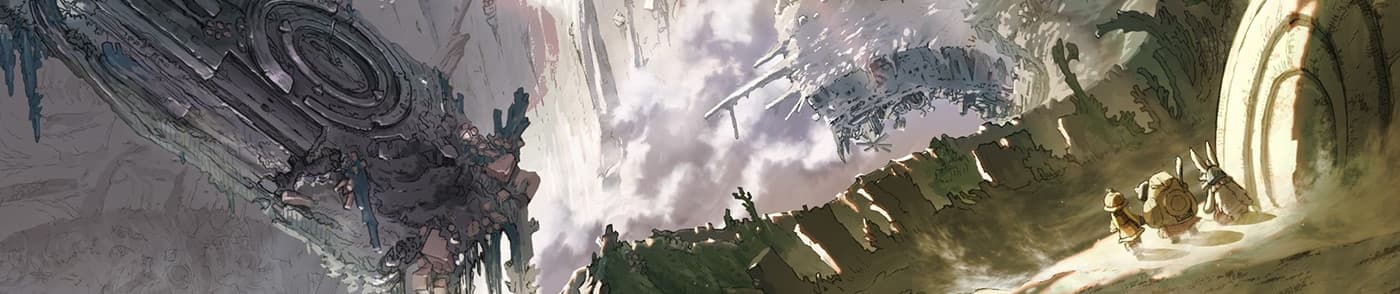
Made in Abyss Season 2 is a harsh pivot that makes you recalibrate and briefly wonder if you accidentally turned on a different show - but by the end, you’re still staring at the credits like you just got emotionally mugged. It’s a fundamental change in the series’ DNA: where Season 1 (and the movie) felt like the Abyss in full descent mode, that intoxicating push ever-downward as wonder slowly curdles into dread, Season 2 shifts into something more like containment mode. It plants you in the sixth layer and asks, what if the Abyss stopped being a journey and became a place you’re forced to live inside?
That structural choice is the whole gamble, and it took me real time to get on its wavelength. The show trades that addictive forward momentum - the constant wondering of what's around the next corner - for something tighter, more claustrophobic, and more character-driven. The Village of Ilblu is fascinating, but it’s also insular: a little pocket ecosystem with its own rules, its own economy of body horror, its own weird moral language of "value.” Early on, it can genuinely feel like the story is idling - our core trio doing alien chores, the show drip-feeding lore, asking for patience while withholding the emotional reason you should care. Coming off the exploratory rush of Season 1 and the brutal action of the movie, that initial slowdown felt like the series holding its breath.
And for me, the flashback crew didn’t immediately hook me either. The Ganja Squad, introduced through a split timeline that feels disconnected at first, landed more as new people I’m being asked to invest in than new people I can’t help but invest in. The village hollows are grotesque and oddly sympathetic, and the mystery of what they are is intriguing, but for a while the stakes felt weirdly muted. I missed the scale of the Abyss - the sense that every layer was a new chapter in some grand, existential void. Here, the mystery is localized. The question shifts from “what is the Abyss?” to “what is this place?”
Then Episode 7 hits, and the season basically grabs you by the throat.
Once the show fully lays its cards on the table - once you understand what the village is, what it cost, and what kind of suffering it’s built on - everything retroactively turns radioactive. Irumyuui’s backstory is some of the most gut-wrenching, gruesome storytelling I’ve run into in years.
It’s tragedy that’s been industrialized and made into infrastructure. All the quirky details and unsettling rules snap into focus, and suddenly you realize this largely peaceful village is a monument built out of desperate survival and inherited sin.
That’s also where Vueko finally clicked for me. Previously framed as a passive observer, she becomes the emotional anchor of the whole season: someone forced to live long enough to watch the world punish her for still having a heart. Her relationship with Irumyuui carries so much weight, and it’s the kind of bond that makes Made in Abyss feel uniquely cruel - because it understands exactly what tenderness looks like, so it knows exactly how to weaponize its absence.
And then there’s Faputa, who is completely magnetic. She’s mythic and visceral and single-minded in a way that feels inevitable. Literally born from a wish, compelled by her very nature to destroy the village, her pursuit of vengeance isn't even a choice but It’s a law of physics stitched into her existence. That’s such an ugly, compelling idea: being born already obligated to break the world in one specific direction. But what really elevates the season is that it refuses to make the moral math clean. Wazukyan’s actions are monstrous, full stop, and the show doesn’t dodge that. But the villagers aren’t all equally culpable, either - some feel guilty by association at most, some may not have understood what they were consuming, and some (like Ma) read as heartbreakingly childlike. Everyone is caught in the machinery of the Abyss, and the tragedy is that survival doesn’t care about your moral purity.
There’s one scene late in the season that I know many people interpret in a colder, purely strategic way, but it hit me too hard not to read it with some symbolism. When Faputa is beaten within an inch of her life and the villagers begin feeding themselves to her, restoring her strength - sure, pragmatically, it’s them powering up the one force that can save what’s left from the beasts tearing everything apart. But emotionally, it landed as atonement made literal. It felt to me like the village, built on a child’s suffering, finally finding the only apology it’s capable of: self-erasure. In a story obsessed with “value,” it feels like the bleak inversion of extraction - if the village took everything, the last thing it can do is give itself back.
By the time the ending arrives, I was satisfied by how right it felt. It's not neat, but the emotional arcs land with real catharsis. Vueko’s end is devastating in that uniquely Abyss way - heartbreak with barbed wire around it - cruel, painful, and yet resolved in a way that feels earned rather than gifted. Faputa’s eventual shift doesn’t feel like a random heel-turn so much as the story finally letting her become more than an instrument. Even the smaller conclusions - Belaf, Majikaja, Wazukyan, the village itself - carry that grim, satisfying sense of reaping what was sown.
But the season isn’t flawless, and my biggest gripe is the Mitty thread. I can’t fully talk myself into liking the intent, even if I can see what they were going for. Nanachi being anchored to a reconstituted Mitty sidelines one of the most compelling characters for a huge chunk of the runtime, and more offensively, it risks undermining something Season 1 nailed: the power of finality. Mitty’s death worked because it was release - pain ending, the story respecting the weight of goodbye. Bringing her back in any form makes that catharsis feel reversible, like the show couldn’t resist picking at its own emotional scar tissue. Even if it’s meant as symbolic closure or a growth lever for Nanachi, it didn’t land for me, and I wish they’d found another way.
And while we’re talking about what gets shifted aside: Reg and Riko feel underfed. Reg gets a couple big moments - a power-up, white whistle activation, some breadcrumbs about his origin - but it's not really a full internal arc. Riko stays lovable and resilient, but she isn’t pushed the way she was earlier, where her optimism felt meaningfully tested against the Abyss’s cruelty. The emotional heavy lifting is exported to the new cast, and while it works (spectacularly, in the back half), it still left me craving more growth from the trio I came here for.
Technically, the show still flexes. Kevin Penkin’s score remains the undisputed MVP - there are motifs here that feel like emotional cheat codes, where a few notes can flip a switch in your chest and suddenly you’re on the verge of tears no matter what’s happening on screen. The sixth layer looks gorgeous in the most alien, discomforting way, like nature designed by something that doesn’t care if humans can process it. Character designs range from genuinely inventive to outright WTF, and the occasional CG on certain hollows can read as slightly uncanny - but honestly, that uncanniness sometimes feels like it belongs. The whole village is supposed to feel wrong.
This wasn’t the adventure I expected, and it asks for patience at the exact moment I wanted the story to keep sprinting forward. It’s slower to hook, narrower in scope, and it withholds its emotional engine until it’s ready to floor it. But when it clicks, it hits with the force of a freight train. The second half is brutal, beautiful, and weirdly intimate - less concerned with escalating the Abyss’s geography and more concerned with showing how survival turns into ideology, how guilt becomes inheritance, and how “value” can be both a coping mechanism and a weapon.
And if a show can make me cry over a robot who can't help but say "goon" every few minutes, it's doing something special. Made in Abyss is still one of the few pieces of media that can pierce through my usual cynical shell and make me feel something raw. I’m fully caught up now, and even after a season that wasn’t exactly the direction I wanted, I’m still impatient for whatever comes next - because the Abyss hasn’t stopped being compelling. Season 2 just proves it can break you open without even needing to move forward.
32.5 out of 33 users liked this review
