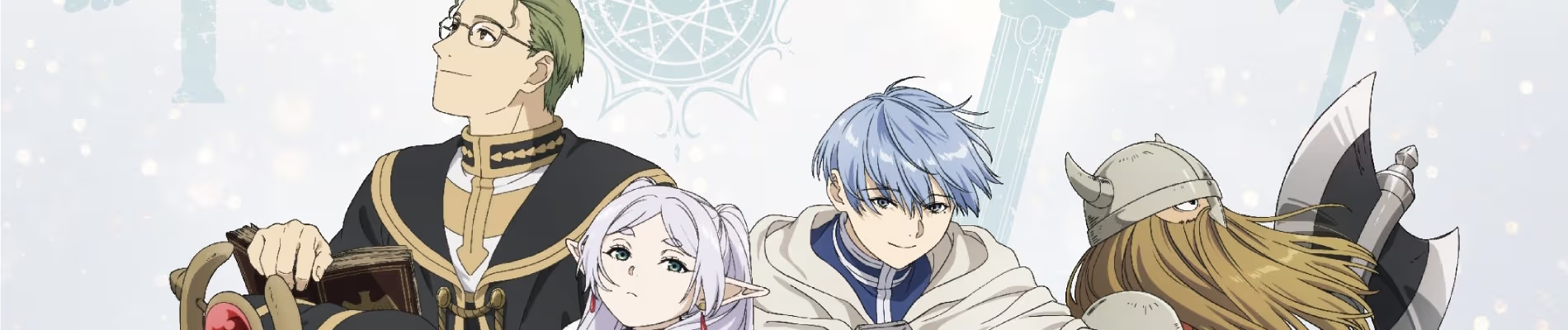
Frieren: Beyond Journey’s End is an anime that takes a subtle yet radical approach. Instead of seeking spectacle or escalating the stakes, it poses a more unsettling question: What happens after the adventure concludes? This question, when revisited, doesn’t become less disturbing but instead expands, revealing the series’ meticulous craftsmanship in terms of time, memory, and emotional perspective.
Fundamentally, Frieren reinvents the fantasy genre by shifting its focus from triumph to aftermath. The Demon King is already defeated, and the party has already saved the world. What remains is Frieren, the mage, elf, and nearly immortal, making mortal bonds in her presence seem insignificant and unreal. Initially, Frieren appears unemotional, but upon closer examination, it becomes evident that this is not indifference but rather ignorance. This ignorance stems from the fact that time has stretched so long that her indifference has been lost in the rush.
The anime’s most remarkable characteristic lies in its masterful use of time as a subject and form. Flashbacks are not dramatic revelations but rather gentle intrusions, mostly unnoticed by Frieren as she begins to realize what she neglected to appreciate when it was too late. What seemed ordinary moments gain emotional weight upon repeated viewing, as the viewer realizes that their absence will be deeply felt. Himel’s kindness, Heiter’s humor, and Eisen’s quiet steadfastness are not merely character traits but echoes of their time spent with Frieren. The limited time they spent together makes every memory heavier to know.
Frieren maintains its introspective tone visually in a self-contained and assured manner. The animation is not overly flashy but instead uses wide shots and lingering frames to convey emotions. This patience in visuals becomes even more apparent on rewatch. The settings are not as grand and majestic as in the first season, but rather cozy, which reinforces the idea that meaning lies not in epic battles but in the moments in between. The low-key score by Evan Call complements this, fading into the background most of the time until a character experiences an emotional epiphany, at which point the score comes to the forefront.
The supporting cast that was introduced in the first season, particularly Fern and Stark, becomes more prominent in a second viewing. Initially, they may be perceived as typical heirs, but a second viewing reveals their deliberate opposition to Frieren’s past. Fern’s emotional sensitivity and Stark’s sheer human insecurity serve as lenses that compel Frieren (and the audience) to confront her overlooked aspects. Their development appears natural, not due to radical transformations, but because Frieren gradually learns to connect with them.
However, Frieren does have its limitations. While its slow pace aligns with its thematic intent, it can sometimes feel overly restrained, especially in routine or travel-focused scenes. Certain episodic arcs are overly tidy, and some side characters lack the depth that the lead characters are given to explore. These shortcomings become more noticeable on rewatch as the novelty of the premise wears off and the series’ structural simplicity becomes apparent.
Despite these minor issues, Frieren still aligns with the emotional aspirations of the anime. Frieren: Beyond Journey’s End is a show that rewards patience and reflection, making it particularly enjoyable to rewatch. It’s not about recalling plot twists or power levels, but rather about sitting down, reflecting, expressing gratitude, and gradually understanding that it’s easy to look back and realize you should have known sooner.
32.5 out of 36 users liked this review