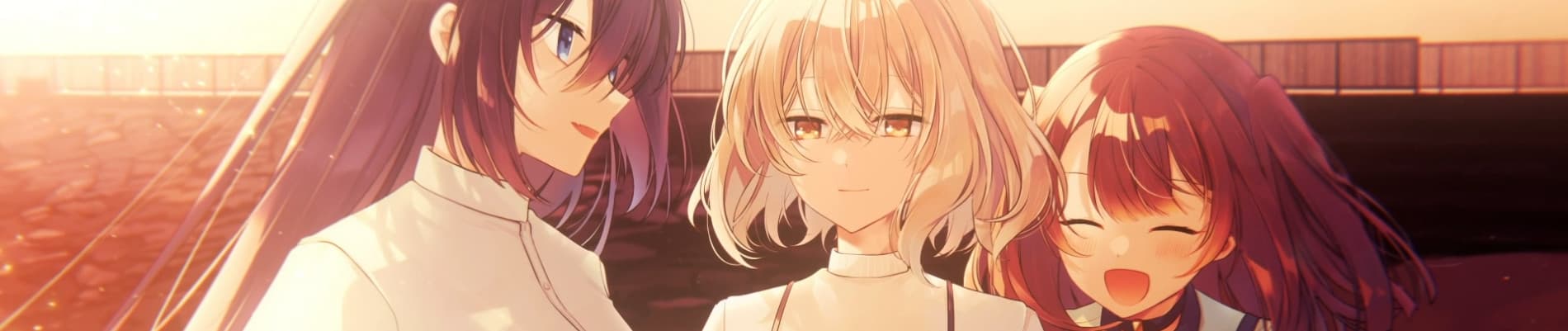
How does one judge a show that's trying to be frustrating?
It's a harder question than you might think. Even compared to other negative emotions fiction can explore- fear, anger, grief, existential dread- frustration can alienate an audience faster than almost anything else. No one likes to sit there screaming at their screen while characters make bad choices or circumstances collapse around them, even when the point is to explore the consequences of those events. It's probably second only to embarrassment for emotions that make you want to stop watching or reading when done poorly. So what do we make of This Monster Wants to Eat Me, or Watatabe, a show almost entirely defined by that kind of frustration? How much of the visceral unpleasantness I felt watching it was on purpose, and how much was a failure on its part? And most importantly: was it worth putting up with that much frustration for the story it was trying to tell?
To start with, I should probably clarify where Watatabe is intentionally being frustrating and why. Our story centers on depressed, passively suicidal Hinako Yaotose, who lost her entire family in a watery car crash as a child and dreams of following them to the depths of the ocean. She's in that very precarious mental state where she doesn't have the guts to actively try and kill herself, but doesn't see much point in going on living either. Which is why it's almost a relief when the titular monster shows up to make that decision for her. Turns out Hinako's blood smells absolutely delicious to yokai, and no shortage of them would love to make a meal out of her. But the one who gets there first is Shiori Oumi, a mermaid disguised as a human girl who promises Hinako that she will be the one to eat her. There's just one catch: as delicious as Hinako's depressed-girl blood tastes, it would be even more delicious if she managed to be happy again. And Shiori doesn't want to snack on her until she's as delectable as she can be. So if Hinako wants to die, all she has to do is start wanting to live again. Only then, when she's finally escaped her pain and found happiness, will Shiori drag her to the scaly, tooth-filled end at the bottom of the sea she so desires.
From that plot description, it's probably not surprising that this show is setting out to be a Bad Time. Watatabe is not a story about well-adjusted people with everything figured out; it's a story about two very, very maladjusted people trying to cope with a terrible situation in self-destructive ways because it's better than just giving up entirely. I mean, do you think you'd make good choices if you were suicidally depressed? Or an inhuman fish monster who sees people as prey before companions? Neither of these girls are in a good place, and while Hinako's damage is pretty obvious, Shiori's got some pretty ugly baggage of her own that's slowly revealed as their story progresses. Even Hinako's perpetually chipper best friend Miko, who's trying her absolute hardest to drag Hinako out of her despair, has some skeletons in her closet that make it hard for her to support her the way she wants to. But they're all locked together in this toxic dance of despair, flailing wildly as they try to swim for the surface only to dive further and further down.
And yes, it is frustrating to watch. It is frustrating to watch these deeply flawed people drag themselves deeper into their demons because they're not mature or mentally stable enough to get the help they need. But, like, that's the point, right? If any of these girls were well-adjusted enough to go to therapy, this show would be over in a heartbeat. Watatabe is not a show about how easy it is to make all the right choices. It's a show about how dragging yourself out of your lowest point is a fucking struggle, one that often goes sideways in a million unpredictable ways because neither you nor the people who love you fully understand the best way forward. Hinako's passive nihilism, Shiori's alien psychopathy, and the vicious co-dependence that binds them together are the reasons this show exists. And that should be frustrating! Depression isn't fun! It's not something that can be easily fixed! Complaining that this series isn't safer and more palatable would be like complaining about a Civil War drama discussing slavery. Sometimes, the ugly, uncomfortable things in life must be confronted head-on, with no sugarcoating to disguise the full weight they carry.
At the same time, though... there IS a line, right? Like, even if you're setting out to tell a frustrating story on purpose, it still has to be done well to get the point across. And there's a lot in Watatabe that left me annoyed, upset, and exhausted for reasons I don't think were intentional. I watched all 47 episodes of Nana, perhaps the ultimate Characters Making Bad Choices and Living With the Consequences anime, and never once felt like it was dicking me around for no reason. With Watatabe, almost every episode gave me something that pulled me out of the experience. And those mistakes matter a lot more when crafting that frustration naturally is the goal you're aiming for. If a comedy or shonen action series has some things that piss you off, you can at least ignore them for the entertaining feel-good parts you came for. But when your only escape from the frustrating aspects of a show is more frustration? Hoooooooo boy, does that pile up fast.
So where is Watatabe falling short? Well, unfortunately, I think a lot of it falls on Hinako herself. Yes, she's stuck in her head and doesn't know how to fix it, but that's not the problem. The problem is there's... kinda nothing else to her besides that? Like, a person with suicidal depression, even in a case as severe as Hinako's, is still a person. They've still got likes, dislikes, opinions, better days and worse days, things that make them more than the trauma or mental illness that takes up so much of their brainspace. But aside from her misery, Hinako just comes off empty. Not empty like her grief has stripped everything away from her, but empty like she wasn't written to be a fully-realized character. Compare her to Sangatsu's Rei Kiriyama and the difference is night and day; we see so many different sides to Rei and his emotions even in the first few episodes. He gets angry! He gets embarrassed! There are things that get under his skin and things that give him comfort! His depression and isolation are overwhelming, but his life is so much more complex than just being numb and sad all the time. Hinako, meanwhile, spends 99% of the show without a single opinion, perspective, or point of view beyond "I'm sad and I wanna drown." That's not frustrating in a good way; that just makes me wish I was watching a depressing, difficult story about someone who actually feels human.
And that lack of emotional presence is a huuuuuuuuuge issue in the show's structural writing as well. Because Hinako isn't written to have any control over her life, it falls to all the other characters to take that control from her. Which means Hinako spends about 99% of the series staring blankly with her mouth open while various yokai push her around like a plot object, barely reacting to anything as the plot Happens(tm) around her. There's even multiple times where she tries to say something, to offer some kind of thoughts about the monsters who approach her and how she feels about them, only for Shiori to interrupt her and take over the conversation like she doesn't even exist. Which, you know, that's also in character for Shiori, but it happens so often and with so little pushback from Hinako that it starts feeling like our protagonist is being pushed out of her own damn story. No, she doesn't have to be swinging a yokai-slaying sword around or whatever, but where's her voice? Where's her agency? Why is she so often reduced to a plot device who doesn't even get to try and affect her circumstances? It's not until the last goddamn episode that the story lets her feel like part of her own narrative, and surprise surprise, it's the best episode of the series by a country mile. Imagine if she got to be like that from a start!
Perhaps some of this could be avoided if the show were better at painting a better picture of its world beyond the bare facts of its story. Unfortunately, I don't think the relatively inexperienced director (Yuusuke Suzuki) or the brand-new studio (A Passione offshoot called Lings) were up to the task of giving this show the production it needed. Sure, there's some solid storyboarding to help cover for the stiff, limited animation, but that constant stillness means the show is pretty much only equipped to portray the story's more morose moments effectively. Any time it tries to be funny, the forced chibis and Miko's painfully screechy vocal performance make it feel like you're watching a bad clown doing stand-up at a funeral. It's also murder on the pacing: it's at once too slow and too fast, individual scenes crawling by at a snail's pace while the overarching story barrels through plot points too fast to get a sense of normality with these characters (it honesly reminds me of the ill-fated 2010 live-action Last Airbender movie in that regard). The absolute low point comes at the end of episode 4, when we get a truly shocking reveal that plunges Hinako into an agonizing standoff... only to then spend 3 minutes on a disconnected comedy skit I can only assume was adapted from a manga extra, which ends with a hyperactive techno-pop ED just to shove the already-slaughtered tone another six feet underground. It's such an inexplicable fucking choice that I sat there staring at the screen a good minute after it was over. It's like they were trying to butcher the tension of that moment as much as possible.
I say again: Watatabe setting out to frustrate its audience on purpose is fine. It's commendable, even! If you're gonna use fiction to explore uncomfortable subjects like depression and suicide, then the audience has to feel that discomfort for themselves if you want them to understand what they're really like. But by the same token, if you're going to ask people to put up with a difficult watching experience? It has to be difficult for a reason. All the best parts of Watatabe come when its characters' flaws lead to genuine emotional consequences, where we see them actively grapple with the darkness in their lives and come out changed for it. None of that benefits from Hinako lacking depth beyond her damage, or being a passenger of her own story. If anything, that accidental frustration makes it a million times harder to engage with the frustration the show actually wants you to feel. If I'm already emotionally exhausted from Watatabe's flaws, I'm not gonna have the mental capacity to take on the weight of a realistically suicidal teenager. I'm just gonna disengage entirely and get nothing out of the experience.
Is that unfair? Possibly. Maybe I'm just annoyed by how much I wanted to like this show only to be let down. I wish we had more good yuri anime, man! Especially ones brave enough to challenge the audience like this and make an actual point about serious subject matter! But Watatabe isn't well-written enough to justify putting you through such a painful watching experience. It asks too much and gives too little in return, and it just leaves me wishing I'd re-watched Takopi's Original Sin instead.
96.5 out of 134 users liked this review