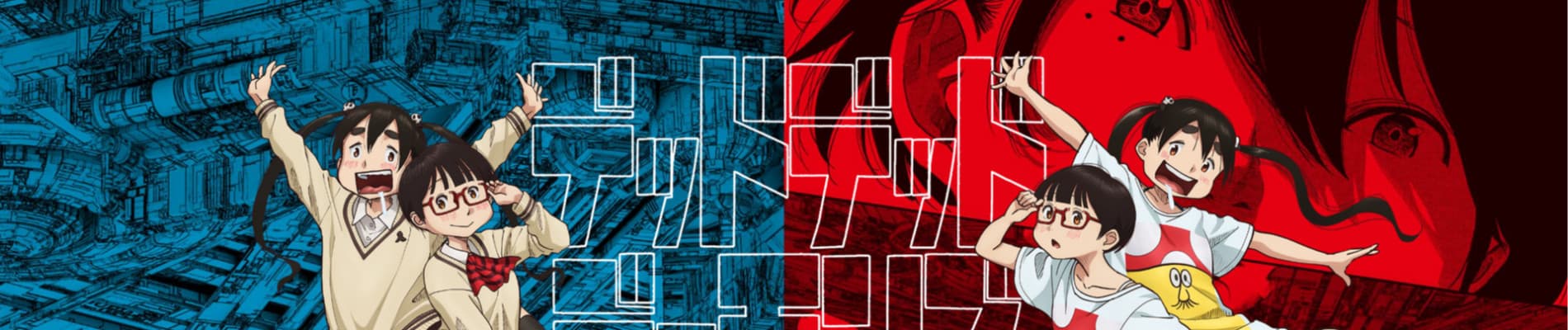
Anime is always good. Dead Demon's Destruction put me into this situation of both safety and apocalypse. Creator Inio Asano shows us that we just want to live our lives peacefully, while we are also left to the fate of the violence around us. You could say you are lucky, though ultimately, you are a fish in the pond. If the pond goes, you go. You can't live a peaceful life as the violence starts creeping in closer and closer to you. You are not guaranteed safety.
(Video essay version of this entire analysis is linked in my profile, with music, AMV sections, and my attempt to sound serious about this. Check that out.)
It reminds us that our problems won't go away, and explores how the new generations try to survive with uncertainty on a global scale.
There is comfort in ignoring problems, and also a sense of relief once you finally go over that bridge. There is comfort in doing what feels good for you and others, though this can come out of selfishness for what you give up for it.
For a series about destruction, it is also very interestingly down to Earth. It alternates between the cast enjoying their school life, and the world ending around them. Asano explores how all types of people respond to the mysterious alien invasion.
The politics of Dead Demon's Destruction are explored in a comedic and absurd matter. The characters constantly make short declarations that demand a certain level of political knowledge to understand them. It doesn't spoon feed you. At first, I laughed along with the ridiculousness of the character's political honesty, though after a while I stopped laughing when I realized how right and horrifying what they were saying was. It started to really hit close to home. We realized the anime was telling us the things we had refused to see and understand through this humor.
A lot of this comes from Kohiruimaki, the "supreme savior," who was radicalized by the oppressive violence, the crooked politicians, and the charming Oran, whom I fell in love with and put on my favorites almost immediately. It almost made me join the moe crowd.
Asano's strange human character designs in this made me feel as if he was trying to capture this decaying and rotting feel in regards to humanity. Sometimes it feels the aliens were the ones that looked normal.
He takes us on a journey into the incompetence of political figures, and makes fun of it. Similar to Mobile Suit Gundam and Ideon, the conflict between the humans and aliens begins and becomes irreparably dysfunctional because humans would rather shoot first and ask questions later, out of their own cowardly paranoia.
The two leads Oran and Kadode blended in with the chaos. They saw reality, but chose to have fun instead. To them, it seemed to me that this was their world, and no one else's. It felt they got too used to everyday life to really care about what was happening all around them, and went with "it's okay."
I could relate to it in how I find my own comfort in the enjoyable everyday life, when I have all sorts of problems inevitably getting closer to me. It's escapism at it's worst in a way with this series, because it is a form of running away. I think it could also be seen as a form of rebellion against the end of the world to ignore it and try to live happily regardless.
Dead Demon's Destruction has an interesting story in how it came to be as a manga because of the idol group Dempagumi.inc inspiring Asano, and as an anime, with its production history, especially how Asano took a big part in helping create it as supervisor, animation director, opening song composer, and lyricist.
Production +h was placed in charge of adapting Dead Demon's right after debuting with Orbital Children. There were already talks among the staff about adapting it before the studio had been formed. Director Kurakawa, animation producer Honda, and another producer had read the original Dead Demon's manga, and were impressed by how cleverly Asano mixed the themes of social disconnection, and political unrest-classic dystopian elements that resonated deeply with the chaos of modern life.
Production +h became fascinated with the realistic look of how Asano took pictures of real scenery and drew them as realistically as possible, and his chaotic world building. As a result, the staff, when borrowing the manuscript data, used Google Street to identify the areas, referring store signs and address displays, and used newer modern tools to achieve the look.
Asano was worried about the cuts that showed expressions and movements, because when adapting a manga, the team has to get creative about the movements in-between the panels. The readers use their imaginations when reading, but for an anime, it has to connect when carefully thought out and animated. As supervisor, Asano was strict and asked for many retakes. This led to him "taking more than one foot it," in which he provided much animation assistance to the project, to ensure he could get the best product out with their limited resources. He himself was training this new studio in how to adapt his manga through this heavy involvement that took several years. Back to Dempagum.Inc. He had worked with them back in 2015 by writing the lyrics to their song "Even if the World Should Break into Pieces Tomorrow." Asano revealed that he had linked that song with the anime when the manga was just starting and knew it would fit the scene. He foreshadowed the climax of the anime 9 years before it aired. In the end, he expressed that he might have been too pushy and annoyed some people from all his revisions.
The production budget for Dead Demon's was planned from the beginning by Japanese distributor Gaga which told the studio this would be based on the expected revenue of the 2 planned movies and the anticipated pre-sales from streaming platforms like that cursed Crunchyroll. Due to the limited runtime, the movies were made to focus more on the slice of life, coming of age story of the two main characters, Oran and Kadode. At the same time, the focus on the series was planned to be different. The anime started out as an 18 episode ONA series first, and was then condensed into 4 hours between 2 movies. Asano wanted both experiences to feel different, which is why it was his idea to start the series out with episode 0. For those that had already read the manga, he went ahead and wrote a new ending. There was also some clarification towards the end that he hoped would help the readers understand more what Kadode's father's motivations were.
Asano felt inspired by the idol group dempagumi.inc between 2013 and 2014 after listening to their single "Denden Passion". He was fascinated that despite their lyrics appeared gloomy, they were vibrant and lively in performing their songs. He found this contrast endearing, and this would lead towards the inspiration of Dead Demon's creation. According to Asano, without Denpagumi.inc, Dead Demon's would never have existed. It is this strange contrast between the members mental state, vis-a-vis their performances, that the nature of Oran's character came to embody. Oran is a manifestation of things Asano learned from watching and listening to idols, and also a technique to insert serious commentary in a way to hook the average viewer. They are not avoiding reality. They are all adults that understand it, but their stance is to just have fun now. He felt a sense of the current times in that, and wondered if he could turn it into a manga. Oran's twin tails is a reference to idol member Misuzu's hairstyle that was new to Asano at the time for his protagonists. Compared to many his older works, he was going in a new direction at the time that had started with Goodnight Punpun.
Asano's approach towards writing the OP was to make the song about "the two of us" living in this chaotic modern world, where an apocalyptic feeling looms, which is an approximation of that worldview. He wanted to lyrically capture the complex emotions of the cheekiness behind the cuteness. A glimpse of resignation amid the banter. He had the two leads sing the song, where their voices combined strength and fragility. Asano also drew the jacket for "SHINSEKAI yori," though he chose to draw the characters small as to avoid making the jacket look too anime-like in Ikuta's discography. Interestingly enough, the staff originally wanted a famous producer to make the OP, but they turned down the project, leading Asano to step up and take it.
And he is no stranger towards making music, since he had spent his 20s creating numerous songs that he never released. He used one of these songs for the OP, but felt it did not fit the mood of the present age and wrote a new song that better went with the idea that, "We are enjoying our youth as the seemingly hopeless abnormal situation gradually blends into everyday life." One artist Asano thinks is talented that makes him feel something new when he listens to him is former Vocaloid producer Kenshi Yonezo, who I mentioned back in the Medalist video. This is not me telling you to watch that video of mine (insert worryblush).
Director Kurakawa said that during auditions for the voice of Oran, they needed someone who could voice her high and energetic teenage personality, as well as her calmer younger self from the flashbacks. This made it difficult compared to live action where they could just hire a younger actor. Ano was the only voice actress that could pull both off, and even brought the staff to tears from her acting. According to the staff, the voice recordings went so smoothly, they animated afterwards over their performance at one point because it was done so well.
For Kadode, they wanted someone to match Ano's stardom and reputation. Then one day, Kurasawa was watching Mamoru Hosoda's Belle, and when he heard Lilas Ikuta's acting, he decided that she would be it, and pitched the idea to Asano who also agreed. The roles were decided by matter of coincidence. The staff were surprised they were able to get Ano, the big hit Idol from Yoasobi who had done tours around the world.
I would take take the time to mention that Tarako, the Voice Actress for Devekoo, known for being the voice of "Chibi Maruko-chan" passed away right before the release of the first movie.
Director Kurakawa also explained that they wanted the viewers to really empathize with the invaders, not just the humans, by showing when the invaders were among themselves, they'd make their language feel as unrecognizable towards human language as possible, and the other way around when Oran and Kadode would talk to them.
Punpun was where Asano began to challenge his audience, especially from an ethical standpoint. He was avoiding that before to reach a wider group of people. He had come to realize he was restricting himself, as he had found that boring as well. I believe he is a very free and creative creator. He doesn't consider using a genre when making manga, as he thinks it's counterproductive, and that other artists are too safe and too "thinking inside the box" instead of using manga as an interesting tool for self-expression.
For Dead Demon's Destruction he did the opposite he usually does by creating the characters before the story, saying that in a long-running series there is more value in the characters than the story.
As someone who observes Japan closely, Asano came to learn of millennials, an unfamiliar term at the time. Asano's observation in relation to that was that this newer generation felt jaded and less motivated, don't seem to expect much for the future, and have a different idea of what happiness is. That all they know is the recession and having no hope for their economic future. Thus, they focus more on their private lives than work. This leads to an outer projection of happiness where they simply convince themselves they are not unhappy. There is an outer projection of happiness that is created, coinciding with the idea it's best to not reach for things that seem too difficult and not take things seriously.
In relation to Dead Demon's, Asano revealed this is one of the most important elements of the story, saying "The thought that one can choose one's own level of happiness is freeing, and I feel there is a lot of potential in this thought."
Once the 18 episodes were done, they were screened in an overnight event where some of the staff including Asano attended.
Asano said that his work reflects how society is changing with the simplest example being how people exchange information on the internet, which makes communication absolutely nothing like how it was in the past. He explains about the mental evolution of society in how the way people think and feel is also always changing. A normal person may not stop to think about this or give it any importance, but he feels it's true that as society evolves, we start encountering new kinds of problems and different issues to think about - although we do not realize it in the moment. Asano dedicates his time to focus on these things in his works.
To create convincing stories, Asano feels the need to bring out characters as close to his own experiences as possible, evidently leading to many of his characters having things in common with him. To try to not make stories based on the experiences of just one character, he aims to make choral stories that rely on several characters with important roles based on outside references from people close to him. Asano feels this is necessary towards being able to create stories that are able to breathe a sense of reality
When it comes to exploring sexually related topics in his works, Asano thought that it would be completely normal to do that, as he sees them as a normal and natural part of our day-to-day life. He believes the most natural way to portray reality is to lean on these sexual characterizations, so someone can appear having lunch in once scene, and then appear later having sex just as naturally.
Unfortunately for Asano, exploring sexual issues led to him getting criticism more often than he'd like in the past. The question of why you can't put sex scenes in a normal manga bothers him because he said it's the most normal thing in the world... that sexuality is so entwined in life, when creating manga based on real life, it is hard to not have sexual content in the work. He doesn't think it cheapens the work to include sexual content when it functions to further the story.
As a creator, he doesn't mind if younger audiences don't understand his work, but aims to create stories that they could come back to later and understand it more or even in a totally different way. He believes that Japanese readers are acquiring more simplified tastes, that they don't like difficult stories. For him, your work has to be eye-catching. He said "if that means drawing characters with attractive designs, even Moe designs, so people will be encouraged to read the manga, I don't mind doing it to avoid immediate rejection." It's the same for Goodnight Punpun. He thinks it's a very deep story, which has a lot to say psychologically, but the reason Punpun and his family are these strange symbols is to give off the impression that it's a simple manga. People will start reading it to think that it's some light lecture, and then they discover that actually, Goodnight Punpun goes much further than that."
In his earlier works, Asano avoided touching on the darker, more troubling aspects of the human character. He focused on the notion that young people have that they are inherently "special." He eventually came to find that writing these stories is boring and restrictive. He made a conscious decision to write stories that challenged the reader.
As a creator, Asano believes in not restricting himself with genre classifications as to not lose freedom and creativity. He states that when manga becomes restricted by what manga is supposed to be, a lot of similar manga are mass-produced and that there are readers who dislike that situation, including himself. Asano uses manga as a tool for self-expression rather than to pursue being too "in the box." He is drawn to the originality of other creators who do this. In the beginning he considered his works niche, but desired to reach a larger audience, which also led to him becoming especially sensitive to what's going on in the world.
Social media is something Asano felt he could not ignore, as he sees it so ingrained into the minds of many people. As result, the frequency with which he draws things like social media apps and the such steadily increases. He used to be interested in social media as a new cultural movement, but found that at it's core there is a lack of responsibility from just being able to start over a new account that made it feel too artificial. This doesn't mean isn't happy using social media for promotion and updates.
Having become more well known now, he has been able to see through social media how the world has reacted to his works. That though manga might be considered an old-style media, it is something a single creator has sole responsibility for, therefore reflecting the creator's talent and style. He said that those creators have prided themselves that they will not be part of the disposable culture of web-based content.
The theme of Dead Demon's also plays on the excitement a person feels towards an unfortunate event. "Something bad has happened, but after a while, it's okay." People stand up and shout, and then the next day they sit down and forget about it.
Oran was breath of fresh to me. I spiritually connected with her right away as a strange person not afraid to show it. I felt validation in my own strangeness of how uncompromisable and outspoken she was, to be the kind of person to so passionately say whatever was on her mind with no fear of public perception.
Her truth is absurd and exaggerated. Her gospel is anti-authoritarian and anti-Capitalist. She understands the contradictions of those in power very well, and has a solid understanding of the flaws of her society on a psychological and philosophical level. What makes her character engaging is that, this is all couched in cuteness, couched in silliness. It's moe. At the same time, we laugh at her analysis of how absurd and cruel the world is, but also silently acknowledge that she is right a lot of the time. It's almost unsettling how a character as adorable as this plainly states out how horrifying the world and people can be, and make us that understand, relate with her about that.
She often talks as if she is in charge of the world, and that everyone, except for the privileged few, are her minions. A born leader that's tragically too eccentric to be taken seriously by those around her. She is a friend that will never bore you, and always be interesting to talk to. She's a fun time wherever you take her.
At the same time, her core hides strong vulnerabilities that leave her pleading towards her friends to never leave her, as she always tells them. There is a deep sense of dependency and obsession Oran develops with the people she gets close to.
It's dangerous, and she is aware of how low she can go to sacrifice everything for the ones she loves. This ties into how Asano said that he thinks some women have a unique emotion between them that is neither friendship nor love.
I respect that Oran is the type of person to tell you exactly how she feels about you. That says more than the people that lie when they smile in your face and fake being nice. There is no filter here, as she is a loose canon in this way.
Her relationship with Kadode makes her appear as a guardian angel. Kadode is a much more serious person, but even Oran can rub off on her at times. As a result, they share a special yet strange dynamic with each other. Together, we see how they deal with the reality of the invasion, by mostly ignoring it and continuing trying to have this fun... at least until it forces them to finally adjust their lives to it and acknowledge it. It's not in Oran's interests in the slightest to care, to the extent Kadode has to check her at times. Oran feels that time is running out, and wonders if she made the best choice to protect their friendship.
Kadode is something that Oran nurtured, saved, and shaped into. Oran does feel a sense of guilt for the price she had to pay to get Kadode to where she wanted to, though it does not matter to her. Despite being ridiculous most of the time, there are small moments where we learn about the much more personal Oran, that loves Kadode more than kadode loves herself, or anything else. Oh, yes, she did.
At her core when she becomes serious, Oran can feel as the most endearing and sincere character in the series. And I think that when Oran is like this, she is truly being herself, not what she changed into for Kadode's sake. She carries a love so fierce it's intimidating to think about. She is someone who would do anything to protect Kadode and make her happy... Who will always be there as long as she is. Her absolute; an important word for them. The person Oran cannot be without, refuse to be without. To Oran, Kadode means more than the world to her as we painfully find out.
One character who I feel is misunderstood and not looked at enough is Kohiruimaki. Seemingly a normal kid, the invader situation and his love life blended him into a vengeful and violent revolutionary with a savior complex on top.
I think his role in Dead Demon's is to fit in with the constant theme of not taking political organization seriously.
Throughout the series, we see the people of this anime who are protesting, take a rather naive and foolish view of what it means to be a revolutionary. You see it with Kadode's mom who hilariously schedules a nail appointment after the protest, the magazines that advertise clothes so that you may protest in style,
And scenes such as where Futaba gets bumped back by a soldier, and gets excited that she was "attacked," as if it really meant something meaningful towards the struggle. Kohiruimaki is a critique of reactionaries; those who simply just don't get it.
Kohiruimaki Is aware of all this nonsense, and calls it out, that these people are too soft and acting like this is a game.
He understood that "political power grows out of the barrel of a gun," and that "politics is war without bloodshed, and war is politics with bloodshed." To face an enemy with a smile is to be a sheep throwing itself into the slaughterhouse. “Non-violence is a very potent weapon when the opponent is civilized, but non-violence is no match or repellent for a sadist.” Meaningful change won't be achieved by changing a person in office, as he believes. Another corrupt politicians will just replace them. After father is done, son will take his place. Asano was clever to hide commentary in this manner.
It's not a matter of individuals but a system.
At the same time, he feels like someone who thinks he's ahead of the curve, but lost very deeply in conspiracy theories to the point sometimes he doesn't register what people are telling him while he rants. He recognizes the apathy of the people, and it irritates him that they don't question what is happening and ignore the problem.
It irritates him that the so called rebellious music and protests are not bringing any kind of meaningful change as they claim. He has this Angel's Egg like conversation with his girlfriend where he does have a point and some proof, but gets doubted about the truth concerning the invaders, sending him into a panic. But his girlfriend did have a point, that it's better to look into things for yourself. It's not what you know, it's what you can prove.
This hypnotized mentality he sees in the people also reflected in the soldiers who are just following orders. Ironically, it is the people who say they are just "doing their jobs" who are causing so much suffering, just as Nazis were. Orders aren't absolute and always right just as laws aren't always absolute and right. Slavery was at some point the law. We have this blind faith in these ridiculous laws. And what good is a law that is supposed to protect us, no more better than a piece of paper, if the government has no interest in enforcing it? There are laws in place that are supposed to guarantee our safety but the problem's still there.
30 out of 32 users liked this review
