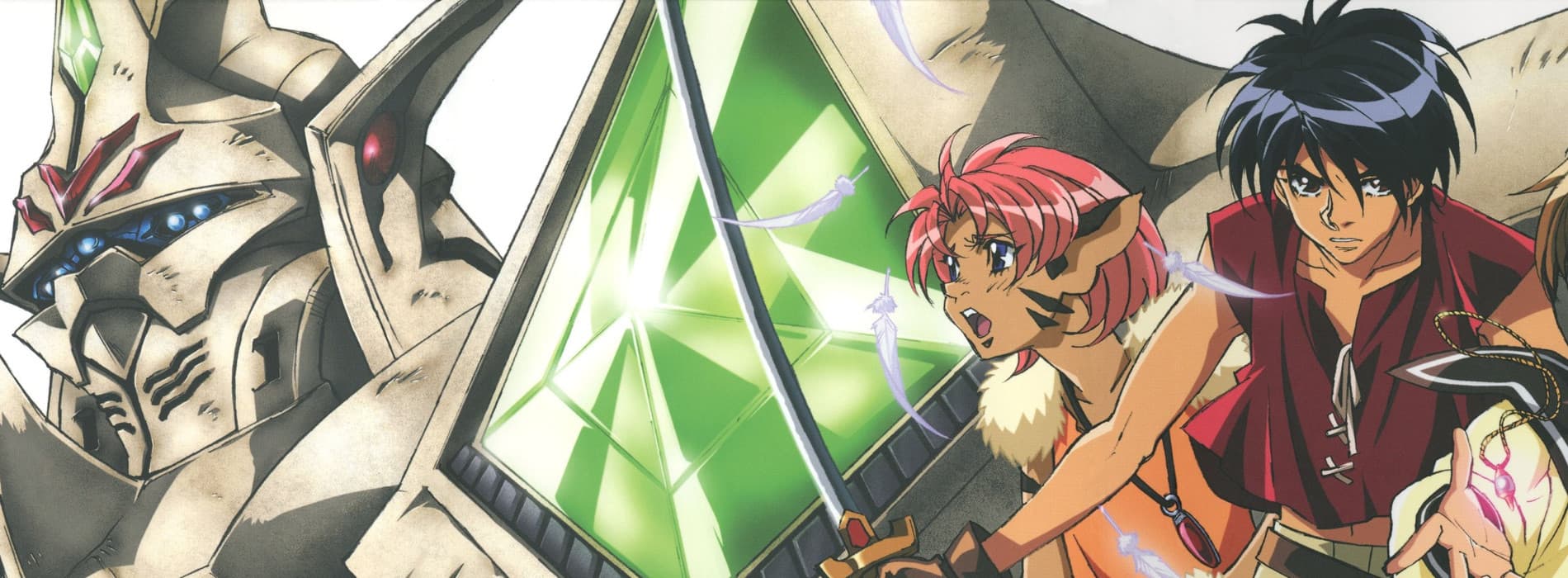
An acquaintance of mine recommended this anime as an ideal representation of a young girl's dream. At its heights, Vision of Escaflowne probably reaches to that state, with its splendidly disunified world, cobbled together from whatever strikes a juvenile fancy, continually brimming with new elements that are gradually yoked together as if by playground improvisation. Knights and castles jostle with robots and airships, and our teenaged heroine, thrust into the middle of a planet-spanning conflict, is more concerned with choosing her favourite pretty boy suitor. Escaflowne itself, a great white panoply encrusted with particoloured gems, which smoothly transforms into a sleek dragon grasping a burning ruby, is as appealing a mech as any. Hearing a Gregorian choir slowly chant the name of this outrageous toy is always a delight. This grave treatment of fantastical caprice is one of the chief pleasures of the show, where the angst of a dragonslaying angel prince is treated with the greatest sincerity. Escaflowne never breaks character: it has the seriousness of a child at play.
This commendation should also serve as a formidable caveat spectator: those expecting a serious epic will be greatly disappointed. An evil empire threatens the free cities of Gaea, where our heroes must band together in a desperate resistance against the wicked machinations of the inscrutable Lord Dornkirk; and only the mysterious power possessed by our heroine Hitomi can oppose his evil plans. It's Star Wars told in the fashion of a JRPG: the heroes travel from place to place responding to whatever mad exigency the world or the villains throw at them. Gamers will note a striking resemblance to Final Fantasies IV and VI. The show probably gets its deepest in the psychological depiction of some of the villains, which is quite tasteful and understated.
The great failings of Vision of Escaflowne seem to be two. Firstly, its occasional inability to be in on the joke: the psychological depth given to some of the side characters seems undue and detracting from their stereotyped, puppet-like appeal. Secondly, and more gravely, is the far more ordinary vice of an inconsistent and inconclusive narrative. It is pleasing to see new elements added, but not old ones altered; and if the characters are too profound, they become insufficiently consistent. The ending, as in so many shows, is too swift, hurried, and unsatisfying. Previously, the merely technical interlinking of the varied inventions was delightful; but suddenly, the sun is going down, and the game must be driven to a rushed conclusion.
9 out of 11 users liked this review