
xJoju
6 months ago·Jan 3, 2026
56
/ 100
6 months ago·Jan 3, 2026
Side Note: I read that the anime was released in three large batches over a year, so, unfortunately, the release schedule messed up what could have been a lot of hype surrounding this part (and also picked up some new fans).
Spoilers ahead!
I have been a fan of Jojo since Part One, and I intermittently read the manga series, so suffice to say, I was hyped for the Stone Ocean adaptation when I first heard it was being released! In my opinion, this part is the weakest in the series, and my review will explain why. My review will focus on the characters and story rather than the art and animation. I will begin with what I enjoyed, then discuss what I didn’t enjoy, and conclude with my final thoughts.
The spiritual aspect of Stone Ocean was different and, coincidentally, interesting. The focus on the New Moon and the Kennedy Space Center as a setting for Pucci’s Stand ‘Made In Heaven’ to accelerate time was essentially a ritual. A ceremony that serves as the final stage of Dio’s plan to birth a new timeline where the Joestar family bloodline does not exist; however, Dio’s minions continue to live on. Pucci’s Stand and its evolution were a crucial part of Dio’s plan for humanity to ‘know their destiny’.
The spiritual aspect of Dio’s personality is not one we’ve seen revealed up to this point. I liked the flashbacks to intimate moments between Pucci and Dio, where we get to learn more about each of them. And it’s perfectly timed to introduce Pucci and his Stand’s powers. What I loved was the clever use of ‘Heaven,’ and its meaning being applied in the story. Pucci is initially introduced as a pastor, and so, my initial thought was that “Heaven” was being used in a traditional religious sense. What Dio actually wants, though, is to achieve ultimate control over the world and knowledge of fate. This is Dio’s goal, which leads to his eventual conception of Heaven. He seeks to vanquish the Joestar family, and in a way, he succeeds by utilizing Pucci’s Stand power to control the universe’s cycle during an elaborate ritual. And this ritual, performed at the Kennedy Space Center, is a lot more complex than just Pucci’s Stand. I won’t go into specifics, but I’ll say that it lives up to Dio’s reputation! If you want to know more about Dio’s Heaven Plan, I recommend the video by Hamon Beat on YouTube.
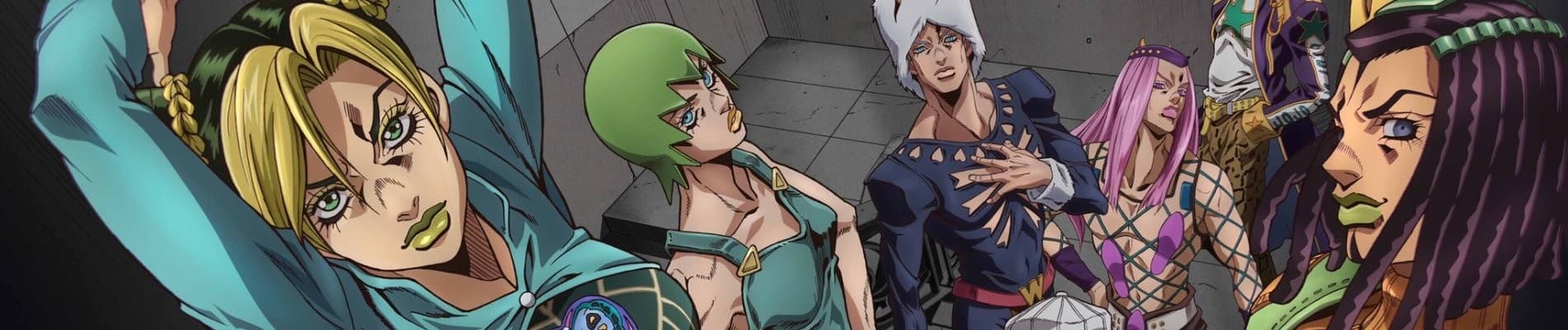
My favorite Stand from this part: Bohemian Rhapsody. It brings fictional characters to life and forces people into fairytale narratives. It might sound and look cute, but it’s actually quite chaotic and dangerous. Seeing Annasui’s perplexed reaction to these characters he is familiar with from childhood, and Weather Report’s utter disinterest in the situation, is hilarious to say the least. The fact that the two cannot agree on a plan of attack just adds to the chaos. In the end, the way that this Stand fight ends reminded me of an infamous pair you may remember from part 3.
Speaking of Stands, if you’re coming straight from watching Part 5: Vento Aureo (Golden Wind), you may notice a resemblance between Secco and Jumpin' Jack Flash. Both in the character design (clothing) and the way they move (crawling on the ground). Donatello Versus’ backstory was a hilarious rip-off of the movie Holes; however, his Stand Underworld has a power that is made even more interesting due to his bitter worldview. In the backstory, as his bad luck increased, the serious tone became a mockery of itself, and I laughed so hard, ironically. Thanks, Araki.
Unfortunately, there is more that I dislike than enjoy. I saw too many similarities with Part 5: Vento Aureo that made Stone Ocean feel a bit like a copycat. Watching the character development of Jolyne was my main motivator for continuing this part; it was also nice to see Annasui explored as a romantic partner, though Jolyne never explicitly agreed to this until the very end, which could be argued whether its actually 'canon' or not. Otherwise, I consider the anime to be a massive borefest of never-ending Stand-of-the-week freak fights. I didn’t feel that Jolyne was a strong enough character or memorable enough to stand on her own like the previous Jojos (ba-dum-tss! ^_~). I was really disappointed about this because she’s setting the stage for the female archetype of a Jojo, and I would have liked a stronger impression.
I felt that some Stands were contrived to work only in the environment of Green Dolphin Prison; take Miu Miu’s Jailhouse Lock, for example. Its ability is to induce short-term memory loss, where the victim can only remember three new pieces of information. The victim still retains information from before the attack; however, they are now only able to remember three new memories, and when they learn a fourth memory, they will forget the first thing they’ve learned, going on and on forever in this time loop. What makes the Stand a challenge is trying to remember important information while at the same time finding Miu Miu to defeat her. The way to circumvent its power is to learn a bunch of facts at once, such as by looking at the reflection of bullet points in a mirror. Very silly. An ability like this is so ultra-specific that I feel it can only be useful at the moment it’s introduced in Jolyne’s story to thwart our main characters. How would someone even acquire this Stand? What does it say about them as a personality? How can the Stand access the minds of other people and differentiate what is truly new information? So many questions. I may be looking into it too much, but this ability and Miu Miu’s design really irked me. I appreciate Araki experimenting with new designs, but to call her Miu Miu and her getup is anything but high fashion is disappointing to say the least. I really miss the interesting backstories and personalities of the villains from Part 5.
Since Emporio was such a hugely important element to the story, you’d think that his presence in Green Dolphin Prison would be less conspicuous. With his Stand, Burning Down the House, he can create “ghost rooms” where he is both invisible and relatively safe (until someone can enter the room). His Stand reminds me of Underworld a bit, where he can access the past, like the space of a room that was destroyed long ago in a fire. The glaring issue, however, is how am I meant to believe that not one person has noticed him living off of the inmates' rations and moving from hall to hall until he decides to show himself to Jolyne? His movement is probably more active once he decides to work with Jolyne, but I still find it hard to believe that no one has caught him even a single time, a little too convenient. I will say, though, that Emporio’s original stand is quite lonely. All he can do is fashion a ghost room stuck in the past with ghost food and one useless gun— its only use is for isolating people in one room, but only if the pursuer does not know anything about it beforehand.
The addition of the incestual love triangle between Pucci, Weather Report, and their sister wasn’t necessary. I feel like we could have made Weather a sympathetic character without dipping into taboo topics. In fact, I think it had the reverse effect. The overuse of music from previous seasons was most obvious to me in part 6; there are too many instances to mention here. I noticed this, probably due to how uneventful everything else was.
Back to Weather. I didn’t find his multiple suicide attempts too sad despite his tragic backstory. What ideal was he dying for? Fighting to be with his blood sister? He’s not my favorite character, to say the least. I also don’t understand the acquisition of his Stand ability and how it relates to his unique personality; heavy weather = heavy emotions? Unsure.
The brightest spot in the story, for me, would be Annasui and his adoration for Jolyne. In fact, I love the shoujo parts of the manga/anime. I appreciate that Jolyne never openly accepted Annasui’s feelings towards her, and Araki instead left it up to the audience’s imagination. It’s only in the new universe, after reality resets, that we see what they would be like as a couple. Annasui would be my favorite male character. His design reminds me of Diavolo enough that it makes him edgy but not a complete copycat.
I should end with Jolyne. My main gripe is that she feels hollow as a character. In fact, I can’t recall one moment in the show that felt definitive for Jolyne as a character. Araki had a chance to let her femininity shine in her interactions with Annasui and as a mother/sister figure to Emporio. Nothing was memorable here; meanwhile, I couldn't help but compare it to the awesome moments from previous parts. The music in Part 6, particularly the ending, seemed melancholic to me. Jolyne herself isn’t necessarily an upbeat person, so it's not surprising that the overall tone of the show and her moments on screen would be more serious; however, I left the show feeling unsatisfied. It almost doesn’t feel related to the Jojoverse at all.
I planned a nifty little wrap-up to end this review with, where I’d comment on the irony of a stranger saving the Joestar family bloodline and humanity at large. Looking back on the show, though, I’m left with the murky feelings of underwhelm and relief at finally being done with writing this review. I said at the beginning of my review that I find Stone Ocean to be the weakest in the series, and I stand by that. However, in a series that is as charming and well-written as Jojo, one single part that may not shine as brightly as the others still manages to gleam against its counterparts. Now-- back to watching parts 1 through 5!
27 out of 48 users liked this review