LOOK BACK
a review by CyberSage999
a review by CyberSage999
Making art is a way for people to express themselves for any number of reasons, such as exploring their own cultures, lives, or personal thoughts, among many other things to explore. It can be done through many different ways, such as drawing, and you can create whatever you want as only your imagination and skill is what can limit you. Outside factors can also push someone to create beyond what they might have otherwise.
This is the case for our protagonist, Ayumo Fujino. When we met her, she’s a manga artist who people in her elementary school do love her work. It’s her main hobby that she enjoys and loves hearing people give her praise for it. Her school features it through the school newspaper, but then, someone else, Kyomoto, starts making manga with gorgeous backgrounds as opposed to Fujino’s more comedic comics with basic backgrounds and funny characters. We follow these two as they grow older and more experienced in making art.
The production (art, animation, music, and voice acting) immediately stands out as incredible. Kiyotaka Oshiyama was not only the director and character designer (translating the manga designs to animation), but was also the animation director, did the key animation, production, script, and storyboard. While this is a rather short film (50 minutes for a one shot manga), doing all of this is nothing short of awe inspiring. He has done key animation on things like Mob Psycho 100 S3 Ep 12, has done the special effects design for Trigun Stampede, and has done design work for many other works (Devil design in Crybaby, mechanical design in FLCL Progressive, etc). He had also directed Flip Flappers beforehand, which I really liked. I also really appreciate Kiyoshi Sameshima’s work as the art director and Haruka Nakamura’s work for the music. It all flows so well. To give a handful of examples:

In this shot, I really like the sunset colors in the back which gives a more relaxed moment with the pair. I also just really like the clothes that they have and and how they contrast with one another, with Kyomoto’s more messy hair compared to Fujino. You can also see Kyomoto’s small smile as she does have fun with Fujino while Fujino herself is more reserved looking.

I really like this shot too, as they are awaiting the results for this manga contest that they’re working together in. They put in Shark Kick, a reference to Chainsaw Man. You can tell that they’re anxiously waiting as they read. I also like how they have these colors that contrast with each other. Kyomoto going for pink and red while Fujino going for more blue and green.

This is one of my favorite moments in…anything if I am being honest. It is a goofy looking run and I love it. She feels so triumphant after making friends with Kyomoto, who is a background artist that she admires greatly, even as she was rather jealous of her up until then. She’s just running in the rain and everything just kinda goes into place, like the splash towards the end.
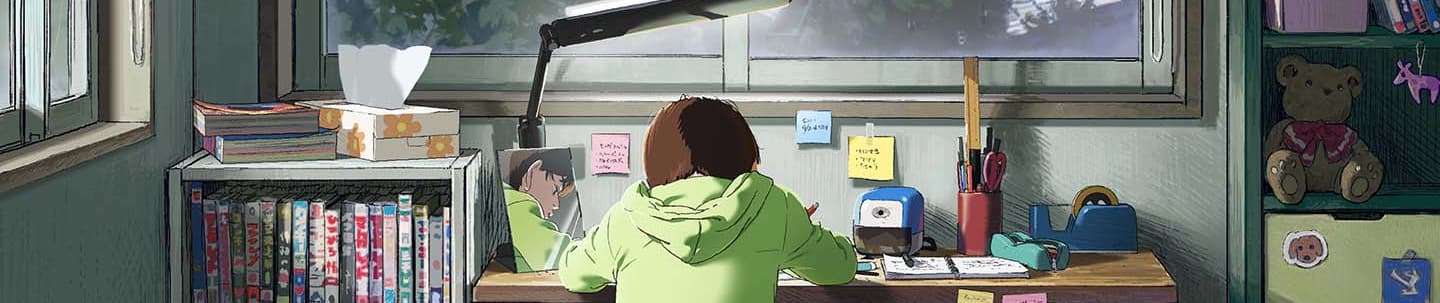
Fujino continuing her work in the end of the film
This is a very somber, yet somewhat bittersweet final shot. I won’t get into the exact details on the ending here, but it is heartwarming that she managed to find a new purpose in making manga after it being somewhat momentous and the tremendous tragedy that happened beforehand. I love how the sun rising is contrasted with the darker room Fujino is in, sort of symbolizing how she is coming out from the dark.

MASSIVE SPOILERS FOR LOOK BACK, DO NOT READ UNLESS YOU’VE READ THE MANGA AND/OR SAW THE MOVIE.
So somewhere in the middle of the film, Fujino and Kyomoto do drift apart as they become young adults. A man tells them that both of them are getting serialized as they made 7 one shots by the time they were 17. Fujino was ecstatic to hear the news, but Kyomoto hesitates. Kyomoto, despite her being shy and very timid to others outside of Fujino, decided to be an art student. Fujino is somewhat distraught as the two of them were making the manga and tries to persuade her to just continue working with her, but Kyomoto is firm in her choice. Fujino always kinda saw Kyomoto as being inseparable and Fujino needing her for the background art and Kyomoto needing her for social activities. So Fujino continues working on her manga while Kyomoto wants to get better at drawing and is in art school.
This all comes to ahead when Fujino gets a call from her mother, telling her an attack took place in Kyomoto’s art school. When I saw the funeral photo for Kyomoto….my heart broke man. It was so sudden, which is exactly how these real life attacks feel like. It all felt so raw and horrible, and you can tell that Fujino is completely distraught over the news. She wonders, for the second time why she’s even drawing at all and blames herself for what happened as she, unintentionally, brought out Kyomoto from her room when they were both little kids.
Fujino distraught looking at the comic panel she made before.

We get a sequence where Fujino considers a life where she didn’t get Kyomoto out of that room and just gave her the graduation from middle school. Fujino continues on to be a manga artist while Kyomoto continues drawing background art and goes to art school still. In this scene, we see the attack who accuses the school of stealing his work, which feels extremely reminiscent of the KyoAni arson attack and why that piece of shit did that, though it could just be a coincidence. Now, Tatsuki Fujimoto, the author, did apparently go to that same university that Kyomoto went to. In any case, the fake flashback ends after Fujino heroically saves Kyomoto, as many feel like that when they lose a loved one in such a horrible manner, they often think about how they would’ve done something, anything differently to prevent it, but after checking through Kyomoto’s room and finding that old comic Fujino made in school still saved by Kyomoto, she decides to keep going, to keep being a manga artist.
Fujino kicking the culprit in the fake flashback.

Now, here’s how I would interpret the finale: It is here where Fujino becomes more aware and more thoughtful of what had brought her up until this point, as she had been at least somewhat selfish up until now. What drove her was being acknowledged as a great artist and to be better than anyone, but when they became friends, she had relied on Kyomoto and tried to keep her with her regardless, but Kyomoto ultimately went to art school. The flashback indicates that Kyomoto would’ve continued to be an artist and went to that same school regardless of whether or not Kyomoto met Fujino when they were kids. She had realized what had driven Kyomoto to making art: The love of making it and admiration for her friend, Fujino. Fujino had lost the most dear friend she had, but she did gain clarity and a drive to keep going despite what had happened. Thus, the ending shot I had mentioned earlier.
END OF SPOILER SECTION
Overall, this is a phenomenal movie and one I would recommend in a heartbeat. It is such a heartbreaking and inspiring piece of work that tells us that we should pursue our artistic endeavors, as you never know when that will end. It is a love letter to the process of art and art itself, and I find both Kyomoto and Fujino to be extremely compelling main characters. You can feel their struggles and their triumph throughout the film, and even with the worst circumstances, you can still keep going. Keep doing what you love.
47 out of 50 users liked this review
