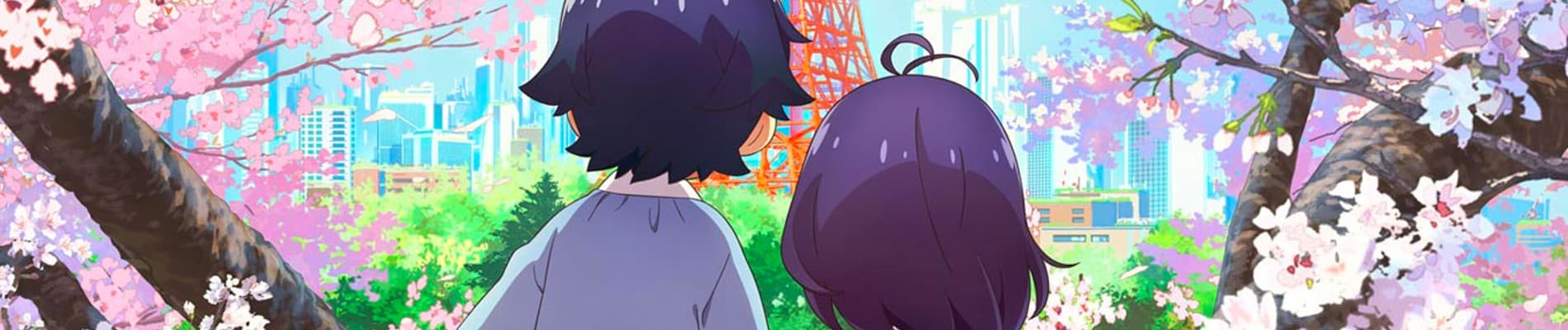
LOVE FLOPS
a review by AftershockWolf
a review by AftershockWolf
Hi, AniList review readers. This isn't going to be like a normal review you'd see from me. I watched this show back when it aired and haven't revisited it or discussed it recently, or anything of the like. I couldn't approach a genuine review of this show with any sort of confidence, as I don't have a clear enough memory of the little details of the plot or characters that would make me remember this show as anything but what it is on the surface. Many reviews for this show as the years go on are those looking back on it and claiming it to be "underrated" or a "hidden gem" but that's far from what I'm planning to do here. So, if you'll excuse me, I'm about to get way too personal with strangers on the internet.
 format(webp))
Love Flops by almost any conventional measure is not a good anime. It's completely incoherent, inconsistent in both writing and tone, tasteless at absolute best when it's not just grueling at worst. The ecchi elements feel slapped in for the sake of having ecchi elements, rather than being used provocatively by any means, the characters are not much more than just loosely stitched together tropes given a vague purpose of being, and its attempts to be a parody of the genre lack the actual edge required to meaningfully cut into and critique harems for their faults and contrivances. Hell, the plot basically relies on contrivance itself in the way of artificial coincidence to force relationships into existence rather than giving them any chance to develop or feel in any way organic. Sometimes the series will gesture towards larger ideas or themes, but very rarely actually demonstrates in any good way the ideas in action or exploration.
I even want to make it as clear as possible, and you can just check my anime list for any evidence you need, that I do genuinely enjoy ecchi anime, harem anime, and can arguably enjoy a series just fine even if it barely has a plot worth mentioning. My biggest issue with Love Flops is that it seems to present itself as something with ideas to share, as if better than those other series, but only manages to fall face first in almost every minute of its screentime. The characters are flat and one-dimensional, but it's not like I actively dislike them - Mongfa was easily one of my favorite characters from the season, Amelia hits just about every design aspect I could ask for in a character, and I don't remember any of them being genuinely grating most of the time, atleast. Rather, the characters feels too much like characters for me to develop any actual connection to them, as they're given such little personality outside of what you already expect from them.
And yet, despite all of this... or maybe because of it, Love Flops is one of very few anime I've watched that actively forced me to pause an episode, sit in silence for minutes on end, and genuinely take a breath before I could press play again. So, what about this show that I clearly don't have an insanely good opinion on led to this? Well, I'm glad you asked. The answer to this question doesn't lie in what Love Flops did right, but, rather, in what it accidentally stumbled into.

For most of its runtime, the show presents itself as what I can only describe as an exaggerated farce of a harem romcom. Asahi, our protagonist, is suddenly surrounded my girls of varying personalities, whose encounters and feelings feel almost predestined by some mythical fortune that he had gotten earlier in the day. Of course, that's part of the comedy in this case. The goal here is for the viewer to laugh at the contrived setups and artificiality in these encounters, with the happenstance being the punch line. As far as destiny matters in Love Flops, it's clearly not anything romantic, but more like something running on a script. Love isn't discovered, it's as if it's been assigned from the very beginning. In this way, it's similar to the (much better) recent romcom 100 Girlfriends in the way the characters are fated to be in love, literally by the hand of God.
In that show, this artificiality is the entire point and it does it well. Yes, the romance is destined, but it's rarely actually immediate and there is still a journey of falling in love. Here, the artificiality just feels lazy rather than intentional. The girls don't feel like people as much as they do just archetypes following a prewritten routine built into their genetic code. Feelings surface too quickly, love feels too easy, and there's not actually much of any emotional connection between them and Asahi to call for it. As a result, the relationships feel fake, and, for a romance anime, the show just feels hollow where it should, theoretically at least, have the most care put into it.
Did I mention yet that it was intentional?
Later in the runtime of the series, it's revealed to Asahi that his world isn't real. The school, his daily life, and, of course, the girls he's grown attached to over the time he's spent with them so far... all sort of based on reality, but fake nonetheless. It's all a simulation - research. Asahi is just a participant in one big algorithm to train an artificial intelligence on what "Love" is and what it feels like. In almost an instant, the series failures - it's shallow characters, the contrived and bare relationships, the sense that nothing ever felt real enough to connect with - aren't just an affect of poor writing. Now, don't get me wrong - some of it was very likely due to bad writing, I don't want to just exclude every fault of a show because of one twist, but some of them, at least, begin to make more sense. The love presented here was never meant to be seen as real, because it wasn't ever trying to be. Love, for all intents and purposes, is a means to an end.
For Asahi, this realization genuinely breaks him. I mean, this doesn't just equate to losing the people he's began to love, but is basically forcing him to confront the idea head-on that they never existed in the first place. Every memory, every shared word, every moment shared - everything he has experienced in the full duration of this show becomes suspect as he begins to grapple with his very understanding of reality. It's not that he imagined everything, he did live through these experiences, but it's about the fact that all these experiences were just an instrument of creation. Love, as has been explored in the series so far, was never something real, but was something created for a purpose that he was forced to serve.
This is the point in the series where Love Flops stopped being just another trashy seasonal harem anime and became something much more personal... uncomfortably so.
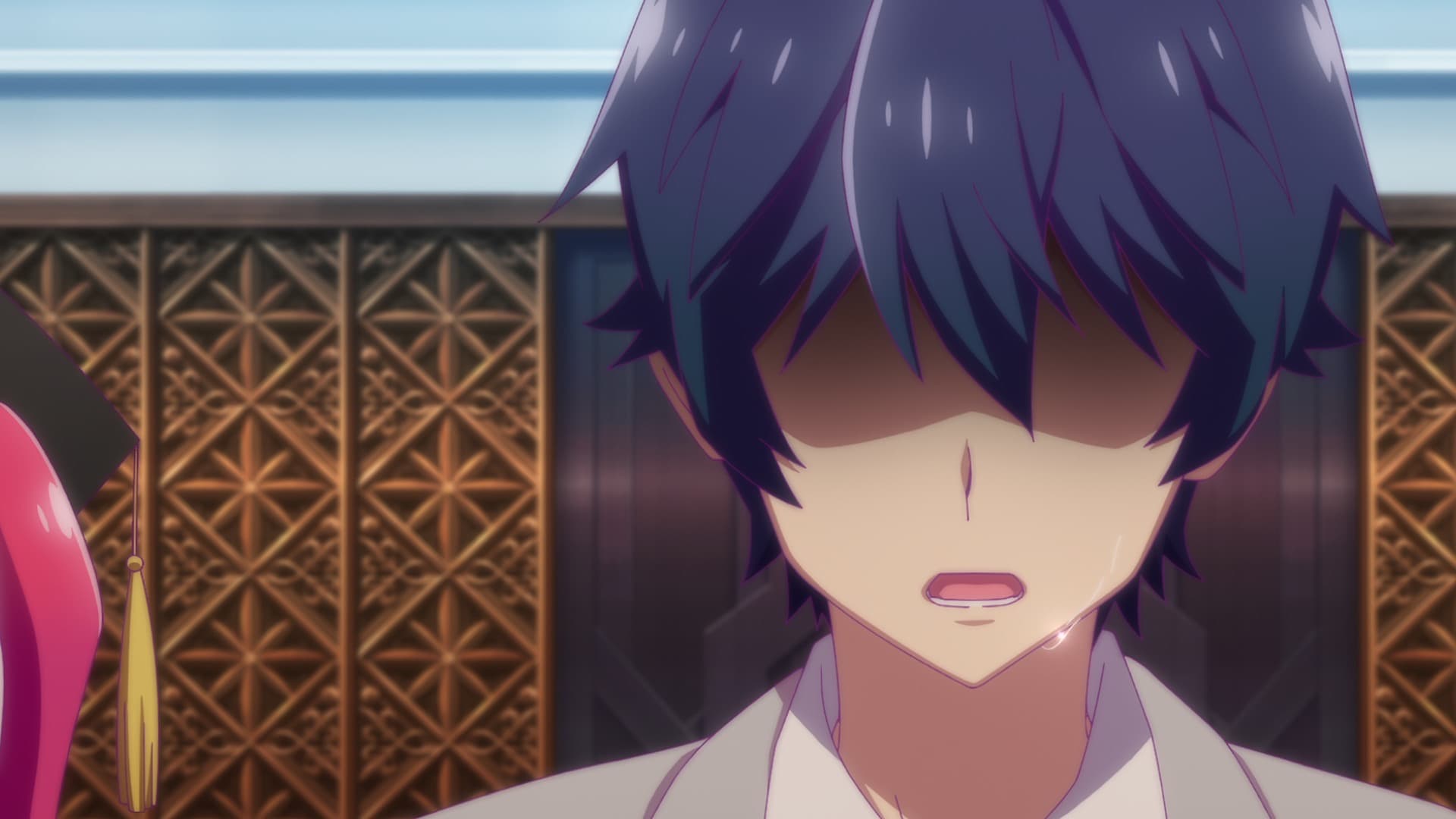
Let me answer the question you probably had when clicking into this review. My greatest fear isn't death. It's not physical harm, it's not isolation, and, for clarity's sake, it's not spiders, or heights, or snaked, or needles, or anything like that. My greatest fear is almost exactly this. It's a fear that none of my relationships are real. It's a fear that people do not care for me out of genuine affection, but out of convenience, obligation, pity, or any other number of sour reasons. It's a fear that my presence in their lives is built on a condition - that, as long as I am still useful, agreeable, entertaining, then I can still stay a part of their life. I am scared of relationships because they end, and, more often than not, it's done quietly, without any explanation or even any malice from either party. One day, without warning, you've traded your last messages, the effort to continue the relationship begins to falter, and, eventually, as if just a part of the plan, you are forced to realize they've moved on.
I often find myself wondering what the lives of those I surround myself with would be like if I wasn't here, or if I've made a big enough impact in anyone's life that, if I were to disappear today, they'd remember me. To briefly self-advertise for a moment, I'll often tell viewers of my streams that one of the reasons I stream is because I hope to make someone smile, and that, hopefully, that moment of happiness can stay with them in their hardest times. A reoccurring part part of my life is just hoping that I'll leave some sort of impact notable enough to remind people that I existed and that my life was real.
What Love Flops does, even if clumsily, is presents the worst possible version of that fear. A world where affection isn't just conditional, but synthetic - literally programmed to exist. Feelings here aren't misunderstood, but manufactured, and the suspicion that you're valued only as a means to an end isn't just paranoia, but the full, objective truth. There's a unexplainable cruelty in love being something that can be real to the person experiencing it, while remaining as something entirely instrumental to the one who is providing it, and it's the exact reason cruel jokes like asking someone out on a dare exist in the first place. Human hearts are fragile, and, more often than not, worn on our sleeves, and it makes them the easiest thing in the world to manipulate. Unlike that, though, Asahi isn't necessarily betrayed by anyone here. No one turns against him out of spite or malice or because they thought toying with him would be funny. In truth, the bonds he treasured literally couldn't be reciprocated in the way he believed they could be. Yes, the girls were theoretically expressing their own thoughts and feelings, but it was never actually human. It was code. Code executing as intended.
Look. The series doesn't actually handle all of this with any of the grace or subtlety I'm explaining here - the writing still remains shaky at best, it's emotional beats work sometimes but are largely undercut by the missteps the show takes to get there, and the plot only gets more absurd and messy from here. Despite all this, this core idea lands with an unsettling amount of force. Love is an emotion that is almost entirely impossible to understand. It's not as simple as happiness, or sadness, or anger. There is no strict definition or feeling of love, and every one experiences it and expresses it in a different way (some not really at all, love all my aromantics out there). Thus, love is an emotion that requires belief without any way to prove it. Gifts, physical affection, words - these all do well at expressing love, but there's no way to actually prove you or anyone else is in love. Considering that fact, love is so exceptionally fragile, and the slightest shakiness in that belief can shatter it, leading to loss that feels life ending.
In the real world, we aren't ever given a reveal or twist as explicit as the one Asahi faces here. No one sits us down and gives us a lovely little chat about the fact that our relationships are actually all simulated, and that all the love and affection we've received was a command getting run rather than a choice made by a human heart. Regardless, we all experience things similarly, if much less fantastical. Instead of this, though, we can only infer things from the absence of what there was. There's no such thing as confirmation in the end of relationships - just silence. We don't get the clarity of knowing whether our fears or justified or just a figment of our imagination, and it's far more likely an answer will never arrive.
It's this ambiguity in this fact that makes this fear so persistent. I can't blame some big bad villain, nor is there some evil organization working behind the scenes that I can expose. Instead, it's the far more human experience of a slow erosion of certainty. It's the questions that ring through my mind each and every day, with unrelenting pounding against my heart.
Were they ever choosing me? Did I truly matter, or was I just a present force? Will I be someone they remember tomorrow?

Love Flops doesn't answer these questions. I'd argue it barely understand them. Still... in it's attempt to become something more than just a shallow parody of a genre, it does one thing incredibly well: it exposes a truth that I will never be able to fully escape. The truth that the real terror in love isn't in its loss, but in the possibility that it was never real to begin with.
For clarification, I don't think Love Flops is some secretly brilliant masterpiece. It doesn't succeed as a critique of the harem genre, nor does it explore the themes of AI or emotions in any meaningful way. What it does do well, almost entirely accidentally, is brush against something deeply human within me and refuse to let go of it.
Love Flops is, at it's best, a fine anime that, for a brief moment, articulated something painfully real.
Sometimes, that's all a story needs to break you.
20 out of 23 users liked this review
