Baccano!
a review by TheRealKyuubey
a review by TheRealKyuubey
One of the more interesting periods of early nineteen hundreds America is prohibition. Taking place one hundred years prior to the time of this writing, America went through a period where the production and consumption of alcohol was illegal, and in its absence, underground production became the norm, giving rise to bootleggers, speakeasies, and a widespread mafia gangland culture. You definitely learned about this period in school, but there are three misconceptions you probably carry as a result. First, your teacher probably didn’t tell you this, but prohibition was actually really popular at first. Pre-prohibition America had a massive drinking problem. No matter how bad you might picture alcoholism back then, it was worse. Prohibition couldn’t have possibly happened if there hadn’t been a huge outcry for it. Of course, that attitude didn’t last long, because you know what they say, you don’t know what you’ve got until it’s gone.
Your second misconception would likely be that prohibition taught America that you can’t legislate morality... It doesn't take a history major to realize this is bullshit. And finally, you might be surprised to learn that at some point, the bootleggers producing alcohol came in contact with alchemists who had perfected an elixir for immortality, and this fateful crossing of wires changed the world forever, albeit behind closed doors, in the shadows, lurking in secret behind the ignorant eyes of society. There are people in the country who have been around for centuries, some dating back to the elixir’s invention itself, others dating back to the few gangs who were lucky enough to partake in this cursed elixir. No matter who you are, though, mortal or otherwise, anything can happen as the result of a chance encounter. Several chance encounters in one evening, though? Shit’s about to get crazy.
Baccano was produced by Brain’s Base, and while I have spoken about this company before, I don’t think my prior comments would really be relevant here. Both of the anime I reviewed from them, Amnesia and Brother’s Conflict, came out in 2013, which means it’s probably not fair of me to compare them to this anime series from seven years earlier, in 2007. That’s probably for the best, as I genuinely don’t remember anything I said about the visuals of either title, and they didn’t have the same director anyway. Director Takahiro Omori does have a pretty impressive resume, though, and looking at the projects I’ve actually seen that he was listed as primary director for, you’ve got shows like Durarara, Natsume’s Book of Friends, Hell Girl and Samurai Flamenco, shows that had a modern day, urban setting, but also incorporated supernatural elements that could get genuinely insane from time to time. I won’t say that sort of thing describes every project he’s helmed, but it does seem to be his bread and butter.
With Baccano in particular, I won’t say that it looks perfect, but it’s produced in such a way that the flaws it does have are more or less unobtrusive, and you’d likely only notice them if you’re paying attention to them specifically. Like, sometimes, artwork in the background can get a little bland(although it is intricately designed and immersive for the most part) but this only happens during scenes where your attention is supposed to be on whatever character is moving around in the center of the screen. The same thing happens with background characters... Extras, basically, anyone who isn’t immediately a part of the action... But the action is what you’re supposed to be focused on, so it’s not as big a deal as it sounds. There’s also the occasional runny eggs shot... You know the drill, broken frames to cheaply animate some fluent character movement... But this tends to happen during intensely crazy scenes where the effect only heightens your stress levels, or during incredibly dark scenes where it’s harder to notice.
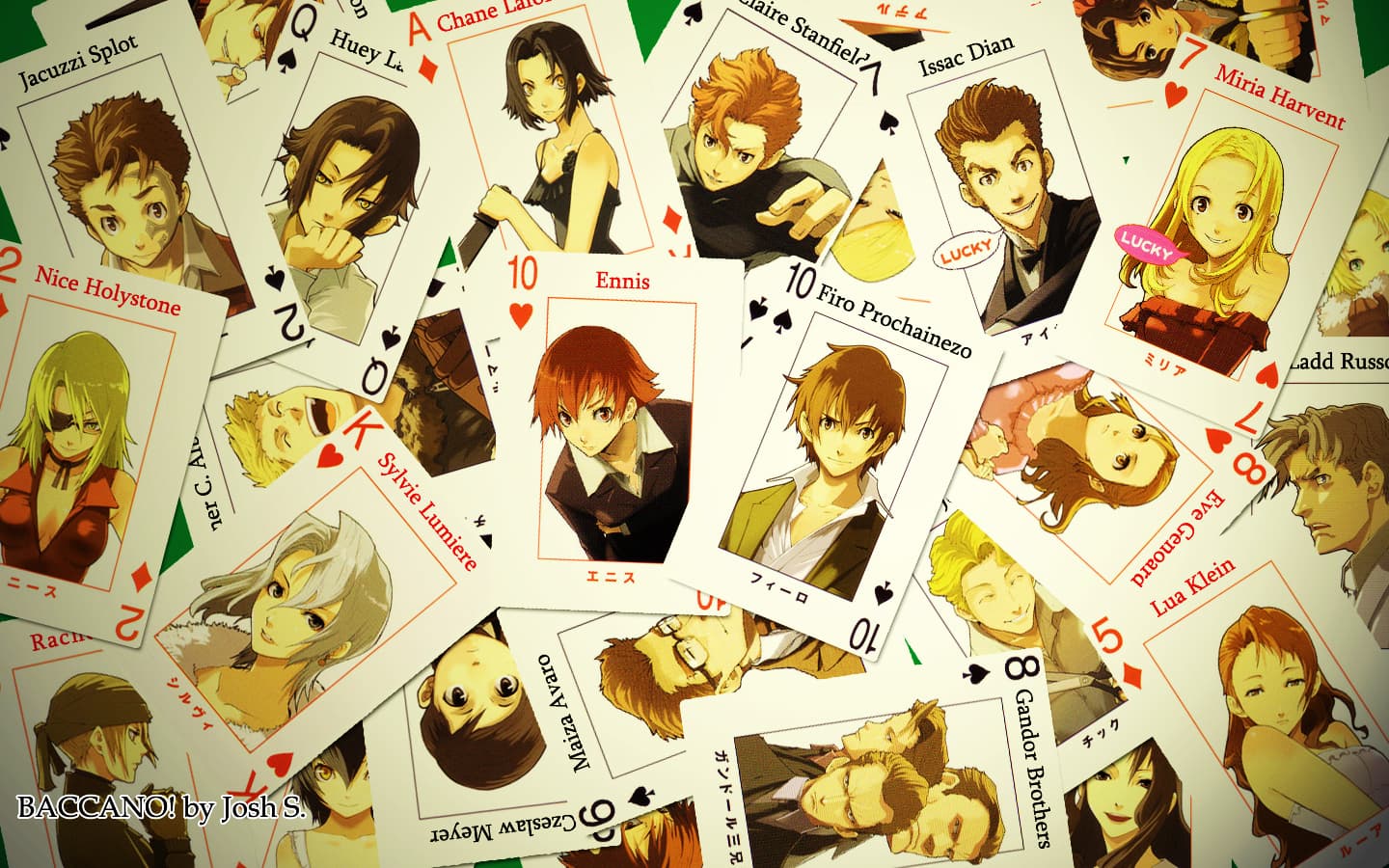
Otherwise, this is a consistently well animated show, where the tone can range from silly, to suspenseful, to even gorram terrifying, and both the speed of the animation and the overall cinematography change as needed. The action is always fast and brutal, and the stiffer shots that the animators used to compensate for them are handled about as well as those kind of scenes can be. This show utilizes a borderline seamless blend of silly slapstick violence and brutal, gory ultraviolence, and that’s not an easy line to walk, but this one does it probably better than most other anime that have tried to. The best aspect of the series, however, is probably its design work. You have a very large cast of characters in this show, and while some of them have extremely unique and striking designs, even the more generic ones still stand out in some way, especially with the amount of gang members and psychotic criminal lackeys, most of whom do manage to stand out in some way or another.
There are at least two dozen characters in this show who I’d be able to identify at a moment’s notice, they’re all basically unforgettable, and the vintage Americana backgrounds have a ton of personality to them. Overall, it’s a pretty good looking show.
The english dub, however, is fan fucking tastic. It’s a little harder these days to throw around the term “best English dub ever” than it used to be, as the overall dubbing field is a lot more consistently on point than it used to be, so having a perfect english dub has become something that’s a lot easier to take for granted, so by my metrics, you would have to offer something extra to really climb the ranks and be considered one of the best. To this day, I consider Beck to have one of the best dubs ever because of how they handled the music of the series, and I still consider Baccano to rank right up there WITH Beck by consideration of just how many actors fucking nailed their accent work. Like I said before, this anime takes place in prohibition America, so there are plenty of different western accents being thrown around, as well as some eastern and some european, and it would be an understatement to say they were all perfect.
The two that strike me the hardest right off the bat, and that I frankly consider to be the most memorable, are Colleen Clinkenbeard as Nice Holystone, and Todd Haberkorn as Firo Prochainezo, both of whom sound so flawless in their delivery that it sounds like they hopped into a time machine to the exact times and places their characters were from and studied the locals for years. Of course, accents aren’t the only area where this dub shines, because the most beloved characters of all are easily the fan favorite performances, the goofy dynamic duo of Isaac and Miria. They were voiced by Funimation veterans J Michael Tatum and Caitlin Glass, two very close friends in real life who have claimed to be like siblings with each other, and their chemistry is electrifying as they play the most uninhibited, outgoing, sincere characters in the cast. Bryan Massey is also outstanding as the loud, proud psychopath known as Ladd Russo, he will pump you up like the best WWE wrestler themes.
This dub is generally just a massive who’s who of Funimation talent from the late 2000s, they’re all performing at their absolute best... Brina Palencia, Monica Rial, a pre-Brotherhood Maxey Whitehead, Jad Saxton, Joel McDonald, so many classic names, and not a single sore spot among them. I’ve heard the original Japanese version was also incredible, and this dub even blows THAT out of the water. I’ve also heard that there’s an Animax dub out there, but I’ve never heard it, nor do I plan to. I would recommend this dub 100 percent, and while I don’t usually talk about music in my reviews anymore, the soundtrack is also exceptional here. You can probably tell right from the swinging instrumental track they used as an opening, called Guns and Roses as an homage to my father’s favorite band of all time, most of Baccano’s soundtrack is that kind of old-timey jazz music that’s timeless as all hell and never goes out of style. The only part I don’t like is when they interrupt the opening to play some dialogue from the previous episodes, that gets pretty annoying.
So Baccano, if you didn’t know, is an Italian word that means a ruckus, a hubbub, or any other English word that means a confused combination of many sounds, especially voices. So a lot of people talking at once in a way that could be difficult to decipher, and that does kind of describe the show kind of perfectly. It also kind of describes the fans to an extent, but no matter how many of us are jabbering, it is at least easy to decipher that most of the talk is positive. And yeah, I’m one of them. That’s right, lower your torches and pitchforks, I’m not trying to get myself run out of town by shit-talking a popular or beloved anime again, at least not this time. Baccano is listed on my top 100 favorite anime, but more importantly, it was listed back when all I had was a top 50. I really like this show, and I have for a long time, but having said that, my score did slip a point during this latest rewatch. I’ll explain why later on, but for now, I think it’s important to explain what this weird little anime is and how it works.
Baccano is a light novel adaptation, and while I’ve personally never read the original books, I’m assuming the story they present is more straightforward and conventional, maybe not in content, but at least in structure. Adapting a light novel to a series almost always comes with a set of problems, because these book stories aren’t paced the same way anime serials are, so liberties have to be taken to not only make all of the expository dialogue more palatable, but to adapt three entire books into a twelve to fourteen episode run, which, again, can create a lot of pacing problems. From what it looks like, Baccano took a very ambitious approach to this issue, by chopping up three different stories and shuffling them together, completely out of order with no clear direction for the viewer on how to follow it. This is probably the closest thing that I would ever call a “Tarantino style anime,” even though it takes Tarantino’s penchant for non-linear narratives about sixty steps farther than Quentin ever did.
There are three stories at play here, and they’re all playing out at exactly the same time, at least from your perspective. The first is the backstory of the immortality elixir. The second is about a mafia turf war revolving around those elixirs, and the third is a chaotic story about multiple factions trying to hijack the same train at once, while immortals are present. The second and third stories do connect in some small ways, but aside from the insane duo of Isaac and Miria, their casts are completely different, outside of who is present right at the end. I’m not going to lie to you, this entire approach could be confusing if you’re not paying attention, or hell, maybe even if you are paying attention. I’m actually very curious if the light novels were also written that way, because if not, well, then this approach comes off as a gimmick, and a gimmick of this magnitude is mostly utilized as a crutch when you feel insecure about the strength of your story.
Put simply, when I imagine this narrative being told in chronological order, I almost immediately start snoozing. The framing device kind of alludes to this, what with a historian and his young protege trying to piece together all of these stories, and they can’t figure out where to start. They start with Firo because, in their words, he’s “Main character-ish,” which is kinda bullshit. They actually picked him because he’s one of the most likeable characters in the cast, and because if they had instead started with the origin of the elixirs, it would have taken the audience too long to get invested in the story. He is one of the few morally sound characters, too, which is why it’s such a shame that he ISN’T actually the main character, at least functionally. There is no main character, which can become kind of a problem when you consider just how morally gray and/or flat out villainous the rest of the cast is.
The second story does have some element of good vs. evil, which is why it stands as the heart and soul of the series, but the third story is pure action, for better or worse. I figure there are probably a lot of people who consider this to be the more fun half of the series, as it is a lot louder, a lot more glorious in its violence and excess, and just buckets and buckets more blood gets spilled. I kind of agree, but where the second story had some semblance of plot, the third story throws the entire idea of plot right out the window, as the entire story is just random happenstance and coincidence, and the character interactions that spawn from them. I’m not going to lie, the second story feels like the most chaotic trainwreck of a tabletop campaign I’ve ever seen, with the Rail Tracer as the BBEG, but the players just don’t give a shit and just go rogue, doing insane shit as they bounce off of each other, until the DM has to force the Chaser out of hiding in the final act. There’s no goal, no clear indication of who to root for, and the only existing stakes are in place because the characters are actively creating them.
So, does shuffling these stories improve the experience? Well, yes and no. It does, but not directly. Showing the events out of order might prevent the individual stories from becoming boring, but that alone wouldn’t be enough. What it does to truly elevate the series is create another, kind of different effect; See, I’m just going to come out and say it, Baccano lives and dies off of its characters. When people talk to each other about how awesome Baccano is, they’re not talking about the themes of mortality and morality. They’re not talking about the deeper lore of the immortality elixir. They’re talking about a small number of very specific characters who have quite frankly outlasted the show itself. They’re talking about Firo. They’re talking about Jacuzzi and Nice. They’re talking about Ladd Russo. They’re talking about Dallas and Chezlaw, Ennis and Clare. Most of all, though, they’re talking about Isaac and Miria. And yes, I know, some of the names are weird... Why do they have a woman named Ennis and a man named Clare? Whatever, it doesn’t matter. Yeah, Jacuzzi Splot is a weird name, but it’s not like they’re throwing around names like Backyard Bottomslash.
More importantly, I think it’s these ten characters that are the lifeblood of the story, and the problem with that is, when your story is being propped up by a fraction of your active cast, it’s really easy to lose the interest of viewers when their favorite character isn’t around. The reason that shuffling the story up and showing it completely out of order works so well is because by doing it that way, all ten of these characters are constantly on screen, so the viewer can constantly bask in the glory of whichever one of them means the most to you. Who needs a plot to get invested in when Isaac and Miria are constantly up to their silly hijinks? Who cares who they’re supposed to be rooting for, when one of the most lovable and charismatic violent psychopaths is screaming about how much he loves killing people? On the one hand this is a criticism, because if the overall narrative were strong enough to stand on it’s own, you wouldn’t need to do this. On the other hand, I can’t fully condemn any story-teller for figuring out what the strength of their work is and leaning into it, especially using a method so bizarre and inspired.
By all accounts, none of this should work as well as it does. They took a lot of risks in this show, and some of them worked, but others didn’t. I like how the writing doesn’t give one flaming shit about spoilers. You’re told right from episode one that Ladd Russo is ultimately taken in by cops with one of his hands torn down to the bones, but it doesn’t ruin the journey, and yeah, you could see that happening to him. I kinda like how the identity of The Rail Chaser comes completely out of nowhere as a dude you never noticed previously. I don’t like how some shots and events are shown two or three times. Another particular issue I’d like to bring up is that the historians from episode one... You know, the ones trying to piece together the story, and who select Firo as the main character... They never come back, not even in the final episode. Don’t get me wrong, the final scene they went with was brilliant, but you could have fit the old man and little girl in there somewhere... Come on, they were charming!
Baccano is out of print from Funimation, and has yet to be picked up and rescued by Crunchyroll. A three episode OVA is available on the DVDs. The original light novels and manga by Ryohgo Narita are available from Yen Press.
I’ve said it before, I’ll say it again, I love anime that combine batshit insane creativity with pure crackhead conviction. I love anime that present you with a bizarre concept that they then explore the fuck out of, but on the other side of the coin, I love stories that present you with something familiar, but with a vision and execution that belong in a padded room in a mental ward. I consider the Excel Saga manga and Akiba Maid Wars to be among the craziest masterpieces of all time, and I see a lot of what made them great IN Baccano, but not every work of insanity is a masterpiece. And yes, I know a lot of people consider Baccano to be a masterpiece, but personally, I don’t think it is. It has a lot of weak parts, and while the stronger parts do a lot of admirable heavy lifting to compensate for them, they are still exposed if you ever stop to think about what you’re watching. Still, I love this show, and I highly recommend it.
I give Baccano! an 8… “Out of how many?”
20.5 out of 25 users liked this review
