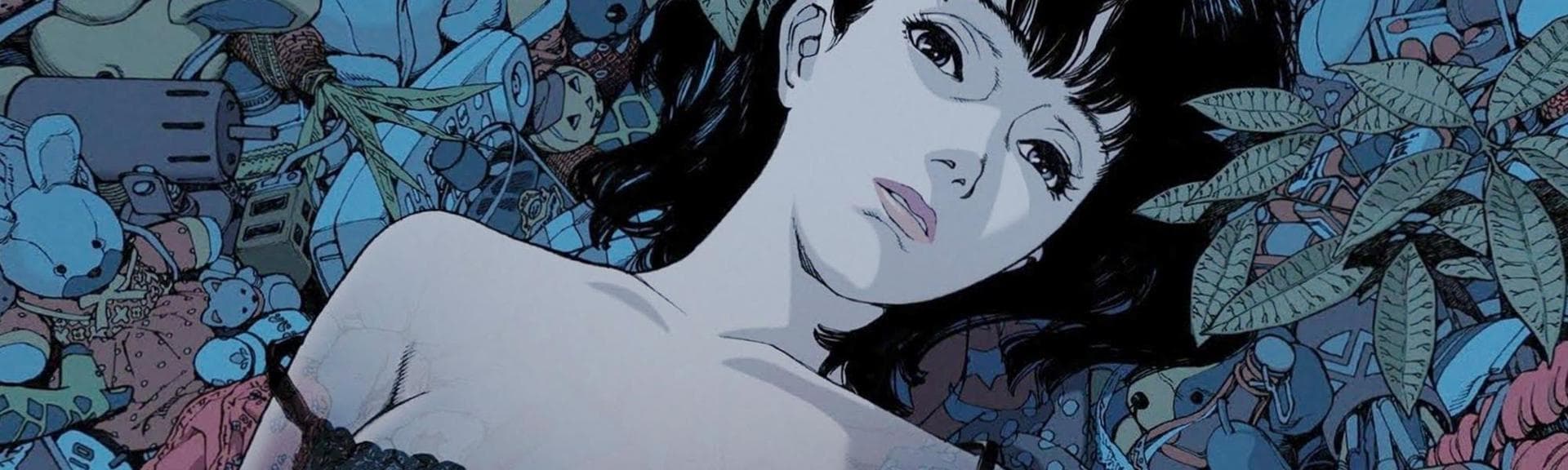
Perfect Blue
a review by Nialled69
a review by Nialled69
"Perfect Blue" by Satoshi Kon is not merely a film; it is a psychological assault that dismantles the viewer’s sense of security. The way I was left astonished, questioning my sanity and battling a profound existential crisis throughout the entire end credit sequence needs to be acknowledged. This is a magnificent story that leaves inexplicable wounds in your mind, altering the very strands of perception and contradicting every moment of foretelling you might have about the narrative. From the opening frames, the film oozes a creepy, eerie vibe that starts as a low-frequency hum of dread and eventually frenzied out like a massive twister, engulfing reality in its entirety.
I believe the movie, at its heart, is a beautiful and subtle metaphor for the internal and external lives of artists—especially actors and writers. It captures the jagged edge of the creative process: how a writer struggles to finish the narration of a mystery/thriller by trying out different paths, walking down the corridors of a reader’s mind in search of a perfect ending, only to find themselves lost in the maze they created. Or perhaps it is a brutal juxtaposition of the life of an actor, for whom the nightmare of stalking and fans cosplaying as them is treated as "just another Tuesday," normalized to the point of horror.
Kon’s direction is surgical. He uses the medium of animation to do things live-action simply cannot, blurring the lines between a performance, a dream, and a hallucination until they are indistinguishable. Mima’s descent into the fractured mirrors of her own identity is a haunting reflection of how we all curate versions of ourselves for public consumption, eventually losing track of which "self" is original. Every frame is loaded with symbolism—the red of a dress, the flickering of a computer monitor, the vacant stare of a "superfan." It is a masterclass in suspense that predates and arguably outclasses many modern psychological thrillers.
The technical prowess of the animation team deserves its own praise. The way the city of Tokyo is depicted—crowded, neon-lit, yet isolating—perfectly mirrors Mima's internal claustrophobia. The character designs are grounded in a realism that makes the sudden eruptions of violence and surrealism all the more jarring. Satoshi Kon was a visionary who understood that the most frightening monsters are not under the bed, but within the fractured segments of our own psyche. This film remains a towering achievement in cinema, proving that animation is a medium capable of profound, adult storytelling that can shake one to their very core. It is a loop of shadows and light that refuses to let go even after the screen goes black.
The brilliance lies in how the editing mimics a dissociative break. One moment Mima is on a film set, the next she is in her room, and the next she is on stage, with the transitions becoming so seamless that the audience loses their footing alongside her. We are forced to inhabit her paranoia. We begin to suspect every shadow, every reflection, and every smile. It challenges the viewer to define where the persona ends and the person begins. By the time you reach the finale, the film has stripped away your confidence in what you’ve seen. The ending isn't just a plot twist; it is a shift in the gravity of the entire experience. It is a terrifyingly relevant commentary on celebrity culture and the male gaze that feels even more poignant in the age of social media. Or maybe me overthinking so much is just an after-effect of—oh wait!!
37 out of 41 users liked this review
