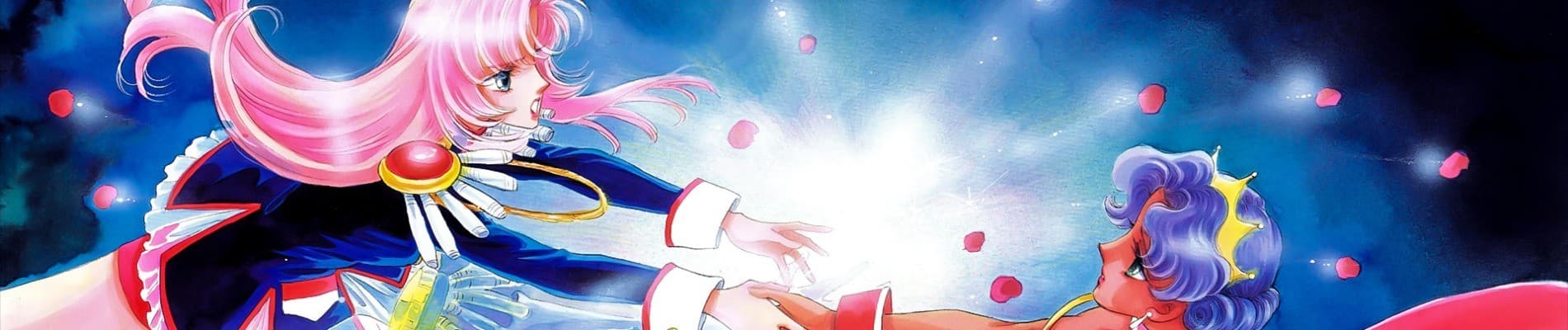
Revolutionary Girl Utena is a show that’s hard to contemplate at first. I sort of knew what to expect coming in, as I’ve watched Sarazanmai and PENGUINDRUM previously. Both highly allegorical and symbolically driven, Kunihiko Ikuhara, the creator, doesn’t really ease you into the madness and understanding of the intricacy. Here, on the other hand, it is more gradual and initially straightforward, though it does contain symbolic imagery everywhere, which will be brought to your attention, and some very subtle ones you only understand in retrospect. Once the first arc is concluded, the Black Rose saga begins, and that's where the imagery is heightened and the symbolism more obscure, and it can be easy to get lost in the weeds.
Kunihiko Ikuhara became popular during his run in Sailor Moon, directing some of the best episodes of the series and the film Sailor Moon R. So, this was his first original gig, being a part of a group called Be-Papas. That membership consisted of director Kunihiko Ikuhara, scriptwriter Youji Enokido, animator and character designer Shinya Hasegawa, planner Yuuichirou Oguro and mangaka Chiho Saitou. As a result, this series is slightly more restrained compared to the masterfully crafted and surreal anime that is PENGUINDRUM. All these factors are to say, in terms of resources, this is by far the most limited in resources. There’s an abundance of repeated animation, music cues and whatnot, but this is entirely mitigated by its deliberateness. Everything you witness is crafted for a deliberate reason. The repetition, which could have been a hindrance to a creative, became a boon here.
This is not even, it’s badly animated; it’s just limited animation. There are some truly stunning pieces of animation throughout, and those are the ones repeated. I partly wanted to watch the show because the creator is amazing, I loved PENGUINDRUM, and lastly, this was a huge influence of Ada Palmer’s science fiction series Terra Ignota. After finishing it, the influence is very apparent, especially in certain gender dynamics and characters.
One interpretation of many is that the series is about adolescence, which can be viewed by the opening quote of the student council:
“if the egg’s shell is not broken, the chick will die without being born. We are the chick. The egg is our world. If we do not break the world’s shell, we will die without being born. Break the world’s shell, to revolutionise the world!"
The quote by Hermann is (according to the penguin translation):
“The bird fights its way out of the egg. The egg is the world. Whoever wants to be born must destroy a world. The bird flies to god. The god is called Abraxas".
It’s altered to fit the context of Utena.
The series could be viewed as a deconstruction of adolescence. Utena frames it as a destruction. Your adult persona cannot coexist with your identity as a child because childhood identity is built on too many falsehoods to remain functional. The world is divided into 2 distinct periods: children and adults. The period where you have to cast off your childhood notions, and we have little choice in when that occurs; it just happens. Once you realise you made the transition, you have to adapt to the adult world for better or worse.
The title itself is a giveaway. Revolutionary Girl Utena. What sort of revolutions does Utena cause? Well, all of them, from a certain perspective. Political, social, etc. It’s hard to go into it without spoilers, especially the political change or revolution cycle, but I can comment on gender norms. Instead of being the helpless princess, she was so inspired by her noble prince, who saved her as a child, that she devoted herself to emulating that heroism by professing to the world that she would become a prince. If you have read Terra Ignota, something here would click with you: it’s that Mycroft assigns gender pronouns to people not via a biological reason, but entirely due to a social construct. Utena would be regarded as a male in Mycroft's eyes. Utena flips gender norms around, she wears boys’ attire, she’s athletic, and she has many features that one could view as masculine and less traditional femininity. That’s not to say she’s one way or another, every person is complex and she shares both masculine and feminine traits.
The series is interested in questioning the relationship between individuals and authority during adolescence, as during adolescenc,e we are more prone to manipulation and coercion, and we need to hold authority to a higher standard if they attempt to take advantage of us during this period. It’s a very introspective period of our lives, and we all face it differently.
This is just one interpretation of many. The series is also an intriguing coming-of-age, primarily for our two leads, Anthy and Utena. The series tackles dark and uncomfortable subject matters that are prevalent and horrifying to witness. It’s difficult to make heads or tails of everything, especially after finishing it only once. There is definitely some metaphysical commentary that went over my head, but beyond its immense layers, the series is a lot of fun. The art direction is simply stunning, as this was during the era of cell animation; the backgrounds are just jaw-dropping. The banter can range from hilarious to cathartic. And lastly, just cool from a magical school perspective, a girl who has to fight in duels in the highest peaks of the school for the power to revolutionise the world.
The ending was simply immaculate, without spoiling it’s just felt so fitting from what this series was communicating from its very beginning. An appropriate ending to a masterpiece of a series, and one of my favourite shows of all time now.
14 out of 16 users liked this review