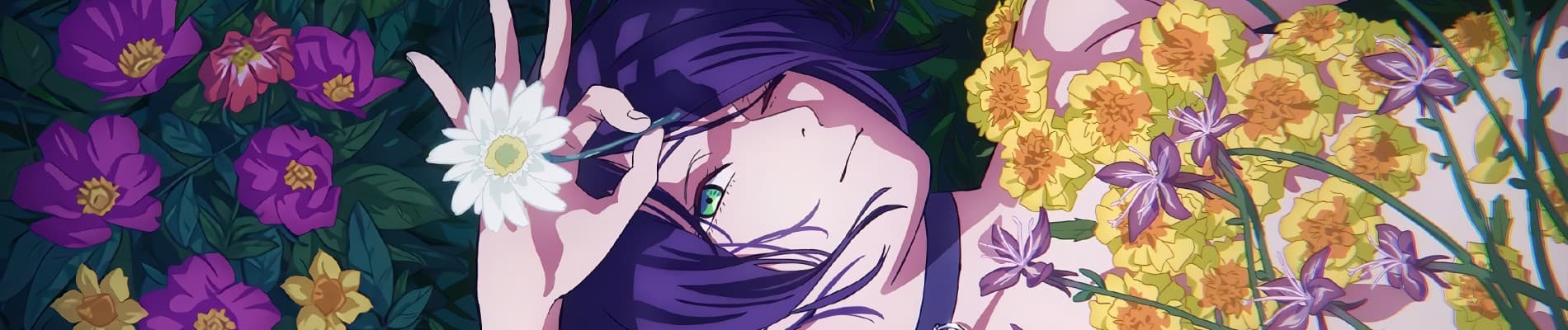
Rewatched again, now along with my fellow unemployed Discord scholars. Might just be time to stop being a lazy bum for a bit, overwork all three of the brain cells I possess and finally write something about my beloved series.
We ALL love whenever magical battle shounen series pay homage to Indiana Jones skit of bringing a gun to aura farming grounds, but I think it is a bit underappreciated how Chainsaw Man implements said energy into its narrative instead of one off sadistic gag. To build the proper Battle Shounen expectations we have the announcement that guns are banned nation-wide, as if to censor the story and give the supernatural aspects of the story breathing room without involving the real world. Except the very first arc starts with gunshots in silence, violence inflicted by the civilians.
Our boy Denji in the TV series is reborn as the main character as he inherits the fate of the hero from Pochita and thanks to the falsely promises - dictated by the government to establish the punishment/reward system where it is physically impossible to be rewarded, a perpetual motion machine - attains the grandest of the goals despite possessing the pettiest of the desires that seem to be impossible to fulfill in the increasingly neglectful and self-destructive world (that Part 2 further emphasizes). Expectations placed on children have been weaponized, hence the tools - Katana, Chainsaw, Bomb, Flamethrower and so and so forth. Almost as if the genre focused on childish innocence has been turned into propaganda for enrollment into someone else’s idea of your family. I know there a lot of people who believe CSM is not a battle shounen for whatever reason and there are also a lot of people on the other side, mocking said perspective but CSM’s premise - of forcing children into adult life when they clearly have never been guided into - is certainly compelled by such sentiments and simply would not function and would have lost quite a bit of weight and value if it was not a battle shounen manga released under Shounen Jump.
The unstoppable force that is our mascot Pochita represents the long lost pure heart of the genre that everyone seems to be seeking, which essentially means that CSM’s examination of the genre’s shortcomings comes to the conclusion that censorship and puritan way of writing grows kids distant from one another and creates hunger for intimacy. Tackles also into how labour and barely affording necessities to survive in the world prevents people to in turn afford to care about anything and anyone else in the world - becoming anti-thesis to heroism - but that is also something Part 2 delves into.
For Makima - who is an image of an ideal citizen - the distant nature is visualized by her attachment to cinema (not like there is anything else to do on weekends) - all she knows is an observation gathered off of someone else’s life. Her nature would not allow gaining experience in a more direct manner as that would be rash and ignorant, a total lack of control. That would mean that she is not fated for intimacy and since she is separated from living a real life, the only thing she is capable of doing - so as to appease her needs - is to turn the world into cinema. Hence the imagery of her being the director. However, Makima who is raised by the government is incapable of comprehending the purity of heart and her understanding of being in possession of a heart is more objective. And sinister as she may be, she is never doing anything unlawful on her own, thus battle shounen directed by her is impure, hence the subversion. Always a copy, never original. And if Makima being a person who never comes in contact and being a person who does not have a capacity to perceive by anything but smell was not telling enough, objectivity is a farce obscuring her subjective needs. Which would lead us to how she is caging the world in the Hierarchy of Needs, but that would be a tale for another time/arc/movie
How is this reflected in the Reze arc narrative? This being the only arc in which CSM proposes a dichotomy - that of city mouse or country - I think makes it more that apparent that there is no actual city life versus village life to be taken at face value like Denji does out of ignorance, but more of a sentiment and plea for help by tormented children trying to separate from themselves the devil inside them tainted by the cruelties of the world. Now the structure of the movie is sound - in the first half we are shown two separate worlds, of romance and of labour, but in the second half both of these things come together and both of them have their authenticity questioned. Being enslaved to us and hunting down your own dreams is good actually!
On top of that, the structure is set-up and resolved by Makima herself. Remembering how the movie opens after Denji’s dream, it is a scene about Denji and Makima going on a date at the movie theatre. Foundation of the scene is how Denji is someone who has never seen a movie before and Makima is someone who has seen a lot of them, assuming it is her hobby at the very least - and then there are just regular movie-goers in-between them who all enjoy movies they are watching as part of the normal life. Denji does not really react to an action fantasy movie at all, given that’s exactly what his normal life is and also looks at Makima to validate his disinterest - Makima, of course, is focused on the movie as she seeks no validation around. Continuing the scene, they are trying to discuss the quality of said movies. Makima being focused on whether directors have made the experience authentic or forceful and unnatural - in retrospect, her interest in movies can be rationalized through her ability to see through every person and their lives altogether or rather, how she is able to perceive everything wrong (a sin, if I dare to say so myself) in people she is supposed to be connected with but a movie is a movie, unknowable beyond what director offers to you, almost as if the closest thing she may be getting to average human interaction. Denji could be seen as the opposite and thus unable to comprehend the appeal of the cinema, yet. Then on the large screen comes the scene of a mother tenderly embracing her son. To me, there could not have been a better example of as grounded as possible showcase of an affection towards a hero than a soldier returning from a war and hugging his mother. As if dream is looking into the mirror of reality (and vice versa), fantasy characters that are merely playing the roles of a hero and a maternal figure despite unknowingly craving for it are looking into a grounded movie that's closer to reality than the world they are living in. Further capitalized by how all of the humans have left before this movie even started, them not being attracted to normalcy and not valuing such a movie similarly to how Makima and Denji dismissed their beloved movies - each of the ‘side’ craving for what they cannot get to indulge in.
Now seeking genuinity both in reality and art (a dream, perhaps) is quite a rich standard coming from a person who has yet to act naturally on her own. Before they enter to watch the final movie in the schedule, Makima not only mentions how people do not seem to understand this specific movie (assuming, they do not understand the appeal since affection is normal to them) but she also says that a certain rare encounter has changed her life. The significance of that line I believe is that out of control and unknowable to the government and their conditioning, watching movies is what allowed her to gain her own agency. All in all, my takeaway from the entire of this scene is that Makima reenacts all of the movies she has seen in span of this entire day as our anime movie and fixes all of their shortcomings - if she can’t feed off of the ingenuine acting done in front of the screen, than she could always feast on the genuine acting done in the real world. You are most welcome on the world stage, Reze. This particular bit has been highlighted in the anime movie adaptation by making Reze hug Denji (which does not exactly happen in the manga) akin to the movie Denji watched (“Ballad of the Soldier”). So as to say that the very first scene is how Makima successfully puts the entire movie into the framework of her making.
For heroes, there are trials
For saints, there are temptations
For Denji, there is a (bomb) devil
Above I have mentioned how the world of CSM has been built up prior to the movie not just because to give what transpired before but also because Denji’s character journey and progression continues and is overarching. If Makima gained agency by watching the highest form cinema (kino, that is), then Denji gained agency by forming relationships in the stories set-up by her. In the previous arc, Denji learns to not just instantly murderize the enemies of the government but to also get his own catharsis outside of putting them in prison by kicking their balls. In the current arc, the didactic part comes from the government dictating how to tell good and evil apart and Denji has to learn how to see past the face value. For this Denji has to overcome something that we all repeatedly fail at, the hardest challenge of them all - understanding women.
On the surface everything is simple and there is no need for a teenage boy to think, a perfect cute girl betrayed romantic ideals by committing the cardinal sin of having temperament, she now is the embodiment of evil only capable of lying as means of manipulating hearts of men and must be eradicated at once. Whenever Denji has second thoughts, everyone in the world makes sure to remind him of this very simple fact and Reze being an actual lying murderer who caved his face in is what sells both Denji and the audience on this sentiment. Beneath the surface, both “romantic” idealistic and “devil” faces have to come together and are not meant to be separated, for the true self to be seen and intimacy reached. There was buncha foreshadowing throughout the whole movie but the final reveal was the bit - that neither Denji nor Reze have ever gone to school - was meant to recontextualize the movie for the target audience. On one hand, in the same vain as Makima separates cruelties of the world from herself via movies, we have a girl who is putting on a facade - that separates her own ideal self from her shortcomings, deemed by someone else - to be able to live her idea life that world never allowed, so the feelings put into the facade were all genuine. On the other hand, we have her devil form that purely reflects the emotional state that she has been suppressing all her life to separate it from herself - so whenever we see her not smiling in her human form, these are all her attempts of suppressing feelings. As in, her emotions are like a ticking bomb about to explode to vent her frustrations against the world on dumb as brick Denji. The way she dresses, the way she behaves, the way she speaks all facilitate the idea. In terms of looks, her dress still showcases vulnerability the way she is open and half-naked and yet her head is entirely a bomb about to go off and the fact that there is no face and no facial expressions further emphasizes the dehumanization of women (moreso in the manga, but still functions perfectly fine in the anime form). In terms of behaviour, in spite of her abilities logically physically damaging her a lot, we never actually see that emotionally reflected even spontaneously on her body language and instead we see how she treats her own body as a toy - emphasizing her detachment from who she is, but is in stark contrast to who she wants to be if we start seeing her behaviour to charm Denji as her trying build manic pixie dream girl toy out of herself via a bit over-the-top and body language and general self-expression. In terms of voice acting, she constantly talks in the playfully mocking manner to further emphasize the sensitivity, which is something I came to appreciate only thanks to the anime because I never interpreted and imagined as such while reading the arc in the mute medium that is manga. And funnily enough Denji does not recognize the evil when it comes to cute girls, visual cue for this characteristic comes way later in the manga where he is remembering Reze but fails to remember her having a choker, which also compels her character design.
I also wanted to take notice of the clever foreshadowing done in the first half purely off of body language, way of speaking and sound effects, subtextually. The scene I am referring to is where Reze murders the american psycho in cold-blood, singing some sort of lullaby to put the killer to eternal sleep. If seen on the face value, as I have already mentioned above, this is obviously a reveal that Reze is just another random villain hunting Denji’s hurt down, yet again Makima’s narrative deceiving the viewer. Beneath the surface, her song communicates her feelings and wish for romance, but her singing in Russian means that the song is not expected to be understood, just like how neither Denji nor the target audience is supposed to recognize her as anything but evil incarnate. There is also how Makima is actually syncing her cup of coffee with the rhythm of the song, implying how she is aware of everything that is going on in the movie and how the entire environment is under her surveillance. Finally, we also have visual imagery of an airplane and rain accompanied by the sound effects most similar to that of falling bombs. Coming together, the scene has communicated to the viewer how Reze has received the grim reminder of who she actually is and how her hand is forced to reveal her true self to Denji and how her dream life cannot be maintained any longer. I daresay that her singing the killer to sleep as rain drops exactly on her eye can be interpreted as her deluding herself and putting her killer nature to sleep, just to delay the inevitable as long as possible, even if just for a bit. Could totally be a stretch, but allow it. It is pretty funny that her Russian is not very good and pales in comparison to her Japanese though lmao.
Either way, we have all the ingredients for the horror flick to be sure, but we are missing something. After all, we are watching action horror, my favourite genre of them all. The main essence of action as a genre is not choreography and explosions, but what they expose within the stake. The main ingredient lacking is the moment of truth. One layer of Reze’s design I have left out above is how she is applying herself to being a bomb (because of course she does) to utilize her powers for whatever he needs. Another layer that I forgot was in the story and I will pretend I conveniently left out is swimming. Basically, if Denji learned to apply himself to the devilish powers from Reze, she in turn learned to let go of her devilish nature from him considering she is literally and figuratively completely naked and vulnerable in the pool. Needless to say, the relationship on equal grounds has been realized, leading to both of them fully expressing themselves in combat, turning venting of frustrations into Looney Tunes a$$ giggling. I am not very sure how Denji's very much unfortunate body manages to tank being turned into Christmas fireworks and how Reze wears her demonic dress intact after using every bit of it as fireworks ammunition, don’t ask.
The movie also looks and sounds great to the most part. I feel like the frequent use of piano is a bit too sappy considering I was not really invested in the story in that sob story manner, but it is over-compensated by the over-abundance of motifs and thoughtfully synchronised soundtracks that more often than not managed uplift the bombastic nature of the action set-pieces and tender night dates. Truth be told, animation could have been a bit better in some of the sections (like police ride and how Makima gets summoned), but the love is meant to be unconditional and all, ya’know… and it would be a lie to say I don’t have half of the movie cut into clips that I put on repeat just to feel something. There were also a bunch of visual cues and symbolism in the movie that are nowhere to be found in the manga and are the most welcome additions - surprisingly, the most climactic spectacle in its entirety simply does not exist in the manga.
There are also some interesting things to talk about in the movie that enrich the narrative, such as how Angel switches his label of an angel and of a demon to separate one from another at convenience, but they are about men and I could not care less about these creatures.
49 out of 56 users liked this review