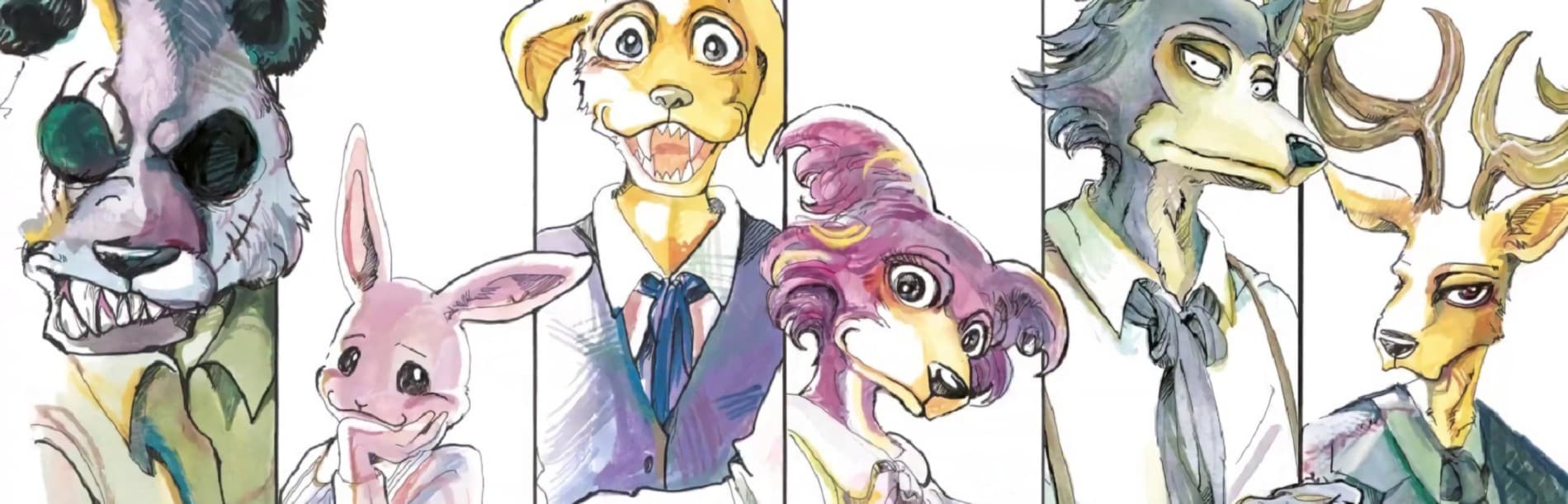
Beastars is a lot deeper than oppression, I guess it’s much more apt to call it a story of repression, but that’s not particularly right either. Society is divided along the lines of Carnivores and Herbivores; you would think in such a scenario it would be them at each-others’ teeth. In real life such is the case in the Animal Kingdom: Plant drink Sun, Rabbit eat Plant, Fox eat Rabbit, Wolf eat Fox. Simple stuff.
In a savage and untamed lifestyle, the above is accepted as fact—cold and dispassionate as it may be—and though we all know love always wins, your will to live unfortunately breaks love’s knee-caps in the back of an alleyway any-day of the week. In a sentient mind though, there’s a little more to it; love actually might have a fighting chance in there. Rats and Cats might not wait for women and children in a sinking ship, (maybe dogs might,) but Humans have their humanity; real messy things like morals and codes of honor and sentimentality tend to make people prioritize what they believe to be the “right thing to do” at their own peril. Civilization—and by extension society—for all it’s merits and great works, is akin to a rug over a swamp, or a house on shaky ground. It’s built upon tolerated evils, and may oftentimes work against the individual and his nature. This is exactly what Beastars attempts to place on full display in it’s story.
We assume the perspective of a sensitive young man in a not-so-sensitive place in society, the role of the Carnivore: a permanent wildcard kept constantly in check by his peers, suspect number one by the police, and permanently faced with a mire of self doubt, he holds his own Sword of Damocles over his own head. Everyone, and even himself, believes that one day he will snap, eventually giving into his base and lowly desires to eat a fellow member of his neighborhood, whereupon he will be stripped of all his rights and permanently cordoned away from polite society. Carnivores are the ones subjected to random searches, segregated housing, state-mandated pills and injections, and so on. Normally, you’d think the Herbivores would be on the back-foot, but in the case of civilization it rings much more true that the means of power have been taken from the physically strong and given to the conniving. Even in real life, much of what we consider to be the “Upper Echelon” are pudgy and doughy than they are Barbarians and Warlords. Rather Prey than Predator. (Preying on Children notwithstanding.) Herbivores are essentially the untouchable class, they get more accommodations, typically live in better neighborhoods, are passed over by the authorities and instead offered greater protection. Herbivores may seem enviable, but they lack the means to protect themselves. When the light of civility no longer casts it’s beam upon them will they be plunged into a darkness where ne’er-do-wells may take their lives. In essence they are reliant, in every sense of the word.
Beastars in my humble opinion highlights the inner struggle of civilized man against his ideals and his realities. Their world is inherently topsy-turvy, yet they carry about as if it were the most normal thing alive. It’s easy to make fun of it, but much of how their society carries itself very much mirrors our own, just in a more hyperbolic way. We, like they with the carnivores, repress the “Men of Yesterday,” those barbarians who rely on strength and machismo—who would cannibalize their kin to exert their will upon the masses, to uplift the “Man of Today,” who is more feminine and demure, who follows orders and keeps their head down low to stay in the good graces of the wider population—an individual ruled by the majority, and not the majority led by the individual.
Legosi, whom in his trials and tribulations he comes into contact with a diverse cast of characters who never once have predictable moments. No character is without flaw, in fact I’d argue most of them are pretty gross. Throughout his story, he internalizes his suffering, and sits with it to almost suicidal degrees, but the closer he draws to despair, he begins to resist this dichotomy he finds himself presented in order to find the synthesis between carnivore and herbivore—"The Man of Tomorrow." If only to fulfill a love he knows in his mind is impossible, but in his heart desperately tries to make true. It’s very profound, and not once does it ever throw him a bone and make him (and you, by extension) feel-good for free. He must stare cold reality in the eyes day after day, and still gather the strength to gnash his teeth, clutch at the temples of his head, and accept what is before him. Despite how insane the odds may be against him, he still finds hope, an indomitable man of calm within the tempest of the scared, meek boy.
I really like the book. I’ve read it months ago and kept coming back thinking about it.
So that basically means it’s a 9.
Written 1/17/2026, 2:53 A.M.
33.5 out of 36 users liked this review
