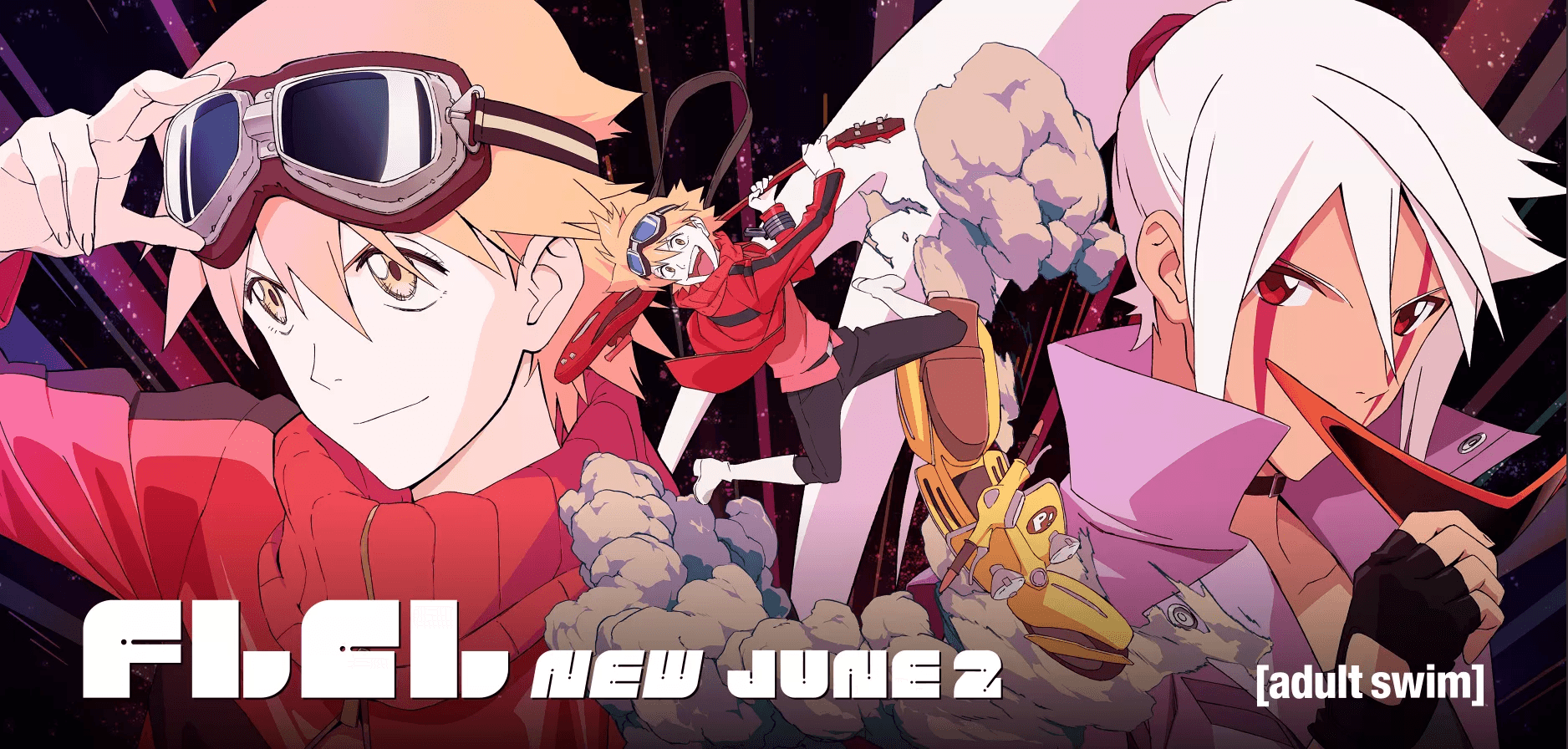
FLCL Progressive
a review by Grassman
a review by Grassman
FLCL Progressive follows our main character, Hidomi Hibajiri, a teenager with identity and family issues. Much like the original, her encounter with Haruko Haruhara (and her alter ego Jinyu) begins the events of the series. She discovers a hidden power inside of her, one sought by Haruko to retrieve Atomsk, but also one feared by Medical Mechanica. Throughout the series Hidomi's creates new relationships with her classmates, Ide, Haruko (and Jinyu), and rebuilds her relationship with her mother. Its these newly founded human connections that support Hidomi into becoming her true self by the end of episode 6.
Alongside our main protagonists there are plenty of interesting, although short, side plots. The story of Aiko and Bureau of Interstellar Immigration being my favorite.

The plot of Progressive follows a similar structure to that of the original. Medical Mechanica, the Bureau of Interstellar Immigration, and the appearance of Haruko are all similar to FLCL. However, Progressive doesn't bind itself to the original and tries to be best it can, without relying on nostalgia.
Progressive tries to build upon on the world set by the original and present its characters from a different perspective. Our main protagonist, Hidomi, differs from Naota. Even though they are both growing teenagers with issues, whereas Naota felt overshadowed by his brother and had an inferiority complex because of it, Hidomi has different problems. The departure of a family member (her father) had a different effect on her compared to that of Naota. She became depressed and kinda messed up, as visualized in her twisted nightmares. It is hinted at that she feels pleasure from violence. At the start of the series Hidomi is very stoic, she doesn't care much about anything, and constantly blocks herself from others. The headphones symbolizing the rift she has created between the world and herself. In the same way her mother decided to stay in the cafe, her life has become stagnant. However, by the end she is a new person, she "swings the bat". One willing to fight Haruko to save Ide because he is important to her. She finds a new purpose in living in the cafe with her mother as well, she will do it for herself and not because of her father.
Haruko receives the most development out of everyone and is an interesting change from the original. We get a deeper understanding into the psyche of her being. Jinyu being the "adult" side of her, a more reasonable one. Haruko without Jinyu acts selfishly (even more than before) and is more of an antagonistic force than the Haruko we knew from FLCL. She is obsessed with chasing Atomsk, speaking of which, we finally know more of. He appears to have some kind of feelings for Haruko, but prefers to not be caged. This duality in character presents interesting themes about the meaning of being an adult. It would seem that Jinyu and Haruko are opponents, but are actually complementary to each other. It is okay to act childish and be weird, but we should accept the bittersweet reality that is growing up.
The supporting cast for Progressive was rather lackluster and underdeveloped. Ide's school friends are generic and not important at all to the overall plot. Aiko and her father, Masurao, had an interesting arc but was undermined by the lack of development. With Aiko being a weapon that was meant to be used by the Bureau of Interstellar Immigration (which her father is secretly part of) she had been trying to gather money to run away from her father. However, unbeknownst to Aiko, her father did not want to do it and ultimately refused; because even if they had a distant relationship she is her daughter. Aiko forgives her father and decides to activate the flowerpot (the weapon) consequently saving the city. In true FLCL spirit, the bizarre act of destroying a giant iron taught Aiko to love her father again. This coupled with the plan of weaponizing an amusement park by Masurao, Eye Patch and Tonkichi, makes a very creative and interesting story. The symbolism of an amusement park (representative of fun), powered by teenagers troubled by puberty, fighting off the symbol of monotony and the adult world, Medical Mechanica, is very unique. However, both of these lack build up. These two appear right at the end of the series and feels rushed. Progressive has a much slower pace than the original, not that this is a problem, but it became one when it restrained itself by making the series six episodes long. Maybe if the creators removed some of the filler in the first three episodes it could have been more rewarding.
I should warn you that the first three episodes of the series feel slow for a FLCL series, but the second half is fascinating.
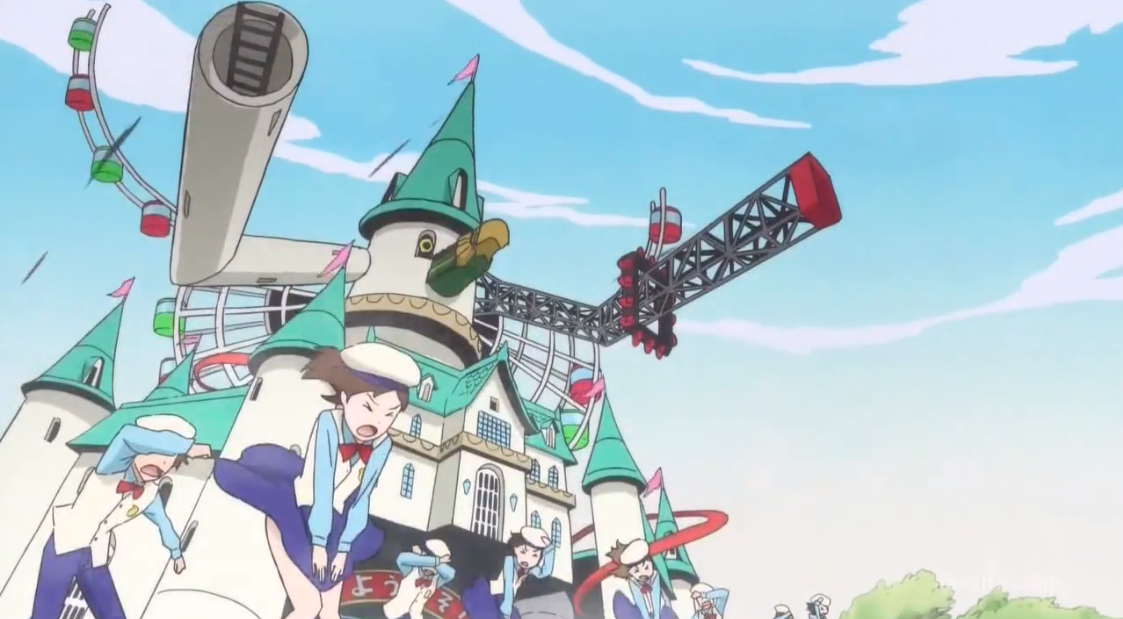 > "We've got to do it, no matter what. We will show them, even if our wrinkles get flattened, we will fight to the very end" (The wrinkles in our brain are a Japanese symbol of wisdom)
Animation and sound are very important to FLCL, it is what it means to be FLCL, its unrivaled experimental style. The series utilizes songs from the original FLCL, which could be seen as fan service, but I think its necessary to pay homage to the original when creating a sequel with high expectations. In addition, there are a few new songs by The Pillows added to the OST. My favorite ones being The Third Eye and Thank You, My Twilight. The soundtrack, as expected, was excellent. However, it was not utilized at its full potential. It felt kinda average, and not as bombastic as in FLCL. I would have liked better sound editing.
Visually speaking, FLCL Progressive is experimental and stylish. With episode 5 being the best out of all since its animated in various styles usually not seen in anime. It is mesmerizing what they did with it. Throughout the whole series, no matter how crazy it gets, the animation is beautiful and fluid (and sometimes abstract). However all of this was expected and it would have been an insult to the original if it didn't. What disappointed me was that it felt simple compared to the original. I am not undermining the work the animators did, but it should have tried to be even more crazy.

The series has many problems. Including uninteresting or undeveloped side characters, slow pacing, misuse of an excellent soundtrack, and a more passive animation style than the original. Compared to the original, Progressive is a more superficial take on the franchise that prioritizes developing a nonsensical world (that really shouldn't be getting this complicated), instead of focusing on the deeper themes, and the characters and their development. It is impossible to not compare Progressive to the original, but it should be praised for its merits. Even if the series isn't as impressive as the original (which to be honest is very hard to equalize) it is still an interesting take on the series. I suggest you to watch this, even if you have not watched the original (which you should watch too), because it is still a fantastic series.
16 out of 18 users liked this review
