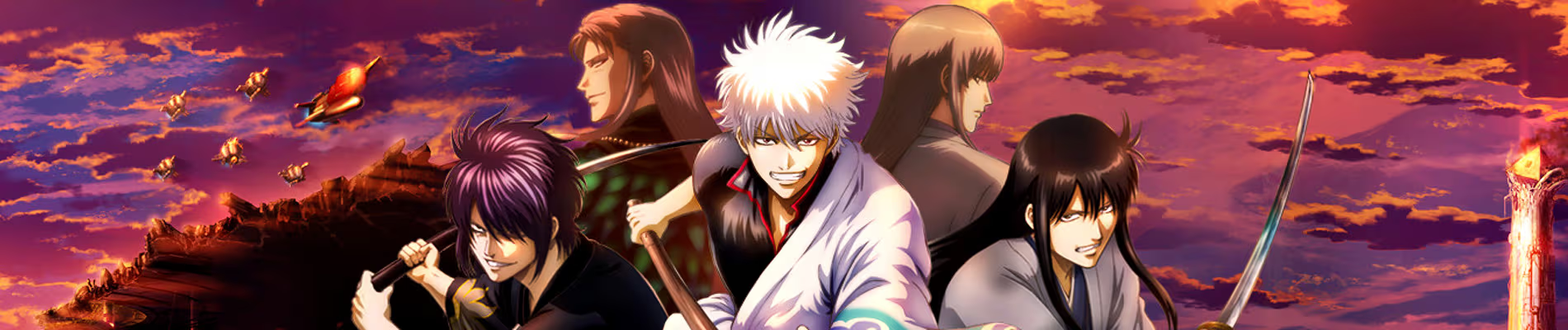
Gintama: The Final is such an ending that it becomes almost surreal when you finally sit down to watch it. Years after the episodes’ arcs, jokes, and emotional gut punches, it’s not easy to believe that this is where everything truly comes to an end. It feels like the film’s foray into seriousness is hesitant, as Gintama has always thrived on its riotous and unpredictable nature. However, the film successfully unites all of this in a natural, heartwarming, and well-deserved manner.
One of the greatest strengths of the movie is its ability to set the tone that characterizes Gintama so easily. The film makes no shame in being dumb, loud, and self-conscious until the very end. The comedy is effective because it recognizes that humor has always been the coping mechanism of these characters, as well as the audience. On the other hand, when it comes to getting serious, the shift doesn’t seem forced. The emotional scenes hit even better because they are surrounded by laughter, making the contrast genuine instead of forced.
Gintoki is undoubtedly the emotional core of the narrative. This movie seems like the culmination of his long journey to come to terms with his past and decide how he will lead his life in the future. His hardships are not described with exaggerated speeches or dramatic monologues but with intimate, small moments that convey more than any words. It’s very satisfying to see him confront the burden he carries, especially for long-time fans who have witnessed all the facets of his personality gradually unraveling over the years.
The supporting characters are treated with great care. Characters that might have been easily condensed into a reused technique or mere fanservice seem to be integral members of the finale. All of them also receive time to showcase their development and their attachment to Gintoki and to one another. This supports the idea that Gintama was never about a single character but about a family of people who helped each other find family in the chaotic and uncertain world.
Visually, Gintama The Final is a significant improvement over the TV series. The animation is more lifelike, the action is less aggressive, and the entire show feels like a movie without losing its essence. The battles are intense, but what truly lingers in the memory is the passion involved in each confrontation. Each battle offers a sense of history and closure, adding weight to the action beyond mere spectacle.
The only notable difference in this movie is its approach to the concept of an ending. Gintama doesn’t try to be overly explicit about its themes or make its farewell feel forced due to tears. It doesn’t need to explain to the audience what the characters are saying or why this goodbye is significant. The final scenes are silent and reflective, yet strangely warm, leaving you with a feeling of closure rather than emptiness.
When the credits roll, Gintama The Final doesn’t feel like the end of an anime; it feels like the farewell of something that has been a part of your life for too long. It retains the comic, heartfelt, slapstick, and earnest nature of Gintama. That’s the only reason why it’s memorable it honors its characters, its story, and its fans.
40.5 out of 41 users liked this review