Cowboy Bebop
a review by Durdio
a review by Durdio
I have never been so disappointed by an anime. Based on everything I had heard, I went in expecting one of the greatest pieces of fiction ever made. What I found instead was something that never came close to those expectations.
In my opinion, Cowboy Bebop suffers from two major flaws: the plot goes nowhere for most of its runtime, and the characters are shallow and poorly developed.
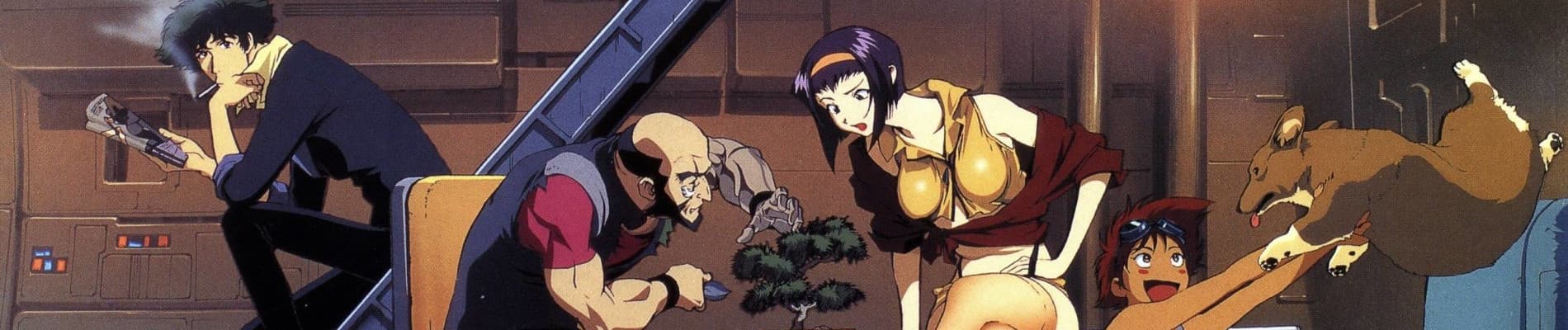
One of the biggest problems is how badly balanced the main cast is. Three out of the four core characters are variations of the same archetype: the mysterious, silent, “cool” type who barely talks. There is no truly charismatic character to break the silences or generate engaging dialogue. This issue is partially addressed with the introduction of Ed, but he has so little relevance and appears in so few episodes that he ends up feeling almost pointless as a character.
This is a flaw that even Shin’ichirō Watanabe himself seems to have recognized, as he clearly fixed it in Samurai Champloo, where Mugen actively complements Jin. In Cowboy Bebop, however, we essentially have three “Jins” sharing the same ship.
I could probably overlook this if the characters themselves were compelling. If they had internal conflicts, meaningful development, or real complexity, I might even love them. But they don’t. Each character gets a backstory, and that’s essentially it. There is no real evolution, and their relationships barely develop because they keep everything secret from one another.
Because of this, the moment when the anime tries to portray the ship as feeling empty after Ed and Faye leave feels completely unearned. The group had very few meaningful interactions, and the dynamic between them was never properly built in the first place.
Even with weak characters, a strong plot could have carried the show. Unfortunately, Cowboy Bebop doesn’t offer that either. Most episodes are entirely self-contained and contribute neither to character development nor to an overarching narrative.
In fact, there is barely any plot at all until the final four episodes, when Spike suddenly decides to go die. There is no sense of progression throughout the series: the crew doesn’t grow closer, doesn’t evolve, and doesn’t even improve their situation financially. Everything resets constantly, making the journey feel stagnant.
One of the most frustrating aspects of Cowboy Bebop is how often it confuses melancholy with depth. The show is drenched in sadness, loneliness, and a sense of emotional emptiness, but that alone does not make it profound. Mood is not substance.
The anime constantly feels deep, but when you actually look for ideas, character exploration, or thematic development, there is very little to engage with. The sadness is there, but it is rarely interrogated or expanded upon in a meaningful way. As a result, the series ends up relying on vibes and atmosphere instead of actual writing depth.
This problem becomes especially clear in the ending. The finale clearly aims to be tragic and cathartic, but it is not emotionally earned. Spike’s final confrontation is framed as the inevitable conclusion of a long, painful journey. But that journey was barely shown.
The death of Spike’s lover, in particular, barely had any emotional impact on me. She is introduced so late into the story that there is simply not enough time to care. The anime expects the viewer to feel the weight of a loss that was never properly built up, which makes the tragedy feel hollow rather than devastating.
The music and visuals are undeniably excellent. The jazz soundtrack and the clean aesthetic are memorable. However, they were not enough to stop me from feeling bored for most of the series.
What frustrates me the most is the contrast between presentation and substance. Cowboy Bebop looks, sounds, and presents itself like a deep, mature, sophisticated story. But beneath that stylish surface, the writing feels extremely simple, often no more complex than your average basic shōnen.
This is where expectations become a serious issue. If Cowboy Bebop were sold simply as a stylish, episodic anime meant to entertain you for 20 minutes at a time, I might have enjoyed it more. But it is constantly treated as a profound masterpiece, and when you approach it with that mindset, the lack of depth becomes impossible to ignore. The result is a show that feels pretentious rather than meaningful.
At some point, I heard an interpretation that almost convinced me. The idea was that Cowboy Bebop is not the main story, but what happens after the real story has already ended; that Spike is, in a sense, already dead, and that the lack of development is intentional because the characters have already lived their lives.
At first, this explanation made me think that maybe Cowboy Bebop was actually exploring a concept I simply hadn’t connected with. But then I realized that there is an anime that literally uses this exact concept, and yet it does not prevent it from delivering strong character development or a meaningful, well-constructed narrative.
That anime is Frieren.
Frieren is also a story that takes place after the “main adventure” is over, but it still manages to deeply explore its characters, their regrets, their growth, and the passage of time in a way that is emotionally resonant and narratively rich. The concept itself is not the problem; Cowboy Bebop simply fails to do anything substantial with it.
The thing with all of this is that, I love slow stories, I am supposed to be the target audience. Slow burners are some of my favourite stories of all time, but the thing is that slow stories must have substance, and Cowboy Bebop just didn't have any.
To end on a somewhat positive note, I did genuinely enjoy episode 8. It’s one of the few episodes with a solid standalone plot, and it gave me hope that the episodic structure might at least lead to consistently strong individual stories. Sadly, that promise is rarely fulfilled afterward.
51 out of 82 users liked this review
