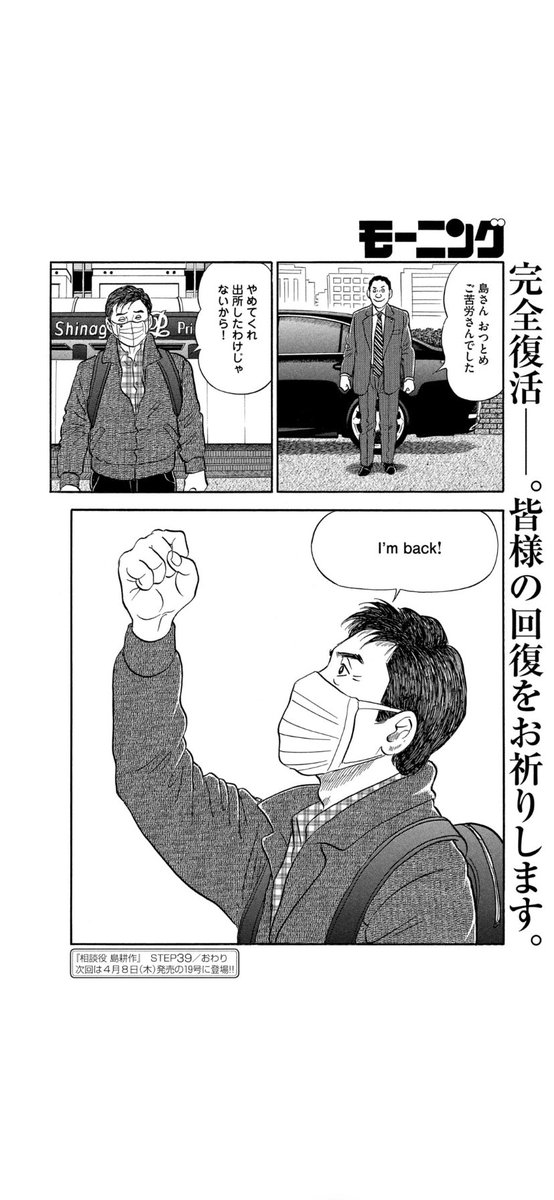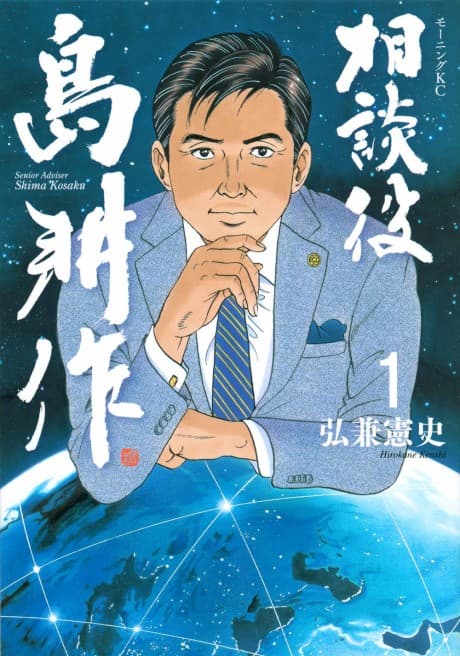

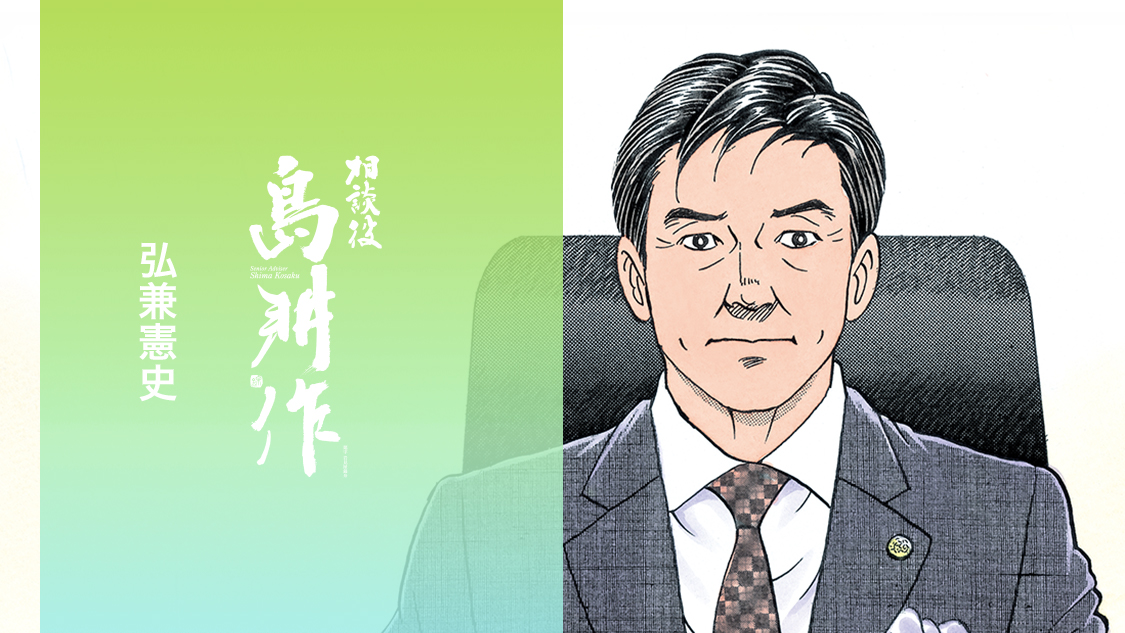
Advisor Shima Kosaku is a seinen by Kenshi Hirokane serialized between 2019 and 2022. It depicts the soft retirement of the title character after more than 40 years in the company.
The Transition to Advisor
This chapter of Shima’s life is markedly less intense than previous iterations. In earlier series, Shima was frequently depicted breaking a heart every other chapter and fighting the mafia all the while swimming with sharks (at one point literally) in the cutthroat waters of global business. As an advisor, his role is more observational. The stakes feel lower, the travel is less frequent, the sex is gone, and the stories are simpler.
It is a series clearly intended for long-time readers who enjoy revisiting old friends and familiar Tokyo landscapes.
More than an essay on Japanese business, though, Shima Kosaku has become for me a depiction of the passing of time.
Themes
Corporate Identity and the Salaryman Psyche
The series has long been promoted as a guide to understanding the Japanese corporate and political machine. While I recommend texts like The Enigma of Japanese Power for a more structured critique of these systems, this manga provides an introductory look at the salaryman psyche. I think a meaningful review of Shima Kosaku is a review of how it has portrayed Japan throughout its serialization from 1983 till today.
A recurring theme throughout the volumes is the total lack of identity outside of the workplace. This is underscored by the tragic frequency of characters who commit suicide after losing their jobs.
In this context, the arc of the (first) female President is a refreshing departure. She, Renko Kazahana, is the first boss in the series who possesses a genuine life outside of the office. Although the narrative subjects her to humiliation and depicts her as more emotional than her male counterparts, her ending is dignified. She chooses to leave the stress of corporate leadership to pursue music in the countryside, rejecting the narrow choice between being a corporate drone or a housewife.
Suggested watch: The Dark Reality of Japan's Salarymen
Evolution of Social Representation
I am happy to see flashes of feminism in what has otherwise been a story of businessmen and the women who fall in love with them. However, I don’t remember a single businesswoman being invited to a round of golf yet. In Japan, a lot of agreements are verbally agreed before the actual meetings begin. Golf clubs are where some of those discussions take place.
Therefore, women not being invited to these spaces is significant, more so considering LDP leader Nikai’s public comments that women shall be invited to policy business meetings as long as they do not speak. This was 2021. Real-life Japan now has its first female prime minister, though a far-right revisionist at that.
The series also emphasizes that the female leadership roles were not mere tokens; when considering a successor, the characters acknowledge that the previous leader’s flaws were a result of her relative inexperience at age forty rather than her gender.
This installment also shows a surprising evolution in its handling of LGBTQ+ representation. The series has moved from concerns about catching AIDS in the streets of California (Section Chief) to featuring several gay characters who participate in business discussions where their sexual orientation is not relevant to the plot.
Cruiously, the characters drink at the Quine Guine bar again, which is a real bar in Shinjuku.
The narrative even explores the legal hurdles of LGBTQ+ family building in Japan, such as the inability to marry or adopt. This progressive shift is mirrored in the development of the character often referred to as the "fat woman", Moe/Boen. Her journey from a closed-minded family in China to a life with the gay/bisexual Mr. Mishiro is handled with more care than many of the business subplots.
Geopolitical Friction and Propaganda
There is a significant amount of content dedicated to the Senkaku Islands and national security-backed mergers and acquisitions. Plots related to these islands already appeared in previous series. They were the plot device that bridged the gap between Shima/Tecot and the Japanese Diet, who is now a recurring cast.
Chapter 59 stands out as a particularly messy moment in the editing process, functioning more as a data dump or propaganda meant to alert citizens to the tensions between China and Taiwan. The discussion of Article 9 and collective self-defense feels more like a lecture than a narrative.
Looking also at the few chapters that see Shima catch COVID and quarantine in a hotel, I suspect at this point that the author and editors of this manga must have frequent nomikais (afterwork drinking) with diet members.
Writing - Shima’s Plot Armor Forever
Shima himself continues to benefit a lot from plot armor.
Business across countries and cultures often bring up stalemate situations where the actors navigate a line between what´s wrong and what´s good for their business. I suspect Shima is likely perceived as a stoic guy with firm values and a good moral compass by the audience.
However, he has never had to stand up for anything he believed in. He does cry about these things sometimes, but he does not fight. Colleagues, romantic partners or even mafia bosses do that for him, sometimes sacrificing themselves for the Company.
His motto is to avoid conflict, a quality attributed to Japanese people that a lot of Westerns find disappointing.
During his Section or Division Chief, he did manage a group of employees that reprimanded him when a music band that Shima invited to Japan got drunk and groped women (of course, they are gaijins after all) and he did nothing about it. The same Shima who in the Job-Hunting series did not stop for a second to consider that what his fellow classmates were protesting for had anything to do with him. Some time after that Division Chief incident, the colleague left Hatsushiba to start his own startup, no other character really brought it up again.
In the story, Shima is now sometimes called a "top star in the world of finances". It is frustrating that so much of his sucess is due to him just moving by inertia rather than principle.
Going back to Renko for a second, I was happy that she refused to mix her private life with business, refusing to perform jazz privately for a major shareholder in exchange for his support. This contrasts a bit with the typical situations where Shima´s private favors "unexpectedly" return to him in the form of business favor to his surprise.
Art
Shima Kosaku´s art is very neutral, safe and cozy. I don´t think there is much to say here. It does not feel unique, and most manga readers will not know who drew this manga. It is a style in the limbo between late gekiga and modern realism.
Whatever the case, he found his style, and has been steadily publishing both Shima Kosaku and Like Shooting Stars in the Twilight monthly since the early 90s, in addition to other long series. Mr. Hirokane is now 78 years old.
Ever since President, there has been a noticeable drop in quality. It looks like the artist is trying out digital tools here and there, and some city landscapes seem to be straight up photos that were scanned and redrawn on. Particularly, the architecture and interior design of Tecot offices are sometimes no more than a handful of straight lines and a lot of white space.
Nevertheless, whenever the story returns to the Ginza nightlife or the golf courses, you can tell the author is enjoying himself with the details. This is Shima Kosaku for me.
What has not changed, though, is the playfulness with which the author uses his backgrounds during long business or political discussions. He uses these panels creatively, depicting elements that mirror the dialogue or the thoughts of a character. These are typically things like sushi dishes, the outcome of good or bad golf shots, or animals. For example, a group of Japanese carps (koi) are drawn while a character discusses ex-PM Koizumi´s policies. I am sure there are plenty of other references I do not catch, but the ones I do, they make me smile.
Funny moments also include Moe and Toshihiko discussing the style in which they themselves are drawn by the author. This is the second time a character breaks the fourth wall, if I remember correctly.
Yet the most memorable scene is in chapter 26, when Shima reunites with his mentors and reflects on his life; his place in the world, his friends that are still here and his friends that passed away.
Final thoughts
Ultimately, Advisor Shima Kosaku is both a business manual and a living time capsule. It is a comfort manga for the salaryman generation who see their dreams and fears in Shima. It is a beautiful, relaxed read that continues to entertain and teach, offering a nostalgic payoff for committed readers as it revisits old characters.