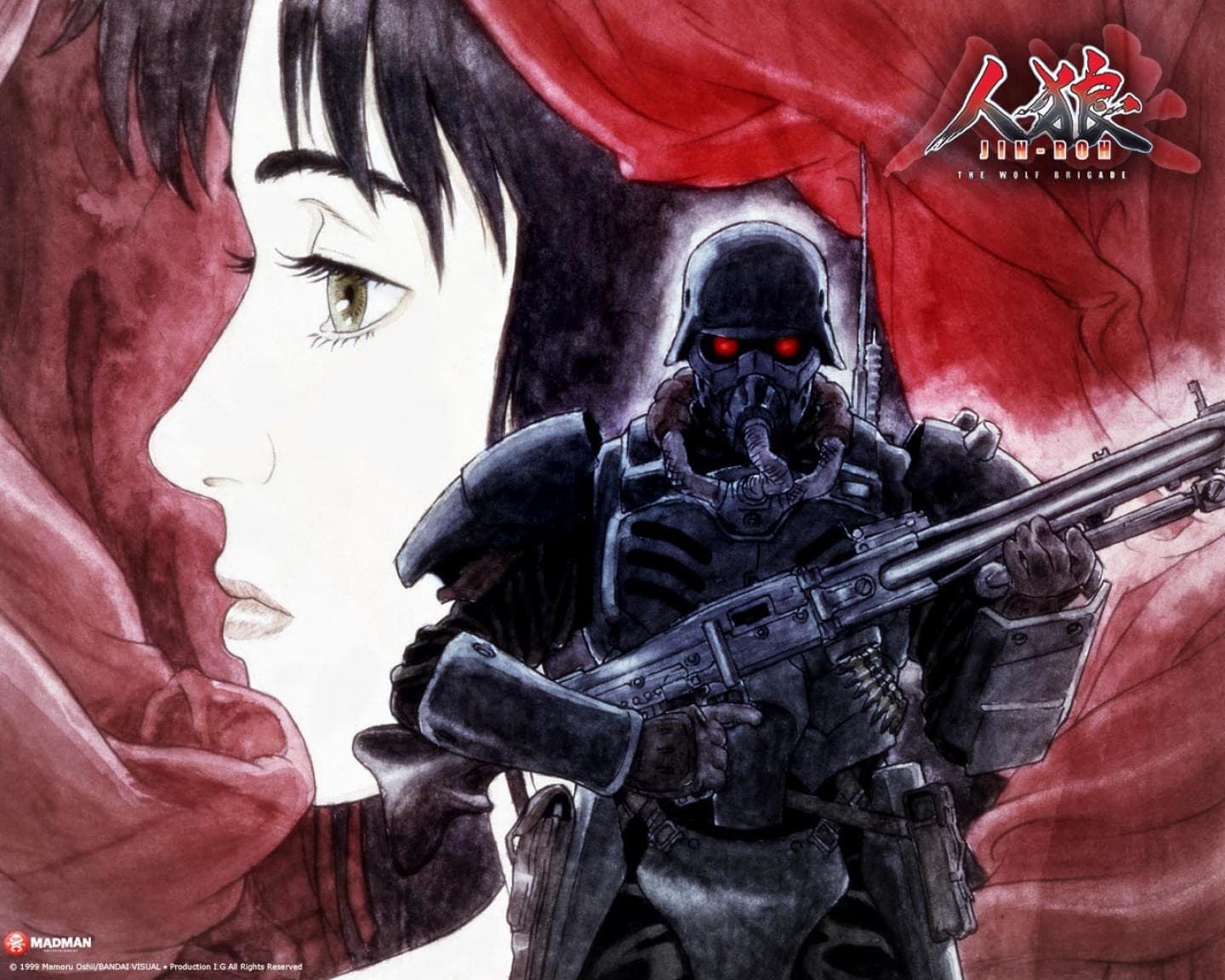
JIN-ROH
6.5/10
BONJOUR! HELLO! GUTEN TAG! Dear readers, today allow me to present JIN-ROH: The Wolf Brigade, a work dating from the year 2000, produced by Production I.G and, moreover, whose original creation belongs to Mamoru Oshii, to whom we owe various animated productions such as Ghost in the Shell, among others.
The work takes place in a universe where the government displays a harsh and brutal authority following its downfall during its perdition caused by the defeat of the Second World War, leaving no room for any possibility of glimpsing the concept, so trivial nowadays, that freedom seems to be.
Society is thus built through the repression of its uprising and the amputation of its expression in order to contain the rupture that may arise at any moment. It is then that factions come to position themselves and define their status: on one side, we therefore have the formulation of what represents the relentless drive of rebellion growing within this tyranny, bearing the name of the Sect; and on the other side, a group of assailants that emerged in order to apply the severity considered necessary to safeguard the state, as it is expressed at this moment, known as the Panzer Unit.
To refine this context, we follow a member of this unit named Kazuki Fuse, who, during a mission to reduce the tensions present in the environment, will come to bear the burden of a death that will gradually gnaw at his being and his condition within his role for the government.
The work begins at full speed; it grabs us, tears us away, and guns us down with its brutality and violence in order to highlight the difficulty of granting even a shred of humanity in this country eaten away by the sufferings of its past downfall. The depicted universe is deeply shaken, unreceptive to prosperity, and conditions itself day after day in despair, despite the absence of any viable and peaceful solution to rebuild its former glory. Its paranoia is felt at every street corner; global discontent is an almost overly perfect norm, a feeling of no longer being able to face the choices that must be applied but whose possibility is granted only to a small handful of the privileged. Injustice takes shape, characterizes itself, materializes itself, and contributes to the endless cycle of a life strewn with a sharp and burning scent of hatred, and it is within all this simulacrum that Kazuki, the protagonist of this dramatic story, intervenes.
This character is what one might describe as very emotional in relation to the framework in which he exists. His respect for his duties makes him one of the most capable individuals to operate in this environment, but through repeated success it is his mind that is gradually amputated by his malaise, leading him to fail during the most fateful moments of his assignments. Kazuki is a solitary, taciturn, and particularly unexpressive man in ordinary times, to the point that he recalls, through their similarities, the animal that is the wolf and the various annotations that demonstrate his daily life: that of a being trained deep within himself for a survival centered on his own person. The man presented to us is afflicted by his double identity and becomes entangled in an affair of conspiracy for the preservation of the status quo, which will illustrate the intertwining of a bond governed by sadness and a sinuous meaning to the offense of betraying the nature of one’s being through disillusionment.
The work overlays itself with an interesting immaturity that will assert itself through a cryptic staging, certainly, but clearly filled with a mystification of the development required for the creation of a relationship between two beings and the deductions that arise concerning the possible chance—or lack thereof—of it. This visual finesse is incredibly enticing, but when aligned with its scenario, it is from the following stage that a sense of desolation becomes foreseeable regarding the establishment of simplicity through an overdose of the same philosophy of self-questioning, which will fail to extrapolate its ideas beyond its narrative base and will thus partially destroy the chances of glimpsing the magnificence of this fiction through its themes and their representations.
The story is far too focused on its manner of intervention through its graphic direction and struggles to give life to its essence. The characters lack attention and, so to speak, move by default for the work rather than by their own nature. The plot is present but justifies no more than its simple existence, and finally, the treatments leave no room for any real specificity in our questioning of what is presented to us, including the whole of such a cathartic society.
Despite everything, the work is very expressive. Its flaws are frustrating throughout its progression, but its messages are strong, and the strength of its critique makes them valuable elements for the conclusion of our perception of it. Freedom cannot be accepted unless there is a serious thirst for its availability; conversely, if its existence cannot be invited, does that justify disdain for cooperation and solidarity in favor of promoting a chain of cruel social destruction and disparities? Man cannot conceive beyond what he considers the hope of his own well-being, but it is to his detriment one of the traits that may make him the most self-destructive species in the worship of himself.
JIN-ROH is precisely here to strike us with this stupidity and at least instruct us in our apparent nullification in view of our actions. Society must prosper, but must it condemn us? It is with this question that this narrative ends, relative to my vision.
7 out of 12 users liked this review