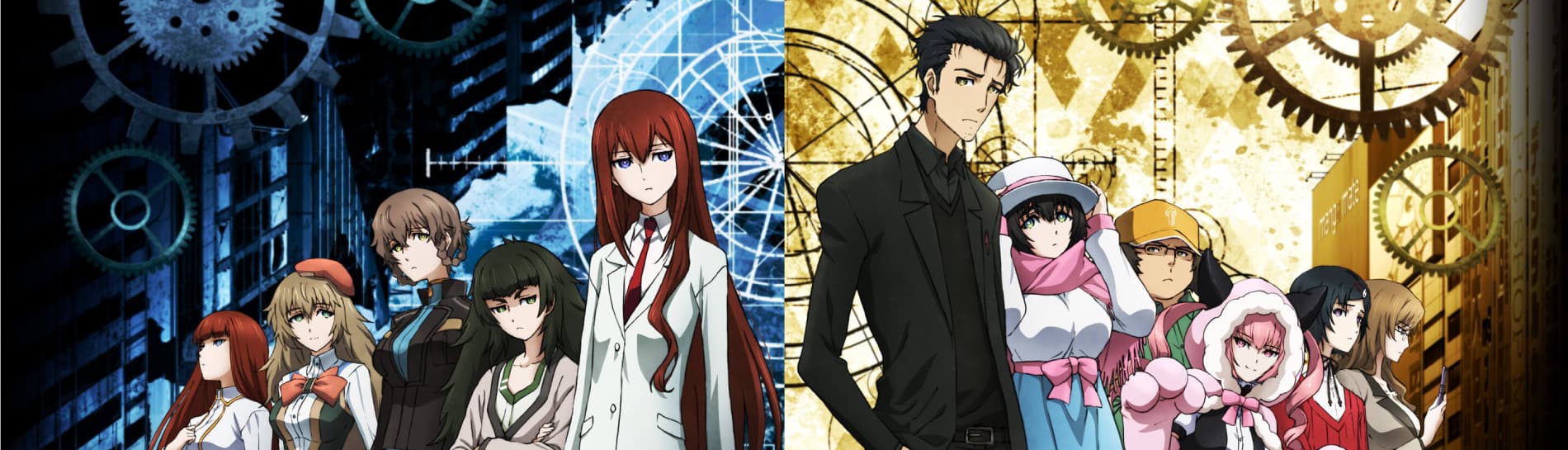
Steins;Gate 0
a review by 149cm
a review by 149cm
Most sequels struggle to surpass their predecessors, and it’s not hard to see why. When a new instalment revisits the same characters, themes, and universe, there’s always the risk that it will feel repetitive rather than refreshing. In that sense, Steins;Gate 0 is no exception. I rated Steins;Gate incredibly highly, so before starting its sequel, I deliberately tempered my expectations. And despire that, I found myself genuinely and pleasantly surprised.
In 0, we are taken into the world line where Okabe never reached the Steins Gate world line, due to the trauma he was faced with after killing Makise physically right after killing her ideologically (by choosing the beta world line). Okabe then, by chance or by fate, comes into contact with Amadeus - an AI with Makise's memories and demeanor, throwing Okabe back into the world that he wanted to forget. The show then follows Okabe’s journey in creating a path to the Steins;Gate world line, sacrificing his own world line.
A time travel show with no time travelling?
In the anime, until episode 19, time manipulation occurred only once, triggered by geopolitical events in Russia that activated Okabe’s Reading Steiner. Yet, the concept of time manipulation was never absent from any episode, looming in every silence, conversation, and decision Okabe refuses to make.
In the original Steins;Gate, after the time manipulation really kicked off in episode 12, the audience is thrown into a repeated cycle of emotionally intense scenes that were chaotic and suffocating, all while Okabe devotes his whole being into fixing what has been broken.
But in 0, we trade that chaos for stillness, instead of watching the time unravel, we watch Okabe unravel, with his determination degrading into depression and trauma. The tension in the anime is not between Okabe and SERN, or any malicious organisation for that matter (until later in the show), but between him and his friends.
Trauma – What happens when the hero gives up
As Okabe bottles up all his emotions and tries to live out the beta world line, desperately trying to protect his friends from the time manipulation that hollowed him out. But his friends can see through him. They see the depression he refuses to acknowledge, the pain he refuses to express.
Their attempts to help are born out of genuine concern; it clashes with Okabe’s attempts to isolate himself. The resulting altercations are not driven by malice, but by love. Everyone wants to protect each other, yet their good intentions pull them further apart.
Okabe isn’t simply sad. He is psychologically fractured. He abandons Hououin Kyouma, suppresses his eccentric persona, and attempts to live as an ordinary university student. But this normalcy is hollow. Time travel in the original series functioned as a coping mechanism: if something went wrong, he could try again, again and again. In 0, that escape is gone. He must live in a world where his failure is permanent.
What makes Steins;Gate 0 so powerful is that Okabe does not recover in some glamorous, self-discovering epiphany; no, there is no triumphant moment where he “finds himself” again. He does not slowly heal through introspection or inspirational resolve.
He is forced back.
After suppressing Kyouma and resigning himself to a stagnant future, he witnesses the deaths of Suzuha and Mayuri — the very people he sacrificed everything to protect. In that moment, the illusion of safety shatters. The Beta world line he chose in order to prevent further suffering proves itself just as cruel. His attempt at inaction becomes its own form of failure.
The tragedy is cyclical. The person who gave up time travel to protect his friends is confronted with the reality that doing nothing also costs lives. His trauma does not disappear; it is reignited. The pain he tried to bury resurfaces with full force.
And yet, in my opinion, this is precisely why his return to Kyouma feels earned. It is not a return born from ego or heroism, but rather from necessity. Okabe does not reclaim his persona because he has healed; he reclaims it because he understands that despair alone changes nothing. Hope, even fragile hope, requires action.
WATASHIWA HOUHOUIN KYOMA DESU!
In this sense, Steins;Gate 0 portrays recovery not as a clean transformation, but as a reluctant decision. Healing is not a straight line upward — it is messy, regressive, and often forced by circumstance. Okabe doesn’t conquer his trauma; he carries it forward.
And that makes his eventual stand far more human than any dramatic redemption arc could ever be.
49.5 out of 52 users liked this review
