Bleach
a review by NordySandwich
a review by NordySandwich
I started Bleach not really knowing what to expect. I’d heard the name thrown around with the other “Big Three,” seen screenshots of sharp black robes and oversized swords, and listened to people argue about arcs and power scaling. But beyond the hype, I didn’t actually know what made it special. I assumed it would be another long-running battle shonen with flashy fights and endless transformations. What I didn’t expect was how distinct it would feel — stylistically, emotionally, and atmospherically.
From the very first episode, there’s a certain coolness to Bleach. Not just in the action, but in the tone. The show introduces Ichigo Kurosaki, a high schooler who can see ghosts. That premise alone gives the series a slightly eerie edge compared to other shonen. When Rukia Kuchiki enters his life and transfers her Soul Reaper powers to him, the story kicks into motion quickly. There’s no overly long training arc at the start, no drawn-out explanation of the power system. Things just happen — and you’re expected to keep up. I actually appreciated that confidence.
Ichigo as a protagonist surprised me the most. On paper, he sounds generic: orange-haired teenager with hidden potential and a massive sword. But the more I watched, the more I realized he’s driven by something refreshingly simple — protection. He doesn’t dream of becoming king of anything. He doesn’t want fame or recognition. He just wants the people around him to be safe. That motivation grounds him. It makes his fights feel personal instead of ambitious.
The early “monster of the week” episodes serve as a decent introduction, but the show truly finds its footing with the Soul Society arc. That arc is where Bleach transforms from “pretty good” to genuinely gripping. The structure of the Soul Society, divided into squads led by captains, gives the world depth. Every captain feels like a powerhouse with their own philosophy, aesthetic, and presence. When the story shifts from hunting Hollows to infiltrating an entire spiritual military system, the stakes suddenly feel massive.
The fights during this arc are unforgettable. There’s something about the way Bleach handles combat that feels clean and dramatic. The animation might not always be the most fluid compared to modern standards, but the framing, pauses, and soundtrack elevate everything. And then there are the Bankai reveals. When a character unveils their Bankai for the first time, it’s not just a power-up — it’s a statement. The buildup, the silence before the name is spoken, the shift in atmosphere — those moments genuinely gave me chills.
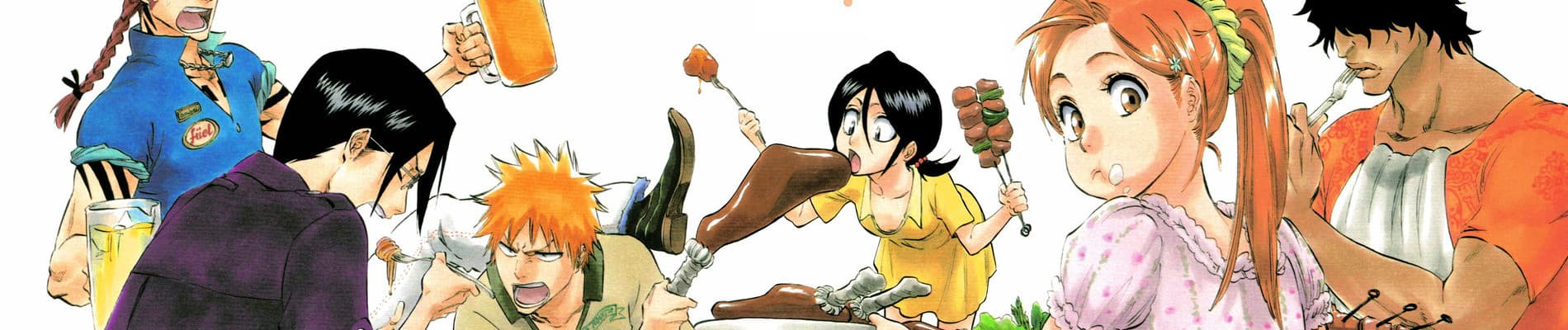
One of the strongest aspects of Bleach is its character design. Tite Kubo’s art style is sharp and minimalistic. The characters look stylish without being overly cluttered. The black Soul Reaper robes, the distinct captain haori, the masks of the Arrancar — everything has a clean aesthetic identity. Even outside of battle, the fashion in casual scenes stands out. It’s rare for an anime to make me think, “Everyone here has insane drip,” but Bleach absolutely does.
The Arrancar and Hueco Mundo arcs expand the world even further. Introducing Aizen as a central antagonist shifts the tone into something more psychological and strategic. Aizen isn’t loud or chaotic — he’s calm, composed, and terrifying because of it. Watching his plans unfold made me realize that Bleach wasn’t just about sword fights; it was also about manipulation, hierarchy, and perception.
Hueco Mundo itself is such a striking setting. The endless white desert, the black sky, the hollow architecture — it feels empty yet oppressive. The Espada, ranked Arrancar with distinct personalities and philosophies about death, add layers to the conflict. Some of my favorite moments come from these battles because they feel heavier. There’s tragedy woven into many of the villains, and that moral grayness adds depth.
However, I can’t ignore the flaws. The pacing can be rough, especially when the anime diverges into filler arcs. Some fillers are decent and expand the world in interesting ways, but others interrupt the momentum at the worst possible times. Watching a climactic arc pause for dozens of episodes can be frustrating. It’s one of the biggest hurdles for new viewers.
Even within canon arcs, there are stretches where fights feel extended longer than necessary. Certain side characters get amazing introductions but then fade into the background. I sometimes wished the show balanced its large cast better. There’s so much potential within the Gotei 13 alone that it’s almost overwhelming.
Still, when Bleach hits its emotional peaks, it really hits. Ichigo’s internal struggles — especially with his Hollow side — add a psychological layer to his growth. His battles aren’t just physical; they’re internal confrontations with fear and identity. That duality makes his power-ups feel earned rather than handed out.
The soundtrack deserves its own appreciation. Tracks like “Number One” inject pure adrenaline into fights. Meanwhile, softer themes add melancholy to emotional scenes. The music knows when to be loud and when to pull back. There are moments where a single musical cue completely transforms a scene’s impact.
Another thing I admire is how Bleach embraces style over explanation at times. Not every power is broken down scientifically. Not every mystery is over-explained. There’s a certain confidence in letting things feel mythic. The spiritual concepts — Soul Society, Hollows, the balance between worlds — create a cosmology that feels grand without becoming overly complicated.
Comparing Bleach to other long-running shonen, what stands out is its vibe. It feels cooler, calmer, more composed. Where some series lean heavily into loud emotion or constant escalation, Bleach often uses silence and stillness. A character standing with their sword drawn, wind blowing through their robes — that quiet tension is powerful.
As the series progresses toward the Fake Karakura Town arc and beyond, the scale becomes enormous. Battles involve multiple captains, shifting alliances, and escalating transformations. Sometimes it borders on overwhelming, but there’s a spectacle to it that’s undeniably entertaining.
Looking back, I think what resonates with me most is the atmosphere. Bleach feels like a late-night anime — something you watch when it’s quiet, when the world feels still. The mix of supernatural elements, stylish combat, and emotional undertones creates a mood that’s hard to replicate.
Of course, nostalgia probably enhances my appreciation. Watching such a long journey creates attachment. Seeing characters grow stronger, suffer losses, and push beyond their limits builds familiarity. Even when arcs drag, I never truly wanted to leave that world.
If I’m being honest, Bleach isn’t perfectly structured storytelling. It has pacing issues, uneven character focus, and occasional repetition. But perfection isn’t what makes it memorable. Its identity does. Its style does. Its highs absolutely do.
When I think about iconic anime moments — dramatic reveals, overwhelming entrances, unforgettable lines — Bleach has plenty. It might not always maintain consistent quality, but when it reaches its peaks, it stands among the greats.
In the end, watching Bleach felt like experiencing a piece of anime history. It’s flawed, stylish, dramatic, and unapologetically cool. It’s a series that embraces spectacle but also carries emotional weight beneath the surface.
And for me, that combination is what makes it a classic.
15.5 out of 20 users liked this review
