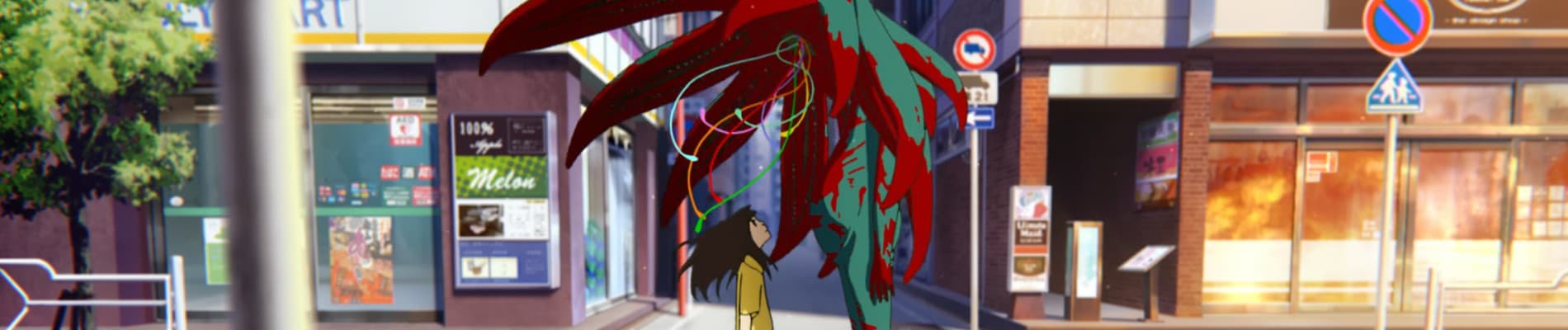
In 17-26, a collection of early one-shots created between the ages of seventeen and twenty-six, this mini-series offers a fascinating lens into the foundations of his later work. Beneath the violence and absurd premises lies a fixation on who gets to belong and what happens to those cast as “the other.” Through the use of found family, explorations of gender and sexuality, and depictions of familial neglect and abuse, these stories lay the groundwork for themes he would later refine.
Rather than breaking down each short, I want to look at the collection as a whole to better understand how Fujimoto uses recurring ideas together to express deeper emotional and social critiques in his works.
I've never written a review on this site before, but I am an art student and trying to understand/delving into an other artist's mind is always fascinating to me, so I am writing this regardless. Forgive me for any mistakes on my part as, I am not a full-time "anime reviewer" and this is more of a study. lol.
The Other
Fujimoto populates these stories with outsiders such as aliens, monsters, social misfits, emotionally stunted boys; who are often coded as threats. Yet he rarely treats them as villains. Instead, “the other” becomes a mirror reflecting society’s cruelty. The horror often doesn’t stem from the monstrous figure, but from the ordinary people who fail to understand or accept them. Fujimoto reframes alienation not as strangeness, but as a condition caused by rejection. His empathy is radical: the grotesque is humanized, while the “normal” is exposed as fragile and sometimes monstrous. He also heavily feautres, trans-coded characters and sexual themes in these works.
__
LGBT and Sexual Themes__
This section intersects with the previous one a lot. In 17–26, Tatsuki Fujimoto weaves LGBT and sexual themes into his broader focus on alienation and belonging. Queerness and desire are not treated as spectacle, but as extensions of his interest in “the other.” The discomfort and judgment of society, rather than identity itself, often become the true source of conflict.
These "others" are often trans-coded characters or teenage boys. Stories featuring these characters often portray sexuality as awkward, vulnerable, and sometimes transactional. It exposes loneliness and insecurity more than it seeks to shock. When Fujimoto portrays imbalanced dynamics, he emphasizes their emotional consequences, critiquing how intimacy can be distorted by power and neglect. Across the collection, sexuality becomes another lens through which he examines identity, agency, and the fragile search for connection. He continues to use these themes heavily in his more polished and finished works, such as Fire Punch and Chainsaw Man.
These themes can be seen in these episodes, especially:
Familial Relationships and Found Family
Blood ties in Fujimoto's work are often unstable, fragile, or absent. Parents neglect, misunderstand, or harm. The biological family often appears as emotional failure rather than safety. In response, Fujimoto repeatedly turns towards found family, and often through brother-sister relationships, bonds formed through shared isolation or survival. These relationships are messy and imperfect, yet they carry a sincerity missing from traditional households.
Fujimoto’s characters cling to each other in desperate, sometimes unhealthy ways. But even dysfunctional solidarity is presented as preferable to abandonment. The tenderness feels accidental, almost embarrassing, which makes it all the more genuine. Love, in these stories, isn’t clean or morally pure. It’s urgent, selfish, and necessary.
These themes can be seen in these episodes specifically:
Familial Trauma and the Critique of Abuse
Fujimoto conveys familial trauma less through exposition and more through emotional atmosphere. His protagonists often display numbness, warped logic, or extreme reactions that hint at deep-rooted neglect. Violence becomes both metaphor and a coping mechanism. When a character explodes, literally or emotionally, it feels like an eruption of long-suppressed damage.
Rather than delivering overt moral commentary, Fujimoto criticizes abuse and neglect by showing their consequences. Parents who fail their children create adults incapable of healthy attachment. Love and sex become transactional. Self-worth becomes conditional. In this way, not just 17-26 but also his other works such as Chainsaw-Man too, becomes devastating: it suggests that the true horror is not the supernatural, but the inherited damage passed down through family structures that failed.
These themes can be seen in these episodes specifically:
Final Thoughts
This series may be featuring his early works, but it is unmistakably Fujimoto’s. He interrogates who counts as human, dismantles the idea of the safe nuclear family; and insists that connection, however flawed, is a survival instinct. Even at his most chaotic, Fujimoto writes with startling compassion for the broken. Art should comfort the disturbed and disturb the comfortable, I guess.
This review might seem pretentious to some, but I think 17-26 serves as a strong gateway to understanding Fujimoto’s current work and the way he constructs his characters. The early one shots feel raw and uneven, clearly functioning as a testing ground for the ideas he would later refine in his longer series. While about half of the mini series did not fully land for me, I still appreciated seeing more of Fujimoto’s work brought to life and overall enjoyed the experience.
My overall Score: 8.5/10
12 out of 14 users liked this review