Foreword :
This review explores the core philosophical themes of Monster and contains spoilers for the key themes of the manga. I will refrain from discussing the events of the story in detail.
*While I read the manga approximately two years ago, the fact that I am still compelled to write about it today should already speak to the lasting impact of the work. I will not discuss major plot events, and this review is not meant to be exhaustive. Instead, it focuses on the philosophical depth of the manga and its characters, drawing parallels with postmodern ideological and philosophical frameworks. I will therefore not address the narrative structure or the artistic dimension of Monster.
With that clarified, let us begin.*
The central moral conflict of Monster originates in the very first chapter, when Tenma saves Johan’s life. This act of medical ethics and human compassion creates a profound sense of responsibility that haunts Tenma throughout the entire manga. His internal conflict is not merely about guilt ; it is about the unbearable realization that an act grounded in goodness may have enabled absolute evil. From that moment onward, Tenma becomes trapped between his belief in the intrinsic value of human life and the consequences of having acted upon that belief.
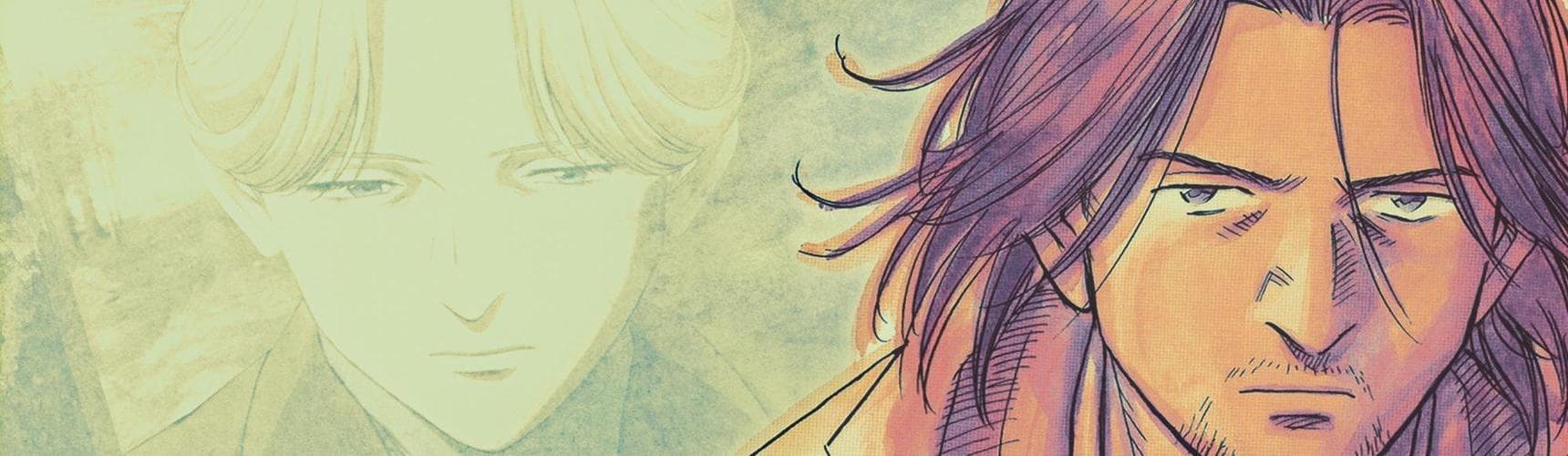
At its core, Monster is structured around the relationship between its protagonist, Dr. Kenzo Tenma, and Johan Liebert. Johan is often praised as one of the greatest antagonists in manga, yet his presence loses much of its meaning when considered in isolation. His ideology only fully takes shape through its confrontation with Tenma’s. Likewise, Tenma is frequently underestimated, despite being one of the most philosophically substantial protagonists in the medium. The dynamic between them is not merely narrative, but ideological: it is the radical opposition between their worldviews that allows the central conflict of Monster to exist, with Tenma ultimately standing as the human response to the questions the manga raises.
Johan embodies nihilism in its most radical form. He does not merely believe that life lacks inherent value ; he seeks to prove it. Johan’s actions are not motivated by chaos for its own sake, but by ideological consistency. His ultimate goal is not domination, survival, or even pleasure ; it is negation. He attempts to affirm his worldview by orchestrating his own death at the hands of the very man who saved him, thereby demonstrating that morality is baseless and that existence itself is empty. If Tenma, the embodiment of moral conviction and humanistic belief, were to kill him, Johan’s philosophy would be validated. In that sense, Johan does not need to survive to win ; his death would be his final argument.
This philosophical tension is deeply rooted in the intellectual history of nihilism. After Charles Darwin revealed, through the theory of evolution, that humans are simply another product of natural processes rather than the center of creation, humanity’s privileged metaphysical position was profoundly shaken. It is within this context that Friedrich Nietzsche diagnosed the “death of God”, describing the collapse of the religious and metaphysical foundations that had traditionally grounded morality and meaning. With divine order dismantled and human exceptionalism undermined, the question of value became radically unstable.
Before Nietzsche fully articulated nihilism as a philosophical crisis, authors such as Turgenev and Dostoevsky explored its psychological and social consequences. In Fathers and Sons and Demons, nihilism appears not as liberation, but as the disintegration of meaning, morality, and ultimately the self. Monster inherits this tradition. Johan is not a villain in the conventional sense ; he is the logical endpoint of a world that has lost its moral anchors.
Tenma, by contrast, represents resistance to this collapse. He stands for the belief that there is something intrinsically valuable in human life, independent of outcomes, usefulness, or ideology. His refusal to abandon this belief is not naïve optimism ; it is a conscious, painful commitment. Tenma continues to affirm human dignity even when doing so becomes unbearable, even when it appears irrational, even when it threatens to destroy him. In this sense, he is not merely Johan’s opponent ; he is Johan’s philosophical counterargument.
Monster thus illustrates the consequences of Nietzsche’s Übermensch taken to its extreme. Johan is constructed as a figure beyond conventional morality, detached from guilt, responsibility, and attachment. But rather than presenting this transcendence as liberation, the manga portrays it as monstrous. Johan’s existence negates beauty, connection, and meaning. He is not free ; he is empty.
This brings us to the significance of the title itself. The “monster” is Johan, not because he kills, but because his worldview is fundamentally inhuman. Monster suggests that there is a fragile but essential beauty in human nature: to believe in goodness, to assign value, and to hope even when the world is fractured and meaning is lost. This is what defines humanity, and this is precisely what Johan rejects. Tenma, defending this fragile belief with his entire being, becomes the moral center of the story.
I believe this interpretation is essential to understanding the final of the manga :
Thank you for taking the time to read this review. It is not meant to be exhaustive, and Monster is a work that would equally deserve deeper analysis of its narrative structure as well as its other essential characters, such as Grimmer and Nina, whose arcs are crucial to fully appreciating the manga’s depth and value. This reflection focuses on one philosophical axis among many, and any serious evaluation of Monster must engage with these additional dimensions. My rating is also based in these elements.
37.5 out of 41 users liked this review
