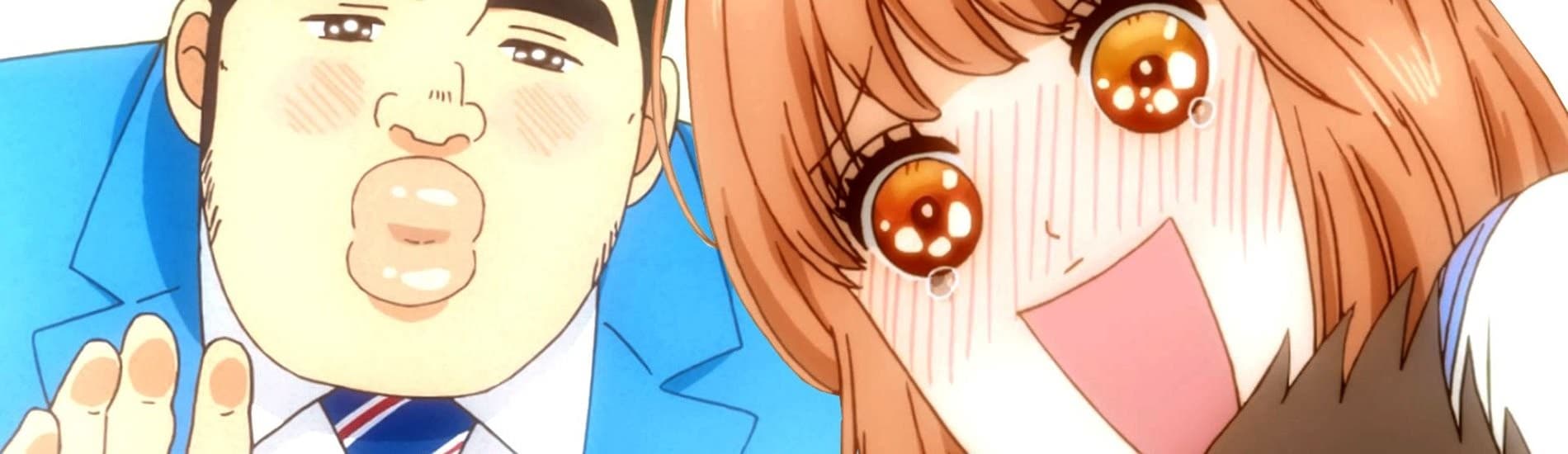
Takeo Goda was never meant to be a main character, not even in his own life story. Don’t get me wrong, he was well loved and popular, and an all around good person, but he was also freakishly huge and monstrously buff for his age. At only sixteen years old, Takeo stood easily higher than eight feet tall, with giant lips, a jar shaped head, and a physique that would give Vince McMahon the fatal heart attack he so desperately deserves. At best, he was born to be the main character’s best friend, so naturally he grew up to become the life long bestie of Makoto Sunakawa, a heart-stoppingly handsome heartthrob who seems to be heartless when it comes to the ladies. One day, while the two are riding the train, Takeo saves a young woman named Rinko Yamato from a groper, and Rinko goes gaga as a result... But it has to be for Sunakawa, right? There’s no way a girl as beautiful and charming and gosh darn sincere as her can possibly be in love with an ape like Takeo, right? Like a good friend, he’ll put aside his own feelings to help the two of them get together, but in doing so, he’s going to find there’s a lot more to Rinko than meets the eye.
With My Love Story, we are returning for the first time in a long time to Studio Madhouse, which is always a coin flip, if we’re being honest. Madhouse has a tendency to bless their anime productions with either all of the money or none of the money, with very few titles resting in the middle, and out of the cheaper titles they put out, only the ones who were left in the hands of extremely skilled directors ever manage to succeed in spite of Madhouse’s callous negligence. I bring this up so you can fully understand and appreciate just how lucky My Love Story was to receive both a lavish budget AND an extremely skilled director, because Madhouse gave this title to one of their most frequent collaborators, and my personal favorite anime director of all time, Morio Asaka.
Morio Asaka has directed a bunch of titles for Studio Madhouse, including CLAMP titles like Cardcaptor Sakura, Chobits and Clamp in Wonderland. He’s also directed some highly critically acclaimed anime like Nana and Chiyayafuru, and what I consider to be his masterpiece, Gunslinger Girl. I can’t say everything he’s touched has turned to gold, I will probably be reviewing Cardcaptor Sakura Clear Card later this year, but for the most part, he has left a very impressive resume in his wake over the last few decades. To be clear, he’s not the kind of director whose presence you immediately notice... He’s not some obnoxious auteur with a repetitive style or any of his own tropes or cliches. Rather, he’s a director who understands whatever project he’s given on a deep enough level that he knows how to bring out the hidden potential and commercial appeal of said project. It’s no big secret that you have to change things when adapting a manga to the screen, and Morio Asaka is one of the best directors you could possibly trust to decide those changes.
I’ve never read the original manga of My Love Story, but it just feels like one of those rare pieces of media where every decision that went into it was just the right one. You might not notice this at first glance, but if you’re as familiar with Asaka’s work as I am, then you can just feel how much fun he was having with this one, especially when it comes to the character designs. Obviously Takeo is the standout character, as a character like him would stand out in most settings, but he, Motoko and Rinko all have extremely exaggerated designs, with an exaggerated innocent bishoujo and the cold, sexy bishounen complementing him really well, and playing against the stereotypes of their designs just as boldly, and Asaka just could not let go of any opportunity to milk as much visual comedy out of these three characters as possible, and he does so without ever being mean-spirited about it. At the very worst, they’re in on his jokes. Takeo has a million different expressions and funny animations for a million funny situations, but Rinko’s sparkly, wide-eyed faces and Makoto’s dead-eyed deanpans that occasionally crack into an incredibly charming laugh are just as pleasing.
And of course, like I said, there was very clearly a massive budget for this series, and the animation across the board is damn near perfect. In comedic moments, the pacing and animation speeds up, so you can enjoy some good-hearted slapstick and Takeo’s goofy running cycles. In romantic moments, the pacing slows down, and Asaka adds these beautiful visual effects that accentuate the stars in Rinko’s eyes, and even make Takeo himself look romantic as hell. I don’t recall a single moment where any frame looked awkward, or when on-screen movement looked anything less than graceful, or where the sight of this massive hulk of a boy holding hands with a girl one fourth his size ever made me cringe, which you’d have to imagine should have been a major concern. I don’t even remember seeing any transparent budget saving tactics, which I’mpretty sure means Madhouse just gave Asaka free reign to make the romantic comedy of his dreams without any pushback or restraint whatsoever. This show is absolutely gorgeous.
The English dub, as it turns out, is also a really strong effort. Produced by Animax and licensed by Sentai Filmworks, there is a very large cast at play here, with some standouts including the legendary Marcy Bannor as Takeo’s mom, and Luci Christian playing his younger self in flash backs, but none of that really matters, because this is flat out a star making vehicle for the voices of its two main characters. Now, this is going to be a bit of a back handed compliment, but Andrew Love doesn’t have a lot of range... He plays dumb muscleheaded tough guys really well, but not much else. That’s the back-handed part, so here’s the compliment: He plays these roles fucking amazingly, and Takeo might just be his finest work, as most of his previous outings haven’t had this much depth of survived pain and kindness behind them. Tia Ballard is also outstanding as Rinko, who is easily able to match and even sometimes exceed him in pure unadulterated sincerity. They both poured their souls into their characters, and in doing so, they make this dub, to the point that it’s easy to underappreciate just how much subtle nuance Austin Tindle puts into Sunakawa to balance them out. I highly recommend this dub.
You know, I’m starting to think I just have a thing for romantic comedy anime with unconventional leading characters. I enjoyed Kiss Him Not Me more than most people, with its fujoshi otaku lead. I lauded Kotoura-san for the ingenious decision to cast the girl crazy lovesick loser as its romantic lead. Toradora is my second favorite anime ever. This in mind, along with my fanhood for Morio Asaka, there was no chance in hell I wasn’t going to love My Love Story. The story of this big dumb giant and a smaller starry-eyed beauty falling in love was practically made for me, and while it’s been about ten years since the first time I saw it, I’m happy to report that I love it just as much now as I did then. Granted, there’s not a ton that I can say about it in a long format review... It’s not all that deep, and it’s really hard to talk at length about good comedy without spoiling all of the jokes... There are a few things I can touch on that will hopefully express my feelings as accurately as possible with minimal spoilers.
The first and most obvious thing that’s working in this show’s favor is everything I mentioned earlier about the production values and Morio Asaka’s direction, and I don’t really want to retread any of that, but I do think it’s important to talk about how well these qualities served the tone of the series. To start, it’s really easy to describe this show as fluff. It’s a feel good, fun and wholesome comedy that takes the high road at every given opportunity, but unlike most fluff, it never really feels manipulative and it never gets boring. I think part of this is because at no point does Asaka try to sexualize anything or anyone to you. There is some fanservice, but it’s entirely situational, rather than in your face, and it’s left entirely up to you to decide how to react to it. This show may feature a beach episode full of bikinis, and several shots of Takeo shirtless, but it doesn’t have an ecchi bone in its body. If anything, it uses scenes like these to show why the characters themselves are attracted to each other, rather than trying to hook YOU onto them.
And yes, while the comedy might occasionally frame Takeo, Rinko or Sunakawa as the butt of a joke, it never feels like it’s doing so at their expense, as they’re either too dense to feel insulted or humiliated, or because they’re entirely in on the joke. The comedy is never mean spirited. The jokes revolving around Takeo’s absurd appearance aren’t poking fun at him as a person, they’re lampooning the effect he has on the world around him and how he exists in it, all the while he’s just living his life and being a good person. No, not just a good person, but an extremely likeable person. While we’re on that subject, I hear what some of you are saying, and at worst, I would go as far as to say that Takeo and Rinko are ALMOST Mary-Sues. Yes they are good people, with a ton of friends who love them, but they do have a few flaws each. Takeo is, to put it nicely, below average in intelligence, and he sucks at reading people. Rinko is a bit of an oddball, as her friends see her, with very strange sensibilities and taste in men.
She’s also low key kind of a stalker, which I don’t think was unintentional on the part of the writers... Don’t get me wrong, I said low key for a reason, and she’s not nearly as bad as another character who is introduced later, but the methods she uses to track down Takeo after their first encounter are a tad questionable. That aside, I love these two as a couple. They might just be one of my favorite anime couples of all time, right behind Ryuji and Taiga, and a huge part of it is that they are probably the best possible example of opposite attracting. These are two characters who look drastically different, come from radically different worlds, and would never have met if it wasn’t for that chance encounter on the train, and yet it still feels like they were made for each other, because they do have one very important thing in common... Their sincerity. They are both highly sensitive, highly emotional people who wear their hearts sewn directly onto their sleeves. It is adorable how they are almost always operating on the exact same wavelength.
This comparison won’t make sense unless you’re familiar with the fantasy books of Mercedes Lackey, but I am convinced that what they have must be what a lifebond looks like. One of the main reasons I love them as a couple, however, lies with the motivations of Rinko herself. At first glance, it would seem like she and Takeo were drawn together mainly by his heroism, and that she’s in love with him because she’s her savior, which would draw upon a story telling trope that’s as old as the art of story telling itself... The hero saves the princess, and lives happily ever after with her. He wins her affections through sheer virtue and positive action. I’m not going to completely condemn this trope, as it is a classic for a reason, and you can tell some very emotionally satisfying stories through it, but there is an underlying implication of entitlement to it... You save somebody, they owe their love to you for it.
This trope has been parodied and deconstructed to death over the years, including by anime. One of the most memorable examples is Charlotte, where the main character orchestrates a rescue scenario to manipulate a girl into dating him, and she dumps him when he moves away. Hilarious, actually, and proof that Charlotte was good before it lost its damn mind. With My Love Story, however, the deviation is a lot more subtle... Rinko isn’t in love with Takeo because he saved her, but because she legitimately finds him attractive, and I mean in an explicitly physical way. Takeo didn’t get a girlfriend because he saved a girl, he got a girlfriend because that girl just happened to have experienced her sexual awakening while watching King Kong. The fact that he’s a good person is just the icing on the beefcake. Thanks to this detail, you get to celebrate the fact that someone finally appreciates Takeo enough to love him, while also celebrating that the someone in question has agency of her own, and a well defined, interesting personality.
As for Takeo, I have referred to him as a good person at several points thus far, and yes, I know, that’s probably one of the most boring ways to describe anybody, fictional or otherwise, but hear me out. Before you judge him, it’s important to establish what kind of good person he is... He’s a nice guy, but he’s not a stereotypical Nice Guy. He doesn’t do nice things for personal gain. He’s not some fedora-clad simp who pulls chairs, holds doors and busts out the umbrella because he thinks it will get him one step closer to some action. That sort of person reeks of entitlement, like they think the affections of a woman are a prize to be won or earned. Takeo never thinks like that. He has low self esteem, and believes himself unworthy of female attention to the point that he refuses to believe Rinko loves him until he hears it for himself, and yet he never has a single thought along the lines of “I’m nice to girls, so why don’t they like me?”
Rather, the fact that his good deeds are never rewarded like that never deters him, because he never makes that connection. He is a true, pure altruistic person. He does kind things not for personal gain, but because he wants to do them. He wants to make the world around him a better place, and he genuinely doesn’t care if people appreciate his deeds or not. He doesn’t seek approval or gratitude. He doesn’t think of women as prizes, which is good, because Rinko is way more than just a prize, she is a fleshed out, interesting character, and he loves every detail and flaw she possesses. I could see a character like him being boring to some people, and that’s fine, but this review is based on my opinions, and if I’m being honest, this is my personal favorite kind of hero; The boy scout who just wants to help people, and makes no effort whatsoever to look cool or appealing while doing it. This is why Captain America is my favorite Avenger. Again, this might not work for you, but I’d still bet Takeo is at least a funny enough character to compensate for it.
Not gonna lie, though, seeing him fall off of a mile-high cliff and survive was stretching things a bit too far for even MY suspension of disbelief.
Now there is another point to their relationship that I feel should be touched on, and it’s going to be a bit of a spoiler, but I don’t think it’s one that’s going to ruin the experience for you. Earlier, I mentioned that Takeo doesn’t realize Rinko has feelings for him at first, so you may have inferred from that that like most romantic comedy anime, there’s going to be a long period of “will they won’t they” in this show, but no, no really. We only get about four episodes of that before Sunakawa breaks it up and helps them get together, which is kind of a double edged sword. On the plus side, it’s really refreshing to see a romcom anime go this very uncommon route, and I personally never got bored with seeing these two together. On the downside, this does rob the series of having any stakes or forward momentum, so I could also see this decision being really disappointing for some viewers, and I personally disagree, but I don’t blame them. It is a pretty steep trade off, objectively speaking.
And like most romcoms, not everything in it has aged well. Don’t get me wrong, it has aged better than most romcoms, but it still has its touchier elements. Probably the worst part is Sunakawa’s sister, who has a crush on the three years younger Takeo. Three years doesn’t matter when you’re adults, but a 19 year old lusting after a 16 year old isn’t great, and when you see their size difference in flashbacks, it’s even more uncomfortable. There’s also a scene where Takeo forces Sunakawa to let him practice kissing on him, which is totally played for laughs, but it’s still non-consensual kissing, so it’s still pretty hard to watch, especially for me, because I’m asexual, and Sunakawa is very likely asexual, so I definitely felt his lack of comfort through the screen. And finally, it is a little weird that Takeo’s part time job makes him wear skimpy, revealing outfits, but when I was in high school I was acquainted with multiple 16 year old Hooters girls, so I’m gonna let that one slide.
Aside from these few sticking points, this is a surprisingly tasteful show that artfully sidesteps most of the potentially problematic elements of both the romance and comedy genres while still never failing to be both funny and charming in equal measures. I said earlier that there really isn’t much depth to it, but there is a little bit... Early on, this anime references the old Japanese fable of the red oni and the blue oni, which is as well known in Japan as The tortoise and the Hare is to those of us in the west, and it is a genuinely complex and thoughtful parable, which is why you’ve seen it referenced in a lot of anime over the years. By placing Takeo in the role of the red oni, and Makoto in the role of the blue oni, this fable establishes not only the full nature of their dynamic, but the main theme of the series, to not judge people by their appearances... A cliche, to be sure, but this story never stops finding clever and entertaining ways to show peoples’ expectations being defied again and again.
My Love Story is available from Sentai Filmworks. The original manga by Kazune Kawahara is available from Viz Media.
I love this show. Yeah, you can call it pure fluff if you want to, but it separates itself from the rest of the fluff by never being boring or manipulative, and remaining consistently funny despite its abject refusal to ever resort to mean or lowbrow humor. That means no panty shots, no cringe moments where a guy gets beat up for walking in on a girl, nothing that needs to be censored, just a clever, heartfelt and wholesome comedy about a handful of extremely likeable characters and their relationships to each other. The pacing is so good that it makes 24 episodes feel like 13. I do wish we could have seen more of Rinko’s family life, especially after all of the time we spent with Takeo’s family, but all in all, I’m happy with the series as is.
I give My Love Story a 9/10
17 out of 20 users liked this review