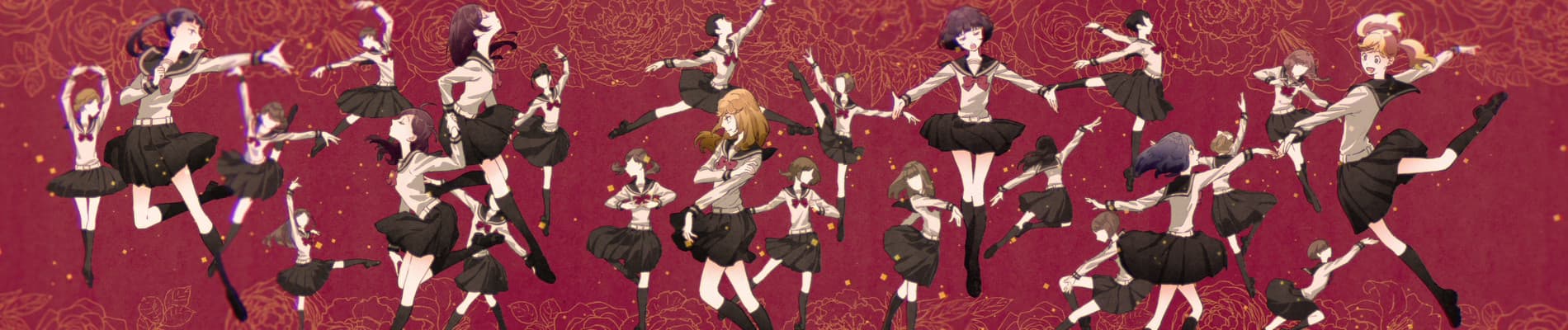
Kageki Shojo!!
a review by JuanCruzIII
a review by JuanCruzIII
On Kageki Shojo!! — An Anthology of Brilliance
The premise is simple: a group of girls has just enrolled at Kouka, an all-female musical theater academy — inspired by the legendary real-life Takarazuka Revue — with the dream of one day performing on its stage. Among them, Sarasa Watanabe, who has always dreamed of playing male roles in an all-female theatrical company, and Ai Narata, a former idol seeking a world without men — two opposites who, without looking for it, end up sharing a room and, little by little, something more than that.
Kageki Shojo!! presents itself as a coming-of-age story, and in many ways it genuinely is one — but it never quite achieves the narrative depth its ambitions seem to demand. The anime gestures toward profound questions of identity, trauma, and growth, yet its storytelling architecture works against it: character backstories are not so much explored as they are deployed, carefully held in reserve until the precise moment they can detonate into dramatic payoff within the walls of the Kouka academy. This makes the show narratively thin in a structural sense — the characters' pasts feel less like lived history and more like dramatic ammunition, loaded and waiting to be fired.
The emotional weight is real, but the scaffolding behind it is somewhat hollow.
And yet — paradoxically — this is also exactly why the show works.
Because Kageki Shojo!! is not, at its heart, an ensemble drama. It is an anthology dressed in the costume of one. Many episodes, especially in the second half, split into two intimate character portraits; others dedicate their full runtime to a single story, sharing the remaining time with Sarasa or Ai. Whatever form it takes, each one functions as a self-contained gem: luminous, complete, and achingly human. The interpersonal dynamics within the academy remain largely surface-level, and the girls' relationships with one another are never given the space to fully breathe — but that absence barely registers, because every individual story shines so brightly on its own terms. These vignettes are so beautifully crafted that you could watch any one of them without prior context and still feel the full force of its emotion. Among the students, Kaoru, Aya, Sawa, and the twins Chika and Chiaki are the ones who carve out the most genuine presence, and the show dedicates its time to them with the same care it gives its protagonists. Perhaps the most elegant expression of this spirit lives in the ending theme: with every shift in focus, it changes too — not merely visually, but vocally, sung by the voice actresses of whichever girls the episode belongs to. The very credits become an extension of the anime's devotion to each individual story.
And yet, not everything receives that same treatment. The great irony of Kageki Shojo!! is that its most promising character — Ai, whose introduction is arguably the most striking in the anime — ends up being its most neglected. Her fear and hostility toward men, initially jarring, reveals itself as the scar tissue left by childhood abuse, a trauma that maps closely onto post-traumatic stress disorder even if the show never names it as such. The early stages of her friendship with Sarasa — that slow, tentative opening of herself to another person — rank among the most moving the anime has to offer. But after that initial arc, Ai recedes: she becomes a supportive presence, a good friend, a steady voice of reason in the final stretch — real, but distant from the interiority that made her so compelling. For a show that shines precisely by giving each girl her moment of truth, it is a quiet irony that the character who opens the story is also the one who least inhabits it.
Kageki Shojo!! is not a perfect anime, and it does not pretend to be. It is an anime that stumbles over its own ambitions, that leaves promises unfulfilled and relationships unexplored. But there is something almost endearing about its imperfection — because what it does do, it does with an honesty and a tenderness that are rarely found. Every small story it tells, every girl it grants a moment of light, carries something true within it. And that, in the end, is what remains: not the narrative architecture or the structural coherence, but the feeling of having accompanied someone through something that mattered.
13 out of 14 users liked this review
