Oh! My Goddess
a review by Miiros
a review by Miiros
Urd and Skuld function as thematic extensions of this core. Urd, with her playful and provocative demeanor, hides her affection behind a mask of indifference. Her role in the story reveals a form of love that acts without openly declaring itself, willing to break rules and take risks for the sake of others, even if disguised by superficial excuses. Skuld, on the other hand, represents the fear of loss. Her resistance to Keiichi and Belldandy’s relationship does not stem from rejection, but from the fear of being left behind. Though intelligent and rational, she acts emotionally and impulsively, exposing the conflict between understanding something and emotionally accepting it.
Sayoko and Toshiyuki introduce external tensions that reinforce the central themes. Sayoko raises a fundamental question: belonging. By suggesting that Keiichi might be better off with someone “from his own world,” she exposes the fragility of his relationship with Belldandy and the real possibility of being replaced. Toshiyuki, in contrast, highlights Belldandy’s absolute trust in Keiichi, especially when she makes a promise without hesitation. This trust is not portrayed as naïve, but as a conscious choice that defines the kind of love the series explores.
In its final episodes, the anime adopts a more melancholic and introspective tone as it explores the fear of loss. Belldandy’s divine nature ceases to be merely a fantastical element and becomes a real threat to the relationship. Their closeness turns into a risk: the closer they grow, the greater the possibility of separation; the further apart they become, the deeper the pain. This paradox structures the final conflict and transforms love into something inherently painful.

The narrative emphasizes the characters’ helplessness in the face of forces beyond their control. The inability to see each other, the fear of being forgotten, and the uncertainty surrounding the permanence of their bond create a constant sense of impending loss. The anime builds this atmosphere delicately, using memories, silence, and visual repetition to suggest that everything will inevitably disappear... Belldandy’s presence itself begins to feel unstable, almost like a dream that could cease to exist.
The tree scene encapsulates this conflict. It represents the origin of the problem, yet no solution is presented. The lack of clear answers—replaced instead by Belldandy’s sadness and Keiichi’s denial—reinforces the sense of inevitability. Their relationship is no longer just an emotional connection, but a space where love and loss coexist.
Within this context, love reveals itself as the driving force. Keiichi strives to fulfill the promise he made in the past, attempting to give Belldandy a tangible symbol of his feelings. Belldandy, in turn, is not only concerned with remembering, but with not being forgotten, as there is not even a trace of hope left in her attempt to fulfill her promise of staying by Keiichi’s side forever. Both are driven by the need to preserve something they know is fragile. The act of knitting a sweater and the effort to deliver the ring are no longer simple gestures of affection, but attempts to make their bond endure.
Urd and Skuld’s intervention, as they are willing to break rules for the sake of the couple, serves as a form of familial validation of their relationship. The resolution does not present the conflict as a battle against an external enemy, but rather as an experience where pain becomes an opportunity for deeper understanding and for recognizing the value of their bond. In the end, the anime suggests that suffering does not weaken love, but instead defines and strengthens it.
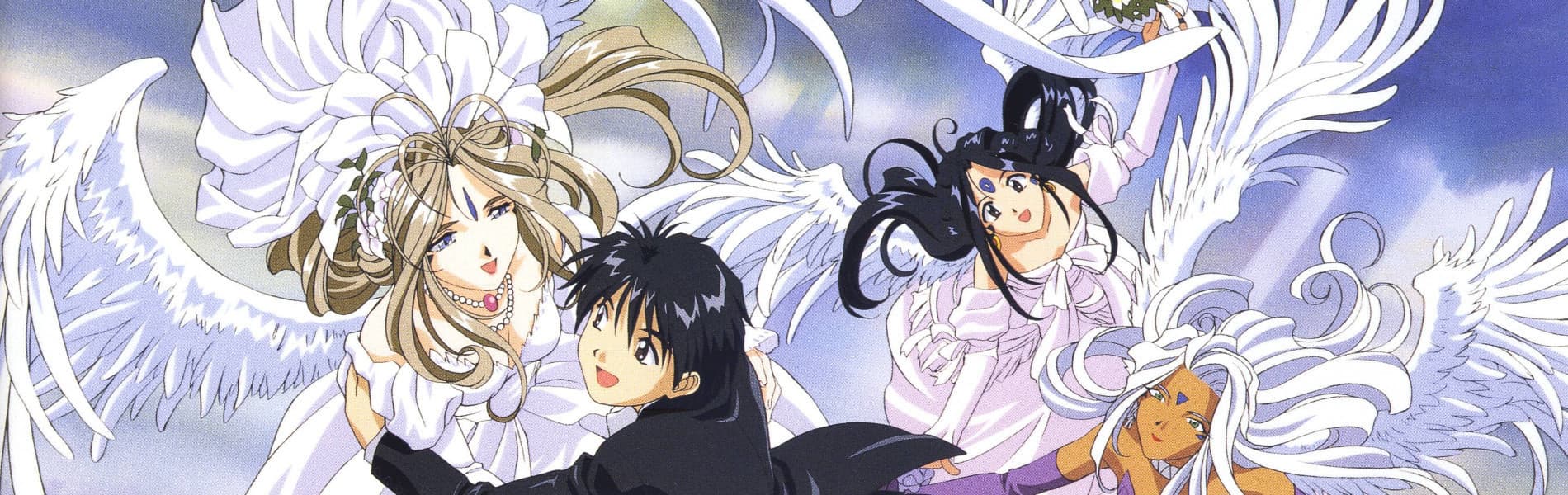
Throughout its narrative, Aa! Megami-sama! constructs a symbolic parallel to marriage. Keiichi and Belldandy’s relationship is, at its core, a promise sustained by trust, tested by insecurity, and maintained through mutual effort. Love is not portrayed as something simple or effortless, but as a commitment that demands complete devotion, even in the face of constant uncertainty. Additionally, the fact that they live together and that the final scene closely resembles a wedding ceremony further reinforces this parallel.

Technically, the anime holds up very well. The animation is not exceptional, but it features detailed designs and well-crafted shots. I really like the overall aesthetic of the series. The soundtrack effectively reinforces emotional moments, enhancing both lighthearted and melancholic scenes. The direction stands out by avoiding monotony, using framing and visual elements that enrich the storytelling and keep the viewer engaged. The comedy provides balance, offering moments of levity without undermining the emotional weight.
The pacing is well handled overall, with the exception of a specific moment in the tree scene, where Keiichi’s emotional shift feels somewhat abrupt. Even so, this seems to be a deliberate narrative trade-off: a portion of the buildup is sacrificed to allow more time for other elements. In this case, it feels justified, as the scene does not significantly disrupt the overall experience.
It is worth noting that I have not read the manga, so I cannot make a direct comparison. However, the anime stands well on its own. Its narrative feels complete and succeeds in developing its themes with clarity and sensitivity.
In the end, Aa! Megami-sama! presents love as a promise that is inherently painful and complex. Commitment, trust, and the risk of losing the other person are what form a genuine bond. This becomes a powerful demonstration of how pain can strengthen and sustain human relationships.
Thanks for reading this far, I hope it was helpful :)

2.5 out of 3 users liked this review
