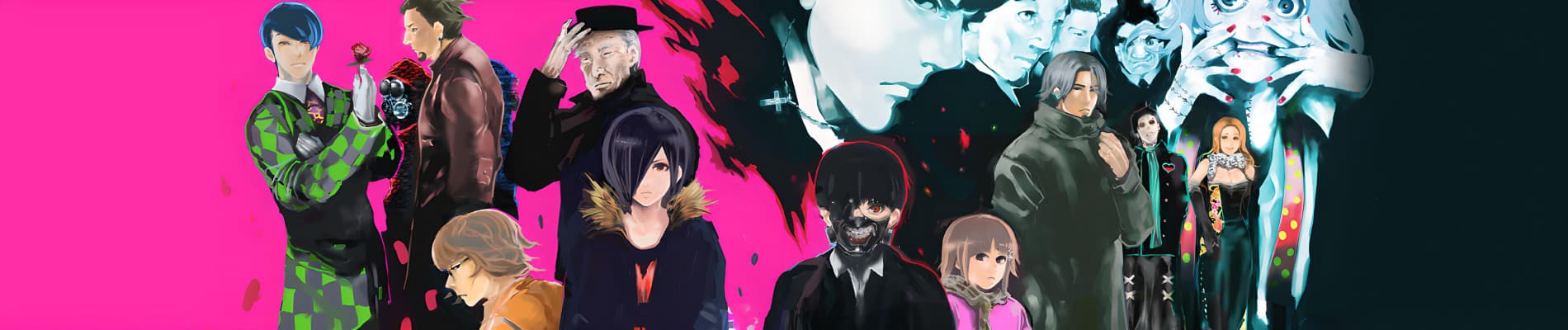
Tokyo Ghoul
a review by aaravg772
a review by aaravg772
⚠️ Spoiler Warning: This review contains major spoilers for the Tokyo Ghoul manga
(the original series, not :Re). Read at your own risk.
I just finished Tokyo Ghoul. Haven't touched :Re yet, so take this as a review of the original run only — but honestly, I have a lot to say.
Tokyo Ghoul is, at its core, a story about a boy who wants to be good in a world that has no room for it. For roughly the first 120 chapters, Tokyo Ghoul is a solid 8/10. Good pacing and compelling characters. Ishida builds a world that feels real and messy, a society where two groups are locked in a cycle of violence that neither side has blood-free hands in.
The art in this series is unique; it has a special feel that I haven't seen anywhere else. It does a great job in capturing the "normal" environment of the world, the people, cafes, cities, and roads, but it always seems to have a secondary layer of horror and messiness bleeding through, ready to pounce at you any second.
In the beginning, the art is normal, clean, and aesthetically pleasing. As it goes on, Ishida's improvement is evident, but another strong point is his strength in capturing emotion and the mental state of a character. Ishida excels in laying down a character's mental state on the table through his art, in a conventional manner, as well as an abstract one, warping text bubbles, using sketchy and messy lines. The art deteriorates alongside Kaneki.
One area where the art stumbles is fight scenes, panels can get cluttered and hard to follow, making it difficult to track what's actually happening. But I can overlook this, as fights aren't a big part of the story, and usually serve to further the psychological aspect.
Art Rating: 9.5/10
Kaneki's mother is one of the most devastating characters in the series. She worked herself to death out of a compulsive need to help everyone around her.
Kaneki inherits this completely. His entire arc is built on the same flaw: the belief that if he just tries hard enough, suffers enough, sacrifices enough, he can be the bridge between humans and ghouls, that he can save everyone. He can absorb all the pain, so no one else has to.
Ishida's argument is that this isn't noble. It's selfish. Deciding you'll carry everything so others don't have to still means you made that decision for everyone. And more than that, it's delusional. No one person can hold two sides of a war together by sheer willpower and self-sacrifice. That amount of sacrifice only results in the erasure of self.
Hide and Touka exist, in part, to show you what Kaneki is throwing away. Hide is the purest version of someone who simply loves Kaneki, no agenda, no ideology, just a person who wants his friend back. Touka is someone who has already lived through the same choice Kaneki is circling and found a way to exist without destroying herself.
Being kind gets you destroyed. Kaneki spends the first half of the series trying to be the good guy, protecting people, refusing to kill unless he has to, looking for compromise. The world he's trying to navigate and our world, as a reflection, doesn't have space for someone who won't commit to a side.
Being cold is just a different kind of loss. The post-torture Kaneki, the one who finally accepts violence, is more "functional", but he's not actually okay. He pushes people away. He survives, but survival and living aren't the same thing. The humanity he was trying to protect in others slowly bleeds out of himself.
There's no version of "be the bridge" that works. The bridge just gets walked over from both directions until it collapses.
Akira is one of the most quietly tragic characters in the series. She spends the entire story trying to exist as her own person while everyone around her only ever sees her father. Amon sees Mado's daughter. Her superiors see Mado's legacy. Even her own sense of identity is built around living up to a dead man's expectations.
Arima is a character that Ishida never fully opens up to, and I think that's intentional. He doesn't get much time on the page, and what little we see of him is hard to read. My interpretation — and I could be wrong — is that he's exhausted. A tool that's been used so many times it's forgotten why it was picked up in the first place. He keeps killing ghouls with no resolution in sight, no end, no light. Just the next ghoul and the next order. He wants to break through the cycle of hatred that he has made even stronger.
Touka is what Kaneki could become if he stopped running. She's already lived through the same impossible position — caught between two worlds, not fully belonging to either — and she found a way to exist. She doesn't resolve the world's cruelty, she just refuses to be consumed by it. Kaneki can't seem to figure out how she does it.
Tsukiyama starts as one of the most overtly sinister characters in the series, a ghoul who views Kaneki as a rare delicacy and wants to consume him. And then something strange happens, he just... stays. He becomes one of the most genuinely devoted characters in the cast, willing to throw himself into danger for someone he started out wanting to eat. His arc is a quiet counter-argument to the rest of the story — proof that people can actually change, that obsession can transform into something genuine.
Banjo is the most purely good-hearted character in the series, and the story treats him accordingly — which is to say, the world keeps stepping on him, and he keeps getting back up. He doesn't have an ideology, he doesn't have a grand plan, he just picks a side and commits to it completely.
Juuzou was kidnapped as a child, raised as a ghoul's pet, tortured until pain stopped being registered, and blamed for things he didn't do by people who found it easy to believe the worst of him. By the time Shinohara finds him, there's barely a person left to salvage. What's interesting is that Shinohara doesn't try to fix him or turn him into something normal. He just treats him like someone worth caring about. And slowly, it works. Juuzou starts to feel things again. When Shinohara goes down in the war arc, Juuzou's reaction is one of the rawest and most impactful moments in the series.
For most of the story, I read Tokyo Ghoul as a humans vs. ghouls story. The cruelty felt one-sided, the violence felt unjustified
The final arc flipped all of that on its head. Everything that had been building finally converged, and what struck me most was that Kaneki still hadn't learned anything. Not from his own suffering, and not from his mother's. He doesn't kill Amon when he has the chance. He doesn't kill Arima. He keeps rushing toward Yoshimura despite the damage piling up around him. The same self-destruction, just on a larger stage.
Amon is, at his core, a man who convinced himself that the world was wrong and that ghouls were the reason for it. That belief cracks the moment Kaneki spares his life — since when did ghouls do that? From that point on, Amon is quietly falling apart ideologically, and the war arc is where it finally catches up to him. He doesn't get a clean resolution. He just gets the uncomfortable truth that he was contributing to the very distortion he swore to fix.
Yoshimura is something else entirely. He's the version of Kaneki's idealism that actually aged — a ghoul who chose not to kill, who built something small and peaceful in Anteiku, who tried to be a quiet bridge between two worlds without making it anyone else's burden. And the war arc destroys him for it. He gets torn apart, harvested, and reduced to a body used to manufacture weapons. Ishida doesn't let the pacifist win.
On the other hand, the final arc isn't without its flaws. Touka, Yomo, and several other characters who had been carefully built up over the course of the series get largely sidelined. For a story so invested in its cast, that stings.
Here's the thing that stuck with me: Tokyo Ghoul isn't saying the world is hopeless. It's saying that living entirely for others is not a virtue.
The takeaway, at least for me, is uncomfortable: You cannot save everyone, you probably shouldn't try to, and attempting it at the cost of yourself just makes you hollow.
The only way forward is to want something for yourself.
A few parts of the story are stretched out and a bit longer than necessary.
Many characters are very underdeveloped and are sidelined in the final arc, such as Yomo and Touka.
Is Tokyo Ghoul a perfect manga? No. The middle stretch drags in places, and some side characters get more setup than payoff. But Ishida is doing something, in my opinion, very unique, and Kaneki's arc hits hard precisely because it's not a hero's journey, it's a psychological autopsy of the "good man".
I believe that if you like dark, tragic, mystery stories you'll enjoy Tokyo Ghoul.
That being said, I leave you with one question: "How is it that a species fighting for its survival can be classified as a crime by mankind?"
9.5 out of 10 users liked this review
