Gurren Lagann
a review by ProSoapbox2001
a review by ProSoapbox2001
Gurren Lagann: A Retrospective
Note: while this review does not contain explicit spoilers, it does go into more depth on certain subjects than a cursory review normally would. Read at your own discretion.
Nineteen years ago, Hiroyuki Imaishi and Kazuki Nakashima of Studio Gainax decided they wanted to make a tribute to an old 70s mecha anime named Getter Robo. The result of that desire, aside from the enduring cultural legacy that would come after Imaishi co-founded the world-renowned Studio TRIGGER, was a short, 27-episode mecha anime named Tengen Toppa Gurren Lagann (or Gurren Lagann). One of the most critically acclaimed anime of the 00s, and the subject of this retrospective. Gurren Lagann is an anime original story. The manga was produced afterward, which is a sharp inversion of the traditional manga-to-anime production. This isn’t a unique phenomenon, but I have found it interesting that in the rare instances I’ve encountered it, it always happens to be innovative mecha anime. Studio Gainax is also responsible for possibly one of the most famous mechas of all time: Neon Genesis Evangelion (which is on my list for the far future). Notably, Gurren Lagann, thematically, could not be more different from Evangelion. It is an optimistic tale* *as opposed to Evangelion’s depressing and somewhat nihilistic outlook (I won’t comment too much as I have not fully watched it).
I’ve never really written reviews before, so I apologize in advance if this seems a bit amateurish. I’ve watched a lot of anime and manga over the last few years. These are primarily action shows or “shonen trash” as some call it, but what can I say? That’s what I like. Nevertheless, I’ve been trying to more critically analyze the media I engage with for fun and to build some more cognitive skills, which I admit have sharply declined as my brain plunges forward into the abyss of adulthood. However, I never really understood the point of writing a review of something that you’re not going to analyze from, at the bare minimum, a slightly more sophisticated level than just “how did this story make me feel in the moment.” Don’t get me wrong, emotions are important in narrative, but for every story there are a thousand opinions based on a thousand different emotions, and none of them ever matter to anyone else because a watcher either will or will not replicate those emotions during their own experience. At that point, why even review?
I’m not pretending that this review is some academic treatise, nor that any of the shows I intend to watch are at all scholarly in nature, so please do not hold this to any standard of that sort. I like to think of it as more of a retrospective. Sure, I’ll give it a score and evaluate it as an artistic product of variable merit, but most of the things I want to talk about have nothing to do with that. I want to examine this show for what it offers the viewer who gives it some attention, even if, at the end of the day, it is just a silly little sci-fi mecha about face-robots fighting for the fate of the universe.
For my methodology, I try to avoid explicitly identifiable spoilers, though keep in mind that a show like this basically requires a discussion of developing elements of the plot and themes that go beyond what one might expect from a synopsis. I’m writing this for people who have already watched the show moreso than for the people who are considering it. Though feel free to read even if you haven’t seen it.
For Gurren Lagann, the lasting legacy of this brief story released in the summer of 2007 is the reminder that life is allowed to have simple, articulate notions about life, courage, and ambition. Simple ideas don’t inspire faith in us because of their essential truth. Our spirits, our bonds, our drive as human beings possess eternal resilience even when we are literally “piercing the heavens.”
The two most emblematic symbols of this resilience are our two protagonists. In the future, self-declared brothers Simon and Kamina live underground with the rest of humanity. Simon, a digger proficient in wielding a literal mining drill, is responsible for carving out new paths for his home village to expand in the dark confines of their underground world. Kamina, by contrast, is an older boy with an unbound desire to travel to the surface in search of his father and leave the underground behind forever. He is forbidden from doing this, but sees all obstacles in his path as just that--obstacles that he needs to break through. One day, Simon finds a strange vehicle called a Gunman named Lagann in the tunnels that he digs, and thus Simon, Kamina, and Yoko, a girl from the surface who wields a powerful raygun, begin their fight for humanity’s freedom. Others quickly join them, and our protagonists assemble the legendary Team Gurren.
I could go on, but in truth, the actual premise of this story evolves multiple times throughout these twenty-seven episodes. Evolution is a major theme harped upon in the story, but that does not become apparent until the latter half. The show itself respects this pattern. Gurren Lagann, both the show and the literal mech that Simon and Kamina will co-pilot in the first few episodes, will find itself in far, far different circumstances by the finale. I will say generally that the show can be divided into three parts: Part 1 (Episodes 1-8), Part 2 (Episodes 9 - 16), and Part 3 (Episodes 17 - 27). These divisions are informal, but people who have watched the show know exactly why I divided them that way. Nevertheless, that is what I am referring to when I mention any of these parts in the future.
The titular mech is the Gurren Lagann, a Gunman made from the combination of Lagann, Simon’s great underground find, and Kamina’s Gurren, a mech repurposed from one of their early victories. I always consider the namesake of any particular media product to be of significance, and this is no exception. Gurren Lagann is the one constant in a constantly evolving series--the anchor through which we experience this rapidly paced plot.
And it is certainly rapidly paced. One of the greatest compliments for this show I can offer is how lean and tightly plotted it actually is. I took over forty pages of notes trying to do this (do not recommend, it was unnecessary), and a good chunk of them were trying to keep track of all the unique, individual plot beats that happen in these 27 episodes, mainly because my memory is just awful. This show is dense but efficient in both its action sequences and its dialogue. It gets to the point with only a couple of lines and a couple of shots. It efficiently condenses emotional character moments that stick in your heart, leaving you with plenty of time to enjoy the flashy, fluid battle sequences that clearly bear the animation hallmarks of what would define Studio TRIGGER. For better and worse, this show got to the point and got to it fast.
The downside is that, while it was narratively efficient most of the time, I found that sometimes the story was *too *lean in its plotting. The show clearly planned deep emotional arcs for many of the main characters, and it pays them off well. However, some of those payoffs rely on elements that were not shown to the audience. In Part 3, for example, Rossiu bases his negative attitude towards Simon’s leadership skills on facts about his leadership that we barely observe in the context of Part 3’s setting. Additionally, Simon apparently forms relationships with the numerous side characters of Team Gurren off-screen, which is acceptable until the show expects those relationships to have the same kind of emotional payoff that we witness between the main characters. It doesn’t make you feel like you’re missing episodes, per se, as the plot is still undeniably cohesive, but there are a few moments where you are expected to care about people who have said maybe less than ten lines over the course of 20 episodes.
Thematically, I’ve seen comments online claiming that *Gurren Lagann *is a “turn your brain off” kind of anime, which I find perplexing. While the show isn’t some intricate, multilayered labyrinth of depth and sophistication, I find that I actually share the sentiment that it is “complex in its simplicity.” Gurren Lagann has some of the most straightforward themes in narrative history: the power of love and friendship can conquer any obstacle in the universe, taken to its utmost extreme. It is deliberately absurd, even somewhat satirical. Yet, to write off Gurren Lagann as just being a show dedicated to the power of friendship ignores so many of the subtleties in building that very theme. Unlike your average Shonen battle anime, Gurren Lagann takes itself seriously. The power of friendship is not just an offhand sentiment made to give the story a superficial sense of emotional weight. It is an idea that is baked into the very logic of its own universe, and the characters reap the benefits AND suffer the consequences of that fact.
Another prominent theme is upward self-striving. Tengen Toppa Gurren Lagann literally means “Heaven-Piercing Gurren Lagann.” The first episode is called “Bust Through the Heavens with Your Drill.” The show is very consistent with this fact. Climb, climb higher, and never let there be a ceiling to your future. Allowing this theme to exaggerate itself to hyperbole is exactly where this show’s greatest strength is. This sentiment of endless self-striving is not just youthful empowerment. It manifests as a literal threat to our antagonists. In response, despair, the natural opposite of hope, becomes a counterforce driving the plot in favor of our antagonists, who, by necessity, need to conquer not just the bodies but the spirits of humankind.
Fate is a frequent thematic visitor. The narrator is constantly talking about the “fate” of our heroes, and he does so using an explicitly antagonistic fate. Fate is not their friend. It is something to destroy because it gets in their way. Weirdly enough, the narrator’s enframing of fate is not passive, and it’s not just describing “the end” of the show. The narrator explicitly changes the way he describes fate as our characters take action. He constantly talks about our heroes’ fight against fate, and then by the end of Part 2, how that fate has arrived, and later, how they are betrayed and how they continue to search for it, etc. Fate is typically written as encapsulating the hero’s journey as a whole, but in Gurren Lagann, it is treated like a pest in various stages of management and suppression.
This is why I praise the show for the depths of its simplicity--it does not treat itself lightly even as it drops ridiculous premises upon the audience. It wants us to hear the same message we’ve heard over and over again about believing in ourselves, but also not to pretend that this is some harmless platitude, nor that it will be met unchallenged by “fate”. These layers reveal themselves in the various central characters.
By far, the number one most notable subtlety to the “complex simplicity” of Gurren Lagann is in its focus on duality. Duality is another theme of the show, best expressed through the literal relationship structure of the characters and the relationship of those characters to the plot itself. Simon and Kamina are dual protagonists; Gurren Lagann is a powerful mech born from a combination of their original, independent Gunmen, born from the bond between them, and the mech literally gets stronger the more powerful their bond grows. The aforementioned evolutionary nature of the plot upends all the character dynamics multiple times throughout the story, and thus, the actual duo of pilots of Gurren Lagann changes over time. This is intentional, and it is why the titular mech is the namesake, as opposed to just naming the show Simon and Kamina’s Traipse Through the Desert. The duality and the nature of bonds are Gurren Lagann, mech and story, personified, and that characteristic remains even if Simon or Kamina are not piloting it.
That’s not to say that neither Simon nor Kamina is a protagonist in their own individual right. As the show progresses, however, it is clear that Simon is given the greater emphasis of the two. Meek and despondent, Simon is not quite content but not quite alienated from living in the underground village of Giha. He has very few outstanding qualities, for which he is picked on and bullied, but for those matters in which he does have drive, such as digging tunnels, Simon’s drive is relentless. He adores Kamina as an older brother figure, even if he cannot quite match Kamina’s escapist energy and hunger to fight for his freedom. It is because of his proximity to and love for Kamina, however, that gives Simon those brief moments of self-empowering confidence that slowly but surely become more and more frequent as the show progresses. This is undeniably the most central character arc throughout the show: with Simon gradually building himself up to match the image of himself that Kamina sees in him throughout Part 1, losing it all and regaining a new sense of self in Part 2, and finally coming to terms with his strengths AND his honest limitations in Part 3 and using that to secure an ultimate victory. It’s a standard character arc about coming of age, bravery, and the aforementioned theme of self-striving.
Kamina, on the other hand, is very difficult to discuss in a review of the show. If you know why, you know why. He starts as the more central figure of the two, but sneakily hands those reins off to Simon as the show progresses. Kamina is self-actualization embodied. He loves drive and hates weakness, as evident in the first episode when he discards his former “Team Gurren” after they pathetically beg for their lives. It is because of this love and drive that he adores Simon as a younger brother figure, because despite his meekness, Kamina recognizes Simon’s inner potential that he unconsciously reveals. This is not to ignore Kamina’s own development, however. Kamina is reckless in his pursuits and stubborn to boot, as seen when he offends Adai Village by insisting on his way of self-striving in episode five, a fact that the show treats as an unapologetic character flaw. The surface world is harsh and far more brutal than his imagination ran wild with, and Kamina, despite his bravado, is paralyzed by death in the early episodes, something that nearly gets him and Simon killed. Nevertheless, it is because of his indomitable fighting spirit that he pushes on, and in the process, inspires countless others to follow him. This image of Kamina is arguably more impactful than his role as a human being and character, a fact evident in the way he converses with Simon in episode 26. However, the less said about that, the better, and again, if you know why, you know why. I really, really wish I could talk more about it.
I want to note a key distinction about Gurren Lagann’s handling of character dynamics that I genuinely have not encountered in fiction all that much, even serious literary fiction: protagonist loyalty. I am not referring to personal bonds of loyalty between characters, though those do exist in this case. I am referring to a more figurative loyalty that often happens in these types of action-heavy narratives, especially manga and anime, and especially in anything shonen or shonen-adjacent. It’s a kind of narrative loyalty that protagonists, by virtue of being a protagonist, command in all the characters around them. They get more trust from side characters unless the plot explicitly demands mistrust or betrayal; they get away with more interpersonal mistakes and are forgiven more easily for heavier circumstances; their interests take precedent over the supposedly independent interests of the other members of the supporting cast. They often come to “serve” the protagonist mechanically, and their own thoughts, beliefs, activities, and goals often temporarily subsume themselves towards those of the protagonist. Protagonists, by virtue of being the centerpiece of a narrative, tend to warp the very plot around them. This isn’t necessarily bad, but it does often strip away the sense of self-agency we might get from the supporting cast that convinces us of the fundamental literary myth that, in the context of the setting, these are real people that we believe can and would exist in this unique world.
Gurren Lagann does not have this phenomenon, and its absence is felt sharply in a positive way. There are two distinct points, namely the beginnings of Part 2 and Part 3, where Simon, in particular, despite all of his accomplishments, is effectively abandoned, emotionally and sometimes physically, by the supporting cast. This is not done out of cruelty, but by the necessary plot-driven pursuits ongoing at the moment. Simon’s heroism does not absolve him of his mistakes. The power of friendship is strong in this show, but it is not strong enough to last eternally in the minds of those who were genuinely, profoundly impacted by the seemingly impossible feats of Gurren Lagann. It’s almost depressing in that regard since it seemingly downgrades Simon’s bonds with Team Gurren to an authentic, yet more transactional nature. However, I think this actually enhances Gurren Lagann’s core theme of the power of friendship substantially. The fact that friendship is not treated as an irrevocable guarantee makes its messaging tighter and more powerful. It’s why, despite the cliche, it’s much easier to appreciate the simplicity of the idea even twenty years later. It feels earned as opposed to stated.
The third member of the core trio of Team Gurren is Yoko Littner. We know very little about Yoko before the story begins. She’s your standard young freedom fighter archetype, and most of her character arc is the result of things that happen throughout the actual story, though I would argue that it is debatable if she has a real overarching story “arc” at all. When Simon and Kamina’s village gets attacked by the first Gunman they encounter, Yoko arrives to fight it off with a massive sniper-like railgun, which is basically her most defining piece of paraphernalia. Taking her with them, the trio arrives on the surface, and Yoko leads them to her surface village of Littner, where Simon and Kamina learn more about the surface world and set out on their next concrete objectives.
I won’t pretend that Yoko has no character moments, but all the ones she receives are infrequent and never conjoined to some overarching theme. For reference, Yoko’s objective by the end of the story is to become a teacher, and my telling you that is hardly a spoiler, as it comes out of nowhere and is basically only relevant in the context of its immediate episodes. Again, it is not a bad development, but there doesn’t seem to be a sense of continuity. She gets a couple of episodes primarily centered on herself, but half the time, she is nearly relegated to a named background character with a peripheral role in Team Gurren. This is* not* the case with Nia, so I have no idea why Gainax dropped the ball with Yoko.
As much as I hate to say it, the answer is likely because Yoko is meant to be the fanservice focal point, which is disappointing since Gurren Lagann clearly showed potential in being able to write a story that did not need to utilize a cheap aesthetic tactic like that. Yoko’s natural character design is basically a swimsuit, and this is acknowledged in-universe as something of a practical joke. All I can say is that, at the very least, that is a step above most anime, which treat fanservice as something to shove in the audience’s face. There is probably futility in arguing against the question of sexualization for Japanese anime audiences in 2007, the target demographic of which I know nothing about. I just think it was really unnecessary. And I think Yoko’s character suffered from trying to include this when it was very clear that Gurren Lagann could have succeeded without having to do this. For what it’s worth, Nia, the other female lead, ends up passing the Bechdel test immediately with her friendship with Yoko. Technically, they both do via bilateral logic, but I highlight that to say that it is slightly disappointing that Gainax refused to extend that same courtesy to Yoko as a character.
On the other hand, the much more cohesive of the two main female characters, Nia, is a human who is also a princess of the show’s first main antagonist, the Spiral King, and the mystery of how that is possible is the initial exploration of her character. Introduced in part two, Nia comes from a world of Beastmen and struggles to understand the ways and means of human beings, despite having a large amount of kindness and empathy for them as her natural disposition. When Simon is in a rough spot, she takes to him immediately, seeing him for who he is in a similar but distinct way to how Kamina sees him, and this distinction forges another strong bond between them that goes on to empower Simon. Nia’s ignorance of humanity, however, sometimes gets in the way of her own benevolence. One of my favorite scenes of the show is a brief conversation between Simon, Yoko, and Nia aboard the Dai-Gurren in episode 10, where all of three of them bring their current angsts to bear, and Nia is effectively left speechless due to her failure to understand the depths of the others’ pain. This prompts her to investigate the roots of her own origins, and to her despair, forces her to come to terms with the evils at the heart of her father’s regime.
I’ll end the character section by mentioning the antagonists (and Rossiu, who occupies a semi-antagonistic role in Part 3). As with the plot, the antagonists of Gurren Lagann are constantly shifting as the story evolves. Obviously, I have to keep the final antagonist quiet, to my chagrin, and I don’t really want to say too much about the Spiral King either. Suffice it to say, the final antagonist’s motivations are about as parallel to Team Gurren as one can get, and with an impressively colossal scope. The Spiral King possesses excellent, well-executed, unapologetic villainy. A-grade tyranny that is reinforced, not undermined, by a somewhat understandable, though unsympathetic motivation. Again, Gurren Lagann loves to portray the natural consequences of “the power of friendship,” and the Spiral King is the personification of those very consequences. He has no desire to persuade or motivate, only to crush, to dominate, and to warn.
The principal antagonist who rivals Simon and Kamina is Viral, who makes his debut in episode 3 and recurs frequently with an increasingly erratic sense of honor, dominance, and desire for revenge. Viral is a skilled combatant and a commander in the Beastman army who introduces our heroes to what a real Gunman threat piloted by someone who knows what they are doing looks like. However, this attitude comes with an intrinsic sense of Beastman superiority, but as Viral starts racking up defeats despite his excellent performance, he starts asking some questions and harboring some doubts. With no outlet for this damaged frame of mind, Viral’s arc develops by directing these confusions again and again back towards humanity, and is met with increased shame and dishonor until finally, that is no longer an option on the table.
I don’t particularly find Viral all that interesting, but he is a necessary character for our window into the lives and ways of the Beastmen, who are normally cruel and conniving to humans. Viral is no exception, but he’s also not that simple either. I think his character arc is adequate in and of itself, though I do think it was also a bit confused, especially in the underdeveloped connection between himself and the Spiral King, which the story tries to present as significant for him in some of the last episodes. It’s another example of how “too lean” certain parts of the story became, but it doesn’t hurt the story so much as promote indifference. I like Viral, but I would forget about him under most circumstances, which is a bit of a shame.
Lastly, I want to talk about Rossiu, who is the definition of a character that takes on antagonistic qualities without being a villain. Rossiu, for the most part, takes on a subdued but notable role within Team Gurren after his introduction in episode 5. Overall, episode 5 feels off because of how superfluous it feels compared to all the other episodes until we start seeing Rossiu take on a more significant role in the story’s latter half. Born in Adai Village, Rossiu was raised under the tutelage of High Priest Magin, who, for the safety and preservation of their scarce underground resources, founded a religion and deliberately kept the population of Adai under 50, exiling excess members through a randomized lottery under the guise of religious pilgrimage. Rossiu respects Magin but doubts some of his teachings. Nevertheless, when Kamina comes barging into his world and tarnishes the name of all they hold sacred, Rossiu stands his ground and defends his principles. In the end, however, he realizes that, for his sake, he needs to visit the surface and becomes the first extraneous member of Team Gurren.
From there, Rossiu takes a background role as one of Gurren Lagann’s alternative pilots, and he has mixed but cautious feelings about the many threats they encounter as Team Gurren progresses through their journey. He believes in Kamina’s hope and future, but that inborn caution never leaves him, especially given the circumstances of Part 3. Rossiu loves mankind, but he ends up taking a Machiavellian and dark consequentialist worldview of where to take mankind’s future in the face of the unknown. Like the Spiral King, this view isn’t incomprehensible. It makes sense under the confines of Gurren Lagann’s setting and is a direct contrast to Simon and Kamina’s self-striving. He does not hold this view out of cruelty but calculation, and this perspective is persuasive for some of the other side characters and, to an extent, the viewer as well. Underneath it all, however, Rossiu possesses that same seed of self-doubt that he has carried since Adai Village. One that his actions never alleviate, no matter how much he wishes it so.
I’ve covered basically every character with a notable emotional arc or distinct worldview. But *Gurren Lagann *has numerous named side characters. Notably, we have Leeron, the brilliant, non-binary engineer who never seems to stop innovating for humanity’s sake, the Black Siblings, Gimmy and Darry, two other kids from Adai Village whom Team Gurren takes under their wings, family man Dayakka, bomb-happy Ateamborough, and many other inspired Gunman pilots who heed Kamina’s call for liberation. Of these, only Kittan of the Black Siblings and maybe his sister Kinon have any independent emphasis as characters. I don’t have much to say about Kittan because it’s best to see his character arc for yourself. It is my favorite of the supporting cast.
I would be remiss to end this review of an anime without actually talking about the animation, and Gurren Lagann, nearly twenty years later, remains a stunning masterpiece of what would become the signature style of Imaishi’s Studio TRIGGER.
I’ll say up front that, critically, I’ve always been more attuned to my reception of narrative rather than aesthetics. My understanding of audio and music is abysmal, so I’ll keep my thoughts limited there. In fact, I’ll keep everything limited here for our collective sanity.
Not every episode of Gurren Lagann is perfect. Notably, and I’m glad to see online that I was not the only one who noticed this, episode 4 in particular had an abundance of close-ups and what I could swear were reused action shots, though I haven’t verified that. Thankfully, that episode appeared more of an anomaly than anything, because the visuals of Gurren Lagann are intentional, breathtaking, and as aforementioned, a distinct language of animation.
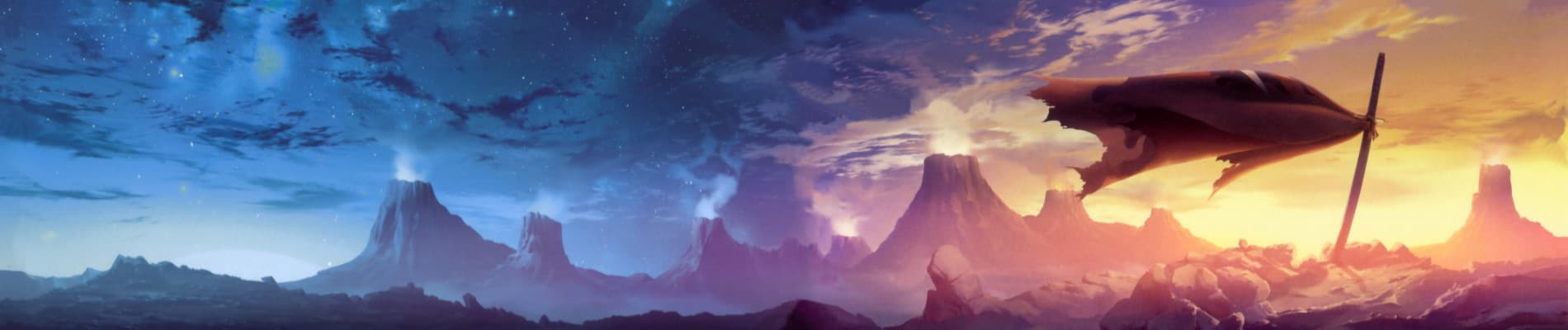
One thing I noticed in particular was the color. Gurren Lagann has a palette of earthen red, brown, and navy blue. It’s evident from the series poster to the barren, mesa-based climate to the portrayal of the night sky and, of course, our main trio’s outfits and hairstyles. One of my favorite shots occurs in Episode 21, when we see Yoko nestled at the top of a large tree bearing witness to the curvature of the Earth’s horizon: the reddish evening twilight and the impending starry night make up two halves of the screen. Even more striking was when those colors were deprived, especially in episodes 5 and 9. Color is almost completely stripped from certain scenes and settings to emphasize a hollow and nihilistic state of mind or an immanent despair defining the current emotional moment. Gainax clearly did this intentionally and for the better. Most anime, especially those adapting from manga, don’t often have the creative freedom to take bold visual choices like this, but as an anime original production, Gainax did not have to constrain itself as such, and they thankfully ran with it. This pattern, as far as I am aware, repeats in later TRIGGER shows like Kill la Kill and Cyberpunk Edgerunners (both also anime originals). So here in Gurren Lagann, we are witnessing the inception of an enduring visual legacy.
Regarding the animation itself, Gainax pioneers what I call “caricaturized action.” Yes, obviously, Gurren Lagann is already a cartoon, but here the cartoonishness reaches another profound extreme. Gurren Lagann simply does not care about realism; it cares about whimsical extravagance. The parodic nature of the story invites us to not only suspend our disbelief, but to throw it in the trash…and it works. Gurren Lagann is literally built on the power of friendship, and when that friendship is powerful enough, it can just pull attacks out of its figurative rear end. This is where commenters say the show is something to turn your brain off to, and they are right, but for too simple a reason. This caricaturized action is not lazy. It is a deliberate choice to elevate the animated insanity, something they can only really do with an original animation. And critically, it is not just an aesthetic choice, but a narrative one as well. From the way the Gunmen mechs combine to the boisterous Looney Tunes explosion of sudden new appendages, the conjuring of drills from thin air, and the way our pilots name and rename their attacks spontaneously, the caricaturization literally makes up the narrative activity occurring. In the final episodes, the show is somehow both narratively comprehensible and conceptually incomprehensible--you can understand what’s going on but could not explain to any third party exactly why any one detail is happening--and that is a direct result of this choice. I have not read the Gurren Lagann manga, but I have to imagine that, assuming it is a 1:1 framing of the anime, much is lost in adaptation. Gurren Lagann is a fantastic show, not just because of the story it animates, but because the story is animation to begin with, which is one of those often underrated virtues of evaluating this specific medium.
I’ve already said my music critique is even weaker than my animation critique, so I’ll keep this brief. Gurren Lagann has a single OP and three EDs, one of which is only available in the Compilation episode. The visuals chosen across these episodes are deliberate and change details on a whim, including the lyrics at one point. Overall, I like them, “Sorairo Days” being a pleasant earworm, but my primary interest in music is whether it catches me emotionally.
For the actual soundtrack, as with the plot and characters, the music evolves with the circumstances. It’s often hopeful and loudly enthusiastic, much like our heroes, but it does take on menacing undertones at certain moments. Most notably, during the Battle of Teppelin in episodes 14-15, you can hear an almost crystalline, ethereal motif as the more mysterious elements of the plot begin to rear their heads. Against the final antagonistic force, you hear these dissonant sequences that sound like a parade in celebration of malevolence. I’m not going to argue for these interpretations, only that they stuck with me, and that’s the why of how they stuck.
Lastly, voice acting. Here’s the thing: I don’t speak Japanese natively, and I feel like I should not comment on the acting pedigree of a language I don’t understand. Don’t get me wrong, I can distinguish certain voice acting archetypes, but I couldn’t really distinguish between two different actors’ use of those archetypes. I’m making note of this here for future reference, as any review I do is probably going to skip over this essential quality of the medium.
Nearly twenty years later, Gurren Lagann is still a fantastic show that has aged well with a timeless message, captivating visual language and style, and idiosyncratic identity that makes it worthwhile even to those who do not like mecha anime generally.
It is not perfect; it possesses some products of its time (though far from the greatest offender), nor will I make a grandiose claim that *Gurren Lagann *is one of the greatest anime of all time. Nevertheless, it received critical acclaim then and since for good reason.
A deep, optimistic thread revitalizes our sense of hope when viewing this story, something somewhat bereft in our present day. Within which more cynical and nihilistic works proliferate into the popular mainstream. Those are not bad stories at all, but I do think it is healthy to explore more positive media once in a while, especially if it does take itself seriously and isn’t just producing facades of optimism just so it can claim to have significant meaning.
For every negative nitpick I might conjure to weigh this story’s quality down, most of them can be outweighed by the chaotic, explosive, vibrant love that Gainax injected into every frame, every line, and every sequence of this story, caring little for your suspended disbelief and laughing at you for worrying about it. Better yet, they planned it all out and ended it quickly and efficiently, saying exactly what they wanted to say and moving forward.
Moving forward, endlessly, relentlessly, moving forward.
For those reasons, I give Gurren Lagann a 9/10.
28 out of 32 users liked this review
