This review contains spoilers (though mostly somewhat vague). Read at your own discretion.
Years ago, I was recommended a niche social deduction game called Gnosia by my friend. I played it and became a huge fan. It had its flaws, but the characters were fun and the emotional beats resonated with me. Soon enough, everyone I knew had heard about it and probably been talked into adding it to their Steam wishlist. So, as you can imagine, I was both ecstatic and apprehensive when an anime adaptation got announced. I was thrilled that I’d get to see characters I loved voiced and in motion… but, well, Gnosia’s storytelling is very tied to its gameplay loop, and I was unsure of how it would adapt to a more linear format. This review will serve to explore my opinion on how the anime relates to its source material.
The game Gnosia is essentially the party game Werewolf or Mafia. You play it against the AI of the game’s characters, and can change the settings to choose the role you play, how many other characters will appear that round, etc. It’s interspersed with randomized events based on the round’s settings that progress the story and teach you about the world and characters. The way its story is written is fully based around this premise.
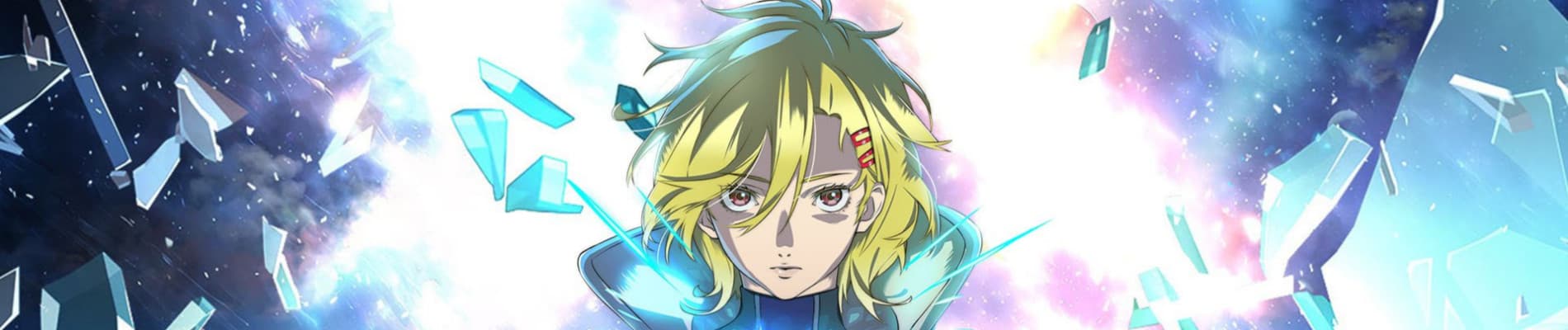
The adaptation does the best it is able. You follow Yuri (a character created for the anime, as you play as a self-insert in the game) as they learn that they are on a ship infected with a mysterious being known as the Gnosia, who is disguised as one of the other crew members. Yuri and the rest of the crew must discuss and vote out the Gnosia before the Gnosia makes them all disappear. Yuri learns that if the Gnosia win, they are sent back in time, and must do everything over again—but the people on board and the identity of the Gnosia changes each time.
This adaptation figured out a way to adapt the gameplay, but it isn’t perfect; and ultimately, this fundamental incompatibility between formats is the anime's biggest flaw. While its constant meeting scenes do serve their purpose, and they can be entertaining and compelling at times, they get boring very quickly. Much of the anime’s time is spent on these, and they’re extremely repetitive; the game is, too, but far less so when you’re playing and making decisions for yourself. It doesn’t help that the anime decided to introduce many of the different roles used in the game to change things up far later than in its source, and some of them are hardly relevant at all (though I do understand this decision, and it makes sense when you take into consideration how complicated things get with even more moving pieces).
When it comes to the characters, they were always somewhat barebones in the game, so the anime did a lot to flesh many of them out. At the same time, though, they lost some of their charm. Everyone’s a bit different; Raqio (or Racio, in the anime) is a little nicer, Setsu is a little more distant, Sha-ming is a bit less sleazy (it makes me a bit sad one of my favorite moments from the game wasn’t added, in which Setsu throws Sha-ming out of the airlock for harassing them and nobody cares because nobody likes him). Yuri is, of course, the largest difference. When it comes to the anime, it is Yuri’s story, as opposed to being yours in the game. Unfortunately… I’m not the biggest fan of them as a protagonist. I knew one would have to be created, but I wish they were more adventurous with it. Yuri does not have much of a personality or a will; they follow along with the story without taking many of their own actions that would meaningfully impact the progression. The only time I found them compelling was in the epilogue episodes that mostly adapt the game’s true ending, in which a lot of anime original content was added.
I really appreciated the extra time we got with characters like Yuriko and Gina (or Jina). The anime did a lot to expand on their stories from the game. SQ was also adapted very well, though a bit oddly; especially in relation to the bizarre choices made with Kukrushka and Remnan. See, Manan’s plot is obviously a very important throughline of Gnosia’s story, but in the game it is a late-stage reveal. You have no idea on Kukrushka’s true identity until far later on than it is implied in the anime. I don’t have that much of an issue with the anime’s decision to put many of the endgame reveals in the early episodes (another example is Raqio being the original owner of the silver key), I just find it somewhat strange. I do quite like how Kukrushka’s rampage was adapted. I can’t say the same for Remnan’s arc. I think he wasn’t focused on nearly enough or given the screen time he deserved to flesh out his story, considering how important it is. It felt like they gave him the scenes needed to understand the main story and just moved on, which was really disappointing.
In the end, Gnosia’s plot progression is just a bit odd, but it was inevitable when you consider the source material it was adapted from. It was never a story that was written to be as linear as it has to be for the anime. Enough criticism from an old fan, though; I’d like to talk about where the anime shines.
The animation is great. It falters every once in a while, but I think it did a very good job bringing the cast to life. The character animation is expressive and fun, and the colorful designs pop. The game’s art style is quite unique and I love that many elements of it were kept while still creating a distinct visual identity. I was unsure of the 3D backgrounds at first, but I think they were a good choice. The D.Q.O. feels vibrant and far more like a real ship than the game could make it. We also got a design for Manan, who never appeared in the game visually, which was really cool.
The voice acting is also incredible; the casting choices are flawless. I was super excited to see who would be voicing all these characters I love, since the game has no voice acting, and I wasn’t disappointed in the slightest. I’d especially like to shout out Hiroki Nanami, who voices Raqio, and Akari Kitou, who voices SQ. They pretty much perfectly encapsulated the characters whenever they spoke. Tomokazu Seki also did a great job switching between Shigemichi’s various voices. The music and sound design surprised me, incorporating many of the game’s sound effects in a way that felt natural. As a big vocal synth fan I was pretty shocked to see Giga with Kasane Teto on the OP. All of its EDs are very fun in how they switch around, though my favorite is the first one.
I have a lot to say about adaptation of various little events, but it’s not necessary to speak on. There were a lot of small moments throughout the show that had me kicking my feet and giggling, pointing at the screen like “Hey! This is X event! That’s so cool!” I quite liked that they added an episode where Yuri became a girl, for example, to show how different characters treat you depending on the gender you play the game as. But I think my favorite moments were the ones that deviated from or added to the game; my favorite episodes, without a doubt, are the final three. They add depth to Gnosia’s world, and manage to tie everything together in a neat bow. I was really starting to doubt things after the conclusion of the normal ending in episode 18, but they regained my trust and I couldn’t be happier for it.
I have mixed feelings on the anime overall, and I don’t think I would recommend it strongly to people before they’ve played the game. I think the game is a better first experience for many reasons, but I would recommend the anime to people after they’ve played it, because it’s a good time. That being said, at the end of the day it has the heart of Gnosia at its core and I think most people would have some fun with it even without the background.
11.5 out of 16 users liked this review
