Suzume
a review by SteadyWatcha
a review by SteadyWatcha
There is a moment in Suzume no Tojimari where a teenage girl looks at a three-legged chair — her childhood companion, now inexplicably inhabited by the soul of a young man she has known for approximately forty-eight hours — and decides, without much deliberation, to follow it across the entirety of Japan. If that sentence made you pause, good. It should. Makoto Shinkai's 2022 disaster-fantasy is exactly that kind of film: strange, gorgeous, emotionally sincere, and structurally maddening in equal measure. It is the work of a director operating at the absolute ceiling of his visual craft while simultaneously bumping his head against the limits of his narrative one.
The Visuals
Let's begin where the film is unimpeachable.
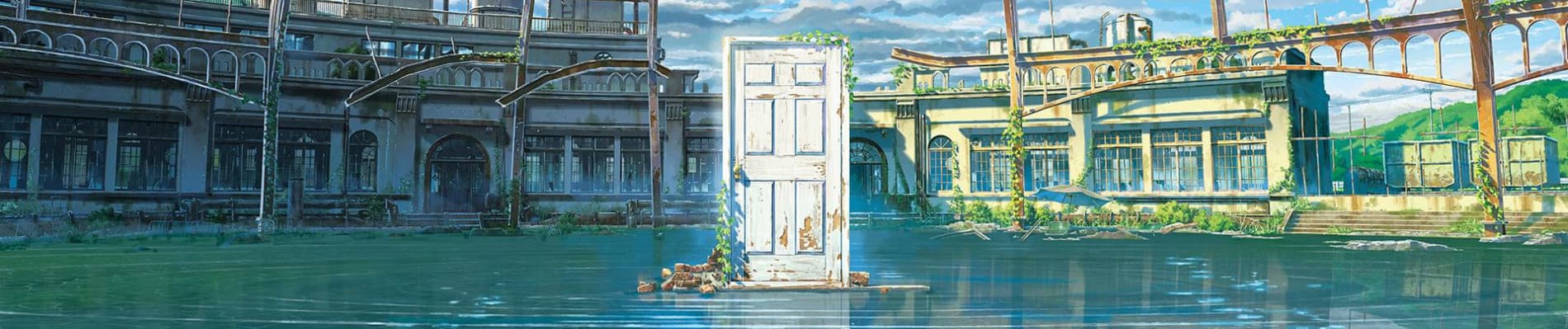
The backgrounds in Suzume are not animation backgrounds. They are something else entirely — closer to grief made painterly, to nostalgia given a color temperature and left to bleed across a frame. Dandelion Animation Studio produces imagery that makes you want to pause every third scene just to sit inside it for a moment. The abandoned resort at dawn. The ruined school overtaken by wildflowers. The endless cosmic corridor where stars hang like held breath. Shinkai has always been a visually gifted director, but here he arguably surpasses even Your Name in terms of sheer environmental storytelling. Light doesn't just illuminate these spaces. It mourns them.
The film understands, at a bone-deep visual level, that post-disaster Japan carries a specific texture of absence — the particular silence of places that used to hold people and no longer do. It renders that absence with aching precision. You feel the weight of the empty roller coaster, the overgrown classroom, the rusted gate. These are not just pretty backdrops. They are arguments the film is making about what it means to lose something so completely that the place itself forgets what it was for.
The technical accomplishment doesn't stop at environments. Nanoka Hara as Suzume delivers voice work calibrated with unusual care — never overselling the emotion, which is a genuine risk in a role that demands vulnerability without self-pity. The animation is fluid in a way that feels almost unfair. Action sequences carry real kinetic weight. Quieter moments breathe with the kind of subtle physical detail that separates great animation from merely competent animation. Whoever signed off on every frame of this film made the right calls. The craft is immaculate in a way that makes the story's failures more frustrating rather than less.
The following section discusses specific plot details and symbolic elements. Skip ahead to remain spoiler-free.
Suzume's childhood chair — the one that eventually houses Souta's displaced soul — appears throughout the narrative with three legs instead of four. The film never announces this. It never underlines it or asks you to notice. But it is always there: a structural incompleteness, something missing that the object has compensated for so long it reads almost as normal. As an externalization of Suzume's grief — a childhood fractured by disaster and maternal loss, a wound so old it has calcified into personality rather than pain — it is more elegant than a dozen expository monologues would be. She has been standing on something broken for so long she no longer registers the tilt.
The time-loop revelation deepens this further. When Suzume discovers that the figure who handed her the chair at her lowest childhood moment was her own future self, the film arrives at something genuinely moving. The comfort she needed — the specific reassurance that she would survive, that she would grow up, that the incomplete thing in her would not be the thing that finally collapsed her — was never available from any adult around her. No one else could give it. Only she could. Shinkai constructs this with real delicacy, and in that single sequence the film justifies its more ambitious emotional aspirations entirely.
It is the kind of scene that doesn't reach for tears. It simply earns them.
The Problems
The door-closing mechanic opens with genuine eerie momentum. The sealed passages to a supernatural realm, the ritual containment of catastrophic energy, the mythology of the Keystones — there is something genuinely uncanny about the early sequences, a sense that the rules of the world are stranger and older than they first appeared. Then the film repeats the mechanic. And repeats it again. Prefecture, door, emotional speech, closure. What begins as ritual becomes procedure. By the time the climax arrives, the audience has already emotionally rehearsed it twice, and the third iteration has to work considerably harder than it should to land with any force.
Plot holes accumulate throughout with the casual confidence of a film that trusts its visual momentum to carry you past them. Often it does. The images are persuasive enough that you follow the logic even when the logic isn't quite there. But occasionally you surface, blinking, aware that something didn't add up and the film has already moved on without addressing it.
The following section discusses the film's climax and central relationships in detail.
Souta becoming a chair is, conceptually, a genuinely bold swing. A romance conducted partially between a girl and a piece of furniture, played with complete sincerity, could be audacious and darkly funny and emotionally resonant simultaneously. Shinkai doesn't quite commit to any of those registers fully. The result is a tonal no-man's-land — the absurdity isn't acknowledged enough to be funny, and isn't suppressed enough to be purely moving. You are being asked to sustain genuine romantic longing on behalf of a three-legged chair, and the film never quite gives you the tools to do it unselfconsciously. It is emblematic of the whole: almost audacious, almost perfectly calibrated. The distance between almost and actually is where the film lives.
Suzume no Tojimari is the purest encapsulation of Shinkai's particular genius and his particular limitation. He thinks in images first and in narrative second, and when those two things align — as they do in scattered, brilliant moments throughout — the result is cinema that lodges itself in the chest and refuses to leave. When they don't align, you are watching breathtaking visuals wrapped around a story that cannot quite hold their weight.
A 7.7 is an honest score. Not a dismissal — the film is too genuinely beautiful, too emotionally sincere, too symbolically intelligent in places for that. But not an overstatement either. Suzume is a flawed film made by someone incapable of making an ugly one. That is both its greatest achievement and its most persistent frustration.
17 out of 20 users liked this review
