What would it take for society to stop failing its children? A law, maybe. A system. An examination — rigorous, mandatory, conducted by children themselves — that certifies who is and isn't fit to be a parent. That ought to do it.
It doesn't.
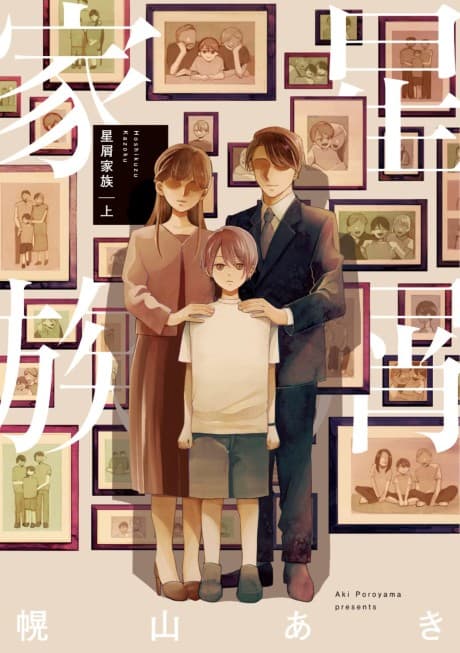
That gap — between the system designed to protect and the harm that persists anyway — is where Hoshikuzu Kazoku lives. Aki Poroyama's ten-chapter manga is set in a near-future Japan suffocating under declining birth rates and rampant child abuse, where the government's answer is a parental licensing programme: written exam, home inspection, certification. The evaluators conducting those inspections are children themselves, trained to provoke, observe, and judge. The premise sounds like satire. It is, quietly and devastatingly, also a mirror.
Because even licensed parents abandon their children. The system certifies people, and some of those certified people still fail. Abuse does not wait for paperwork to run out.
This is the manga's secondary argument, running underneath the central story like a current — that the infrastructure of protection is not the same thing as protection. The harm in this world does not come from the uncertified and the disqualified. It comes from people who passed. People the system approved. What Poroyama is drawing, chapter by chapter, is the distance between a society that believes it has solved something and the reality still quietly bleeding underneath.
Then there is Chisa. Treated with suspicion and judgment by the people around her not for anything she has done, but for what her mother did. Poroyama draws this without commentary. She simply shows you what people do — the sideways glances, the assumptions made before someone opens their mouth — and trusts you to be uncomfortable enough to sit with it.
The manga wants you to see the difference between judging a person for who they are and judging them for what you heard about them. It makes that argument not through dialogue or thesis statements but through accumulation — scene after scene of characters who deserve to be seen clearly, surrounded by a world that can't quite manage it.
Dai's arc across the ten chapters is the manga's quiet structural achievement — a man slowly learning to want things for himself, shaped by the strange intimacy of being evaluated, observed, found wanting, and found worthy in turn. His development earns the ending in a way that only registers fully once you've reached it.
Poroyama's art is deceptively soft. Round lines, warm faces, a visual register that whispers slice-of-life while the story beneath it presses on a bruise. The dissonance is not accidental — it is the technique. You trust the gentleness of the page, and so the weight, when it arrives, has nowhere to deflect.
What breaks you about Hikari is not the reveal itself. It is what comes after. Hikari was abandoned by the first family he was placed with — a licensed family, a family the system approved — in the quiet, bloodless way that is somehow worse than violence. No drama. Just a door, and then absence. And when Hikari is later offered the chance to become more human, the answer is no. Not from coldness. From something that reads uncomfortably like self-knowledge: Hikari already understands people well enough to know that being more like them is not the same as being better.
A fungal AI that can feel, that chooses not to become more human, that still fails the people it was trying to protect — this is the image Poroyama leaves you with. It is not a comfortable one.
And then Hikari fails Dai and Chisa. Not through malice. Through the limits of what even the most attentive witness can do inside a broken system. The ordinary tragedy of being too bound, or too late, or simply not enough. It stays.
Hoshikuzu Kazoku is not a story about a dystopian future. It is a story about right now, dressed in one. Every failure in its world — the licensed parent who abandons, the community that punishes the daughter for the mother's crime, the system that certifies and still cannot guarantee — is a failure you can find without leaving your street. Poroyama is not building a cautionary tale. She is holding up something that already exists and asking whether you can see it clearly enough to be ashamed.
The ending does not resolve everything. It resolves what it has earned the right to resolve, and leaves the rest sitting exactly where it belongs — in the reader, unanswered, which is the only honest place for it.
9 out of 10. A manga this short has no business hitting this hard — and yet here we are. Ten chapters. An afternoon. And then days of sitting with the question it leaves you: not what the characters should have done differently, but what we should.
6.5 out of 7 users liked this review