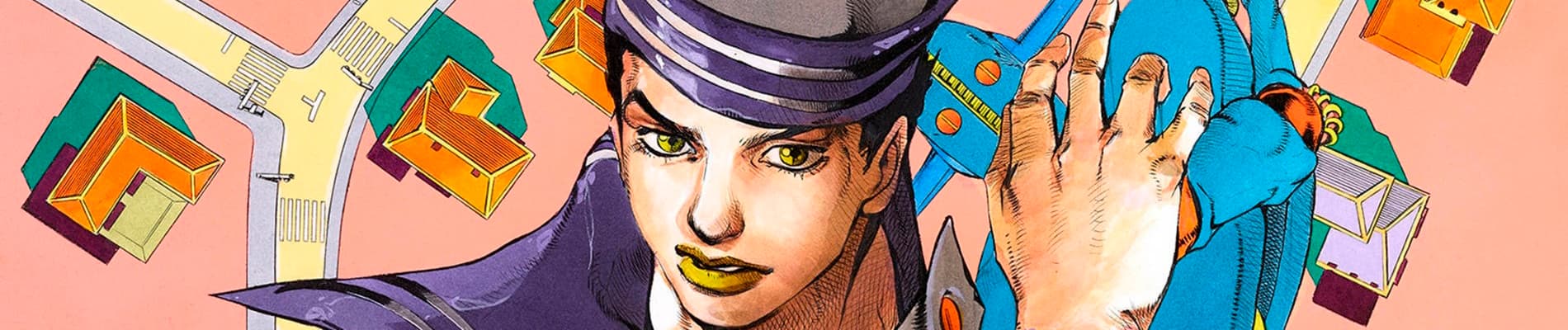
In a world without Steel Ball Run, Jojolion would without a doubt be the best part of JoJo's Bizarre Adventure. And even in the shadow of that absolute masterpiece, Part 8 remains a work of rare depth and ambition, pushing the saga into territories no one could have anticipated. It is the part that best represents what JoJo is in its purest essence, the one that questions most sincerely what it means to be human, and it is today one of my favorite works in all of manga.
Jojolion begins with a simple and dizzying question : who are you when you remember nothing ? Josuke Higashikata is found in the rubble of a wall of bubbles after the Morioh earthquake, with no identity, no past, no name. He is literally a blank slate, a human being reduced to his most raw form, stripped of the social constructions, memories and relationships that normally define a person. And it is from this void that the entire part is built. Josuke's search for identity is not a simple narrative pretext, it is the philosophical backbone of the entire work. Araki asks a fundamental question : do our memories make us who we are, or is there something deeper, something irreducible that persists even when everything else has disappeared ?
And the answer he builds over the course of the chapters is admirably rich. Because Josuke, despite the absence of memory, develops attachments, values, instincts. He becomes someone not by recovering his past, but by building it from nothing. It is a narrative arc that touches on something universal, the question of whether identity is something we inherit or something we choose. And Araki answers it with a nuance and an intelligence that elevate Jojolion well above the simple action shōnen.
At the heart of this journey is Yasuho Hirose, and her relationship with Josuke is one of the most beautiful the saga has ever offered. Yasuho is the first to believe in him, the first to reach out to him when he is still nothing but a walking enigma. Their relationship builds slowly, with a tenderness and an authenticity that contrast sharply with the violence and chaos surrounding them. She is not simply a support character, she is his anchor, his reason to keep searching, and at times his mirror. It is through her eyes that we understand what Josuke is becoming, and it is their bond that gives his quest its most human dimension. Their relationship is all the more moving for surviving everything, the revelations, the betrayals, the losses, and remaining standing until the very end.
The Higashikata family is another of Jojolion's greatest strengths. Each member of this dysfunctional and secretive family embodies in their own way a different philosophy of life, a personal response to the trials existence has inflicted on them. Norisuke, the pragmatic patriarch who sacrifices everything to his family's survival. Joshu, the jealous and insecure eldest who masks his fragility behind aggression. Daiya, Hato, Jobin, each one carries within them a vision of the world, a way of facing suffering, a morality that is sometimes questionable but always understandable. Araki does not judge his characters, he observes them, he lets them exist in their complexity, and that is what makes the Higashikata family so fascinating to follow. They are not good or evil, they are human, and that is all it takes.
And then there is Toru. The main antagonist of Jojolion is a remarkable achievement, precisely because he represents the exact opposite of Josuke on a philosophical level. Where Josuke is a man without a past who builds his identity through his relationships with others, Toru is a man who has sacrificed everything to an abstract idea, who has emptied himself of his own humanity in the name of a goal. His duality with Josuke is not just a physical confrontation, it is an existential debate about what gives a life its value. Toru has chosen to no longer need anyone, to place himself above human bonds, and it is precisely that choice that condemns him. Facing him, Josuke embodies Araki's answer : it is others who make us exist, it is our bonds that give us a reason to fight.
The necessity of memories in Jojolion goes far beyond Josuke's arc alone. It is a theme that runs through the entire part, touching every character in one way or another. Memories as burden, as engine, as identity. Araki explores them from every angle. The Higashikata curse itself is tied to something stretching back generations, to debts contracted in the past and passed down to the living like a poisoned inheritance. And it is by understanding that history, by tracing the thread of buried memories, that Josuke will ultimately find not only who he is, but also what he must do.
The stand system in Jojolion lives up to the narrative richness of the part. Soft and Wet is a remarkably creative stand whose abilities evolve alongside the revelations about Josuke's identity, as if the power itself is being constructed at the same time as its user. The fights are always intellectual puzzles, always rooted in the internal logic of the world Araki has built, and the adversaries Josuke faces, the users of the Wall of Bubbles, are among the most inventive and unsettling in the entire saga.
And then there is the ending. The conclusion of Jojolion is masterful, and that is an understatement. Araki closes Josuke's arc with an economy of means and an emotional power that leaves you speechless. There is no thunderous resolution, no blazing victory. There is something more subtle, more profound, that answers every question posed since the first chapter without ever feeling like it resolves them mechanically. The final scene between Josuke and Yasuho is of a simple and devastating beauty, a conclusion that rings true because it is the exact reflection of everything the part has built. You close Jojolion with the rare feeling of having read something complete, something that always knew exactly where it was going.
Visually, Araki continues to evolve toward an increasingly refined and expressive style, with page compositions that are at times almost abstractly beautiful. Post-earthquake Morioh, with its fractured landscapes and mysterious walls of bubbles, is one of the most atmospheric settings in the entire saga. There is a soft and unsettling strangeness that permeates every panel, a constant feeling that the world the characters inhabit obeys rules the reader does not quite understand yet, and that sensation is maintained with impressive mastery throughout.
Jojolion is a work that questions what humanity is with a sincerity and a depth that are rare in the medium. It is the part of JoJo that goes furthest in exploring its themes, that takes the greatest narrative risks, and that rewards its reader's patience and attention most generously. In a world without Steel Ball Run, it would be the undisputed peak of the saga. And even with Steel Ball Run, it is a work that deserves to be read, reread, and celebrated.
10/10.
32 out of 34 users liked this review