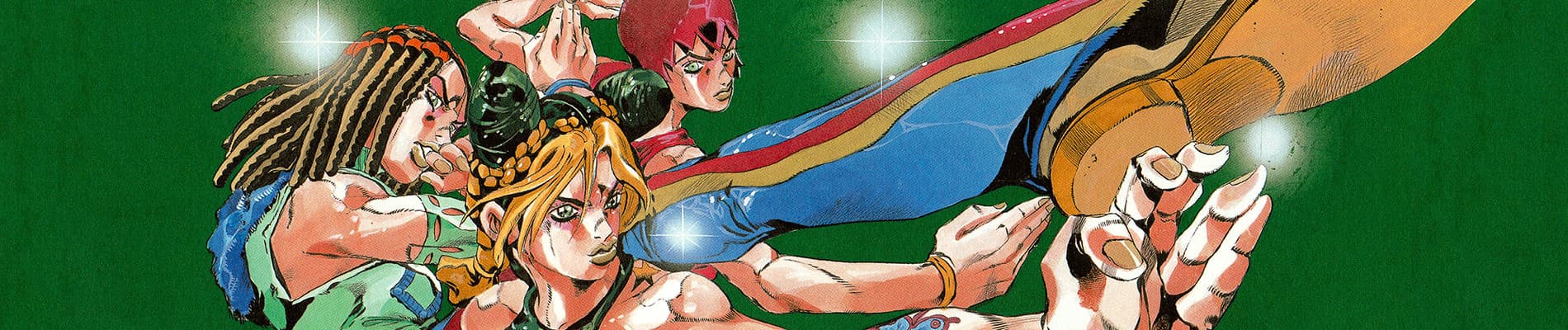
Stone Ocean is a part that divides, a part that many underestimate, and a part that I personally consider one of the most courageous and accomplished in the entire first universe of JoJo's Bizarre Adventure. It is not perfect, it takes risks that not everyone appreciates, but it carries within it a narrative and thematic ambition that makes it unique, and its conclusion is simply one of the best in all of fiction.
Let us start with what immediately makes Stone Ocean so strong : its cast. For me, it is the best cast of the first universe, and that is a claim I stand behind fully. Every character that gravitates around Jolyne brings something unique, a color, an energy, a depth that enriches the whole without ever weighing the story down. Ermes Costello, loyal, raw, driven by a cold rage and an unwavering determination, is the perfect ally, the one you never doubt even in the most desperate situations. Foo Fighters, a non-human entity who gradually discovers what it means to exist, what it means to care for someone, embodies one of the most moving arcs of the part with a remarkable economy of means. Narciso Anasui, eccentric and obsessive, brings a welcome lightness without ever feeling superfluous. And Weather Report, mysterious, powerful, haunted by a painful past that is revealed drop by drop, is one of the most fascinating characters Araki has ever created. This cast works because it is built around an authentic group dynamic, where each member exists for themselves before existing for the group.
And at the center of it all is Jolyne Cujoh. An incredible protagonist, one of the best in the entire saga, and probably the strongest female character Araki has ever written. Jolyne is a revolution within the JoJo universe, and she is that on multiple levels. On a thematic level first, Stone Ocean is a part that tackles subjects of rare density for a shōnen. Through Jolyne and her prison environment, Araki explores the question of freedom in all its forms, physical freedom of course, but also freedom of identity, the freedom to define oneself outside the gaze of others and outside the weight of family legacy. Jolyne is the daughter of Jotaro Kujo, one of the most iconic characters in the saga, and the entire part is threaded through with the question of what it means to carry such a name, such a legacy, and how to emancipate oneself from it without denying it. Araki also explores feminine resilience with a disarming sincerity. Jolyne is confronted with violence, injustice, betrayal, abandonment, and she gets back up every time not because she is invincible, but because she chooses to. There is in her arc an exploration of profound loneliness, the loneliness of someone who grew up feeling misunderstood and abandoned, and who gradually learns to trust, to open up, to let others in. Stone Ocean also speaks about transmission, about what fathers leave to their children, about the debts and burdens passed down from generation to generation, and about whether it is possible to break free from them. It is a part that has things to say about family, about justice, about what it means to fight for something when everything seems lost, and it says them with a conviction and a coherence that commands respect.
On the level of pure character, Jolyne is simply electrifying. She is funny, fierce, vulnerable at the right moments, capable of both rage and tenderness, and her evolution across the chapters is one of the most satisfying in the entire saga. You watch her go from a young woman broken and angry at the entire world to someone who understands what she is truly fighting for, and that transformation is all the more beautiful for never coming at the cost of her personality. Jolyne remains Jolyne until the very last panel, and that is what makes her unforgettable.
Facing her, Enrico Pucci is one of the most remarkable antagonists in the entire saga. What distinguishes him from the other great JoJo villains is the nature of his presence in the work. Pucci is not an antagonist who appears occasionally to confront the protagonists, he is a tentacular presence that you feel everywhere, all the time, even when he is not on screen. He is the spider's web that structures the entire part, the invisible architect of every obstacle, every betrayal, every moment of despair. His agents, his plans, his influence permeate every arc of Stone Ocean in one way or another, creating a constant and diffuse sense of threat that never truly lets up. And his philosophy, his obsession with destiny, with the notion of heaven, with the idea that human suffering comes from uncertainty about the future, is fascinating precisely because it is coherent. Pucci is not a madman, he is a believer, someone who has a vision of the world and is willing to do anything to realize it. Facing Jolyne who fights for freedom and choice, he embodies the temptation of absolute determinism, and that underlying philosophical debate elevates their confrontations far beyond simple physical conflict.
The fights in Stone Ocean are among the most creative and intense in the saga. Araki is at the peak of his inventiveness in designing stands and their clashes, and every fight is an intellectual puzzle that resolves itself in an unexpected way. But among all these confrontations, the one between Pucci and Weather Report stands out as one of the most intense and painful moments in the entire part. This fight is anything but a simple stand battle. It is the convergence point of every narrative and emotional thread that has been patiently woven across dozens of chapters. Weather Report reveals there the full depth of his past, the full tragedy of his history with Pucci, and the confrontation between them takes on a dimension that goes far beyond the combat itself. It is great writing, the kind that hurts precisely because it took the time to build everything before blowing it all apart.
And then there is the ending. Cape Canaveral. The conclusion of Stone Ocean is one of the best endings in all of fiction, and I mean that. Araki pulls no punches, protects no one, and pushes his story to its most extreme consequences with a narrative courage that leaves you breathless. What happens in those final chapters is devastating, unexpected, and yet perfectly consistent with everything the part has built from the very beginning. The final confrontation with Pucci is of a rare tension and intensity, and its resolution literally redefines the rules of the game in a way no one could have anticipated. Araki breaks something irreparable, and it is precisely that rupture that makes the ending so powerful. There is a profound sadness in those last pages, but also something that resembles hope, a fragile and uncertain hope, but a real one.
Because Stone Ocean is not only the conclusion of its own story. It is the conclusion of the first universe of JoJo's Bizarre Adventure, the final punctuation mark of a saga that stretches back to Jonathan Joestar and has crossed generations, continents, decades of fights and sacrifices. And Araki closes that first universe in a way that is both a farewell and a promise, a way of saying that even when everything collapses, even when the world itself is rewritten, something persists. This conclusion is simply brilliant because it dares to go where no other part would have dared, and because it does so with an irreproachable thematic and narrative coherence.
Stone Ocean is a courageous, dense, sometimes imperfect part, but one carried by an energy and an ambition that make it unique within the saga. It has the best protagonist of the first universe, the strongest cast, an antagonist of rare presence, memorable fights, and an ending that will remain etched in the memory of anyone who reads it. It deserves far more recognition than it typically receives.
10/10.
32 out of 34 users liked this review
