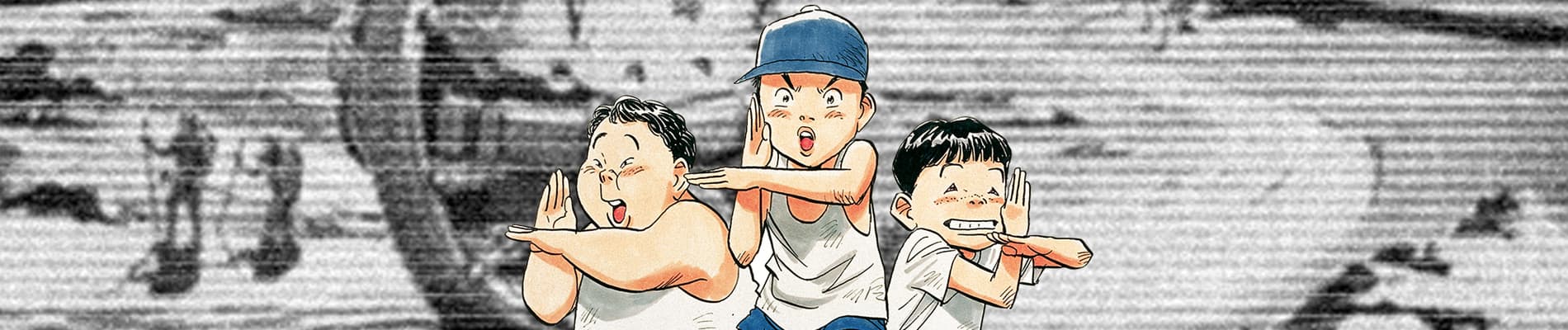
20th Century Boys is not a story about the end of the world. It is a love letter to our own childhood, and a reminder that our actions, even the most insignificant ones in a school playground, resonate forever. Naoki Urasawa signs here one of the most ambitious, most moving, and most intelligent works manga has ever produced. It is an absolute masterpiece, and I say that with the conviction of someone who has been profoundly marked by each one of its pages.
The starting point is vertiginous in its simplicity. A group of children who, during one summer, build a secret base and invent a Book of Prophecies, an imaginary apocalyptic narrative born from their science fiction readings and their summer games. Decades later, those prophecies begin to come true. And behind it all, a mysterious figure nobody knows, that everyone calls Friend, who seems to have transformed these childhood daydreams into a project of worldwide destruction. What was a refuge for imagining worlds becomes the starting point of an apocalypse. And it is heartbreaking, profoundly heartbreaking, to watch those joyful memories, those moments of pure innocence, be corrupted and turned against those who lived them.
Because the true emotional engine of 20th Century Boys is this permanent contrast between the light of childhood and the darkness of adulthood. Urasawa captures with a rare precision and tenderness the carefree nature of summer games, secret bases, first manga readings, those moments when everything seemed possible because you did not yet know that the world could be cruel. And he places opposite that light a group of ordinary adults, tired, worn down, who abandoned their dreams along the way. Kenji wanted to be a musician. He manages a convenience store. His friends have also packed away their ambitions, accepted life as it came, let the spark die out. Their fight against Friend is therefore also, and perhaps above all, a desperate attempt to rediscover that spark they had at ten years old. A way of proving that their childhood meant something, that those dreams had a purpose, that those moments mattered.
The distortion of memories is one of the most brilliant narrative mechanisms of the work. The fact that the heroes have forgotten certain details of their childhood, that their memory is incomplete, imprecise, sometimes contradictory, is the engine of suspense across hundreds of chapters. How can a childhood trauma transform into an apocalypse in adulthood ? Who was really there that day ? What truly happened in that secret base ? Urasawa plays with these questions with an absolute narrative mastery, distilling revelations with a patience and a precision that make each discovery all the more striking.
The cast of 20th Century Boys is one of its greatest strengths, and it deserves to be talked about with the place it merits. What is remarkable about Urasawa is his ability to make every character memorable, including and especially the most secondary ones. In 20th Century Boys, even characters who appear for only a few chapters can leave a lasting impression, can carry within them a humanity and a depth that means you never forget them. It is an incredibly diverse cast, made up of men and women from all walks of life, all ages, all conditions, and each one brings something unique to the whole. A convenience store manager, a housewife, a deserter, a police officer, a child — these are not superheroes, they are ordinary people, and that is precisely what makes them so powerful. Their courage is not that of characters endowed with extraordinary powers, it is the courage of ordinary people who choose not to look away, not to give up, to remain standing out of pure loyalty to their childhood memories and to those they love. And that loyalty, Urasawa draws on their faces with a precision that hurts — the fatigue, the regrets, the years that have passed, but also that light that never quite goes out.
Kanna is the emotional center of the second part of the manga, and she is one of Urasawa's most moving creations. She carries an immense burden : being the daughter of the devil, growing up in the shadow of a man the entire world fears and hates, while trying to follow in the footsteps of an uncle she only knows through stories and an old song. Her loneliness is deep and silent. She unites people around her, she inspires, she protects, she moves forward — but deep inside, she is alone with a legacy she never chose. Her love for Kenji, that man she never truly knew but whose presence permeates her entire existence, is one of the most moving threads in the entire work. It is a love built on absences, on fragments, on a song that returns like a ghost, and it is perhaps the most beautiful of all.
Music is the other great thread running through 20th Century Boys. Kenji's song, with its simple chords and its repetitive lyrics, becomes far more than a melody over the course of the chapters. It becomes a symbol of resistance, the voice of the one who does not give up, the proof that something survives despite everything. Every time it resonates through Urasawa's pages, it sends a guaranteed shiver down your spine, because it carries within it all the hope of the forgotten ones of history, of those who have been crushed and erased but who continue to exist in a guitar note. It is one of the most powerful uses of music as a narrative motif that manga has ever offered.
Beneath its appearances as an apocalyptic thriller, 20th Century Boys is also a social and political critique of remarkable acuity. Urasawa describes with an almost prophetic precision the mechanics of populism, the way a charismatic figure can seduce the masses by playing on their fears, by offering them a simple enemy for complex problems, by building a collective identity based on exclusion and fear of the other. Friend is not simply a manga villain, he is a metaphor for everything the darkest chapters of human history have produced when fear was allowed to guide the crowds. And the treatment of conspiracy thinking, the way reality can be rewritten by those who hold the power of information, resonates with a troubling relevance.
And beyond the monster he represents, Friend is also something more painful and more complex. It is the story of a child who just wanted to play with the others, who just wanted to be recognized, accepted, included. A child who never knew how to go about it, whose loneliness turned into resentment, whose resentment turned into something infinitely darker. There is a profound sadness in the story of a child who went wrong out of loneliness, and Urasawa handles it with a nuance that commands respect even as it sends a chill through you.
The conclusion of Kenji's arc does not end with an explosion. It ends with an intimate confrontation with his past, with a global request for forgiveness, with the recognition that our most innocent mistakes can have consequences we cannot begin to imagine. It is an ending in the image of everything the manga has built, sober, human, devastating in its simplicity.
20th Century Boys is not a story about the end of the world. It is a story about us, about what we were, about what we have become, about everything we left behind as we grew up. And about the possibility, always fragile, always precious, of one day finding again what we have lost.
10/10.
14.5 out of 15 users liked this review