Dorohedoro
a review by DragonDelta
a review by DragonDelta
There are mangas that welcome you in. And then there is Dorohedoro, which kicks the door open with a lizard head, hands you a steaming gyoza, and tells you that if you have a problem with that, the exit is somewhere behind the pile of corpses. It’s brutal, it’s bizarre, it’s filthy, it’s absolutely beautiful, and it is one of the most singular and vibrant works the medium has ever produced. It’s an uninhibited masterpiece a bloody celebration that makes you want to stay until the bitter end, even when your hands are stained with blood.
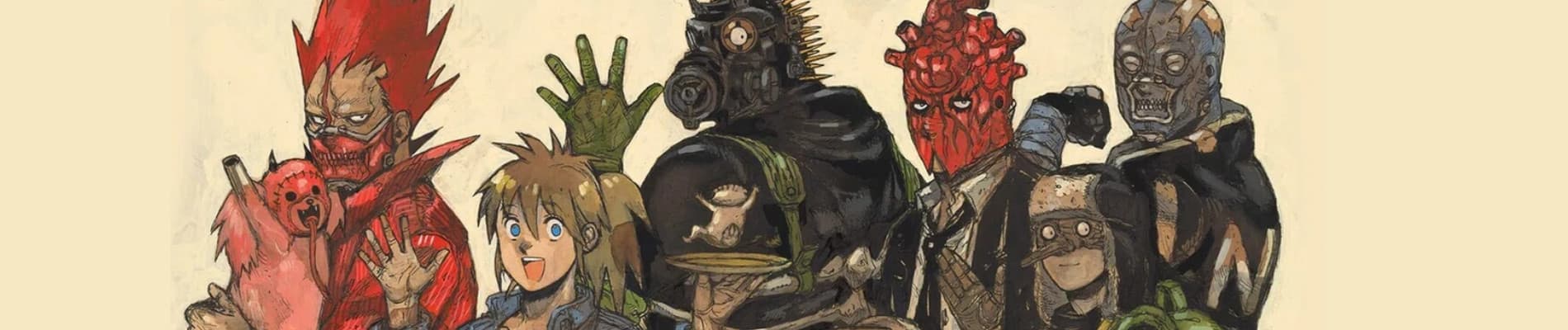
If you are looking for the manga that most directly inherits the spirit of JoJo’s Bizarre Adventure without ever being a carbon copy, it’s Dorohedoro. Q Hayashida and Hirohiko Araki share something essential: the ability to build a universe where the absurd has its own logic, where the strange is the norm, and where visual design is as much a statement of intent as it is a narrative tool. The punk aesthetic of Dorohedoro its iconic masks and outfits that look like they came from a post-apocalyptic wardrobe managed by someone who read too many experimental comics resonates with the same energy as Araki’s improbable outfits and impossible silhouettes. Furthermore, the magical powers in Dorohedoro the "smoke" and its various manifestations are just as inventive, absurd, and narratively exploited as the Stands in JoJo. Every sorcerer has a power that mirrors them, revealing something about their psyche, their desires, and their way of inhabiting a world where magic is both a privilege and a curse. It’s not a clean, codified system; it’s something organic, visceral, and deeply tied to the identity of the user. It is JoJo distilled in a grimy alembic, and the result is sublime.
But what makes Dorohedoro much more than just an aesthetic relative to JoJo is its cast. At the heart of this cast are Kaiman and Nikaido the most immediately endearing, human, and touching duo the medium has produced in years. Kaiman is a man with a lizard head who can’t remember his past and hunts the sorcerer responsible for his transformation by devouring sorcerers alive to see if a mysterious man in his throat recognizes them. It’s the most absurd premise in the world, yet it works perfectly because Q Hayashida never asks you to find it reasonable. She only asks you to trust Kaiman, and that’s easy because Kaiman is immediately and viscerally likable. He is funny, direct, and loyal in a way that feels entirely uncalculated. Beside him, Nikaido is his anchor, his family, and the reason he keeps moving forward. Their chemistry is absolute—two outcasts with blind faith in each other in a world that rarely invites trust.
What makes their relationship so powerful is precisely its normalcy in the midst of absolute abnormality. Kaiman and Nikaido eat gyozas. They joke. They tease each other. They have ordinary conversations in a world that is anything but. It is this contrast this bubble of human warmth and shared daily life amidst the gore and violence of "The Hole" that makes their duo so moving. Hayashida understood something many authors forget: what makes a relationship endearing isn’t the intensity of the dramatic moments, but the texture of the ordinary ones. Every gyoza shared between Kaiman and Nikaido says more about their friendship than any action scene ever could. This duo is what keeps Dorohedoro human in the middle of the chaos, and it’s this duo that breaks your heart when the story decides to come for them.
The genius of Dorohedoro, however, is that it doesn’t stop with its main pair. In this manga, no one is a background character. Every person, whether presented as a protagonist or an antagonist, exists with a fullness and depth that commands respect. The "En Family" is the perfect example of this narrative generosity. En is the big sorcerer, the boss, the apparent antagonist, and yet he is likable in a way that should be impossible given his actions. Because Hayashida gives him humanity a way of loving the people around him in his own way, a sense of loneliness beneath the opulence—he feels real, and therefore lovable despite everything.
Then there are Shin and Noi, the mirror image of Kaiman and Nikaido, and one of the greatest casting achievements in manga history. Shin is a relentless, methodical killer whose signature is the neat dismemberment of his victims. Noi is a fighter of terrifying physical power, capable of regenerating what Shin destroys. Together, they are En's best fixers the most effective and the most redoubtable. And together, they share a loyalty and affection that are among the most touching elements of the entire work. Their relationship echoes Kaiman and Nikaido’s, built on the same absolute trust and warmth in their shared daily routine. The fact that they are killers changes nothing about the sincerity of their bond. This is the core philosophy of Dorohedoro: there are no real "villains" here. There are just people trying to survive in an absurd world, each with their own rules, their own codes, and their own ways of loving and being loved.
The theme of loneliness and belonging is the invisible thread connecting all these characters. Each of them is a prisoner of something their own bizarreness, a past that is either erased or too present, their nature as a sorcerer or a resident of The Hole, and the fundamental fracture between two worlds that do not understand each other. Yet, each of them finds, one way or another, a surrogate family. In Dorohedoro, loneliness is not a permanent condition. It is broken by camaraderie, by loyalty, and repeatedly and wonderfully concretely by food. Shared meals in this manga are political acts, declarations of belonging, ways of telling the other that they exist and that they matter. Hayashida uses food as an affective language with a consistency that makes every scene around a table hum with an emotion you don't see coming.
All of this exists within a graphic style that is a statement in itself. Q Hayashida’s "dirty" and detailed line work is not a flaw, and anyone who thinks so is missing something essential. This dense, organic, sometimes frankly filthy stroke gives every character a sense of flesh and personality that clean, smooth drawings simply couldn't offer. The faces in Dorohedoro are faces that have lived, carrying their stories in their scars and asymmetries. The masks are works of art in their own right, each with its own visual identity, each saying something about the wearer. And the action scenes possess an energy and readability that completely defy the idea that detail hinders clarity. Hayashida draws chaos with a mastery that demands admiration.
Dorohedoro is a bloody feast. But it’s a feast where everyone is invited, where the gyozas never stop coming out of the kitchen, where the world's worst killers share a beer with the most ordinary residents of The Hole, and where you end up loving every single participant without exception because Hayashida had the generosity and the talent to give them all a soul.
10/10
15.5 out of 17 users liked this review
