Dear Violet Evergarden:
With news of your arrival, you managed to rally up our community in a way no upcoming first installment title has before. The way you presented yourself was inviting, enchanting even. Few knew exactly what they were in for, but while not many expected a work as flawed as yourself, they knew to expect something beautiful. Your approach to conveying emotion is interesting, to say the least. Your intentions were rather wonderful: to show someone adjust to life after a war in which her entire existence was predicated towards while trying to understand and convey emotions via letters and experiences in order to understand the last words of someone she loved. You take this robotic husk of a human being, slowly piece her past and how others are affected by said past, and have her grow as a person thanks to the people she encounters and the experiences she has. You showcase the brutality of war and the despair it has on civilians who will never see their loved ones again, all the while showcasing the struggles of adapting to civilization and coping with loss. On paper, it seemed to be a precious concept. While you seem to understand how to convey emotion, how to tie emotional moments together for maximum payoff, and how to truly utilize the audiovisual medium of animation to accentuate every emotional moment, you seem to have a difficult time earning emotional climaxes thanks to your pacing, how you like to spell out how a character, most commonly Violet herself, has grown, and the sheer lunacy you display in occasion. In a way, you’re eerily similar to your main character.
You don’t entirely lack subtlety per se, but you tend to spell out how Violet or another character has developed after an experience or what one of them is thinking that the audience is supposed to take away from a scene. It is the equivalent of Violet telling people how they are feeling. As they do not like it when she does it, it is bothersome when you do it. I like how you try to clue us into the fate of Violet's beloved major early on, simply with the characters’ pauses, their expressions, and how they try to dodge the issue. If you were more like that, simply letting the visuals convey a character’s feelings and what they mean in any given situation, you would’ve been even more emotionally resonant, especially early on and in the very end.
Another hindrance to the power of what you convey is how you skip events. For example, in episode 3, Violet enrolls in a program to improve her skills, and by the halfway point, she still cannot convey emotions in her writing, so she fails the course. After one more exercise after an unknown amount of time has passed, after the course is over, she writes a small, satisfactory letter, and automatically passes. Moments like this feel far too sudden, too undercooked, and thus, unearned. Each story is episodic in nature, in that they begin and end by the end of any given episode. With the way you employed this style of writing, you failed to give yourself enough room for some of these stories to play out properly. As such, you resort to nebulous and/or blatant time skips such as a few month time skip in episode 5, which makes everything feel ridiculous and cheap. The progression of Violet herself is not only spelled out to unfortunate degrees, but erratic and unnatural. Her character builds with each interaction, each letter, and each new event she finds herself as a centerpiece of, but the effects feel ill-prepared. It does not feel disingenuous or forced, but it feels awkward and confused at times. The silliness and even stupidity of some of your situations and outcomes make it even harder to take these tear-jerking moments seriously.
Violet is your primary focus, as she is molded by those around her. She is incredibly well-constructed, with every story hand-crafted to tie into her in some way and make her grow as a person and understand emotions and love better than she did before each encounter, even if they sometimes feel like overdone conveniences for the sake of more tears. Additionally, her progression feels awkwardly handled, and as if she grew far too fast too quickly. The time skips make this even more apparent, such as in episodes 3 and 5. It is also a shame that the characters do not click as well as expected. You give us a few entertaining individuals such as Cattleya, but the rest feel less like distinct characters whose plights shake you to your knees, and more like people designed to get violet to grow and relate for the sake of pruning your doughy eyes. This would be fine if everything felt natural, but it doesn’t, so the cast, while not inherently bad or weak, are not nearly as impactful as Violet herself. Even the rare comedic moment feels forced, and moments of Violet being blunt are somehow far more amusing. Some of the more asinine moments you showcase are equally hilarious, unintentionally so. At the very least, these side-characters generally do a satisfactory job at what they are intended, so emotional scenes work with them, but there is a surprising lack of chemistry between them and violet, or between each other. Some almost feel like they should never be allowed to interact with certain characters lest they become harder to put up with. Other characters can be borderline laughable or outright pathetic, such as miscellaneous military men in episodes such as 8, or the male tsundere in episode 6. Violet cannot carry the weight of your cast on her own, especially when some do the dolls don't even get their closure, unlike the one-offs.
However, as mentioned prior, you have a clear path you intend to tread, and you know exactly how to tie things together, even at the borderline frequent cost of the naturality and subtlety required for you to succeed at your goals. The purposeful irony behind your usage of “doll” is brilliant, as Violet is described as a doll in a variety of ways, from her job description to her as a person. Each story reveals something new about Violet that causes her to relate to them, such as how she got her name or feeling the warmth of knowing a soldier you care about is alive. These are thinly-veiled, however. They are small, fleeting moments strung together in rapid succession to build without realizing the time there must be set aside or how natural and unspoken the growth must be. Combined with the borderline confusing and barely explored world-building, you’re ultimately a worse Mahoutsukai no Yome in this regard, and that's a shame given how you weave everything together to piece Violet more and more together each time, and how you utilized its audiovisual strengths to bolster your moments. These moments grow all the stronger, all the more painful in the second half, as things feel much more grounded, well-paced, and devastating on the whole, while the moments of nonsense stopped interfering for the most part, ending entirely excluded.
Evan Call, oft known as someone who composes good music for bad shows, seems to have broken that reputation thanks to you, as he furnishes you, an actually competent show, with a myriad of emotional pieces that compliment their scenes in a satisfactory way. A few pieces stood out, such as “Never Coming Back” and “Inconsolable” for being the most emotional of them all, and “Torment” for being the only notable string piece full of violins and cellos. While none of his work here truly rivals his magnum opus “One More Time” for an inferior show named Chronos Ruler, this is probably the best soundtrack he has composed overall. Where the music he has gifted you truly shines, however, is with the opening: “Sincerely”, by TRUE. As one of the best opening of the year and one of the most emotional openings, even songs I have listened to, this song represents everything you hope to achieve and moves me even more than your emotional climaxes do. Your ED theme, "Michishirube (みちしるべ)" by Minori Chihara, tries a similar approach, but the vocals can downplay the effects of the sad song.
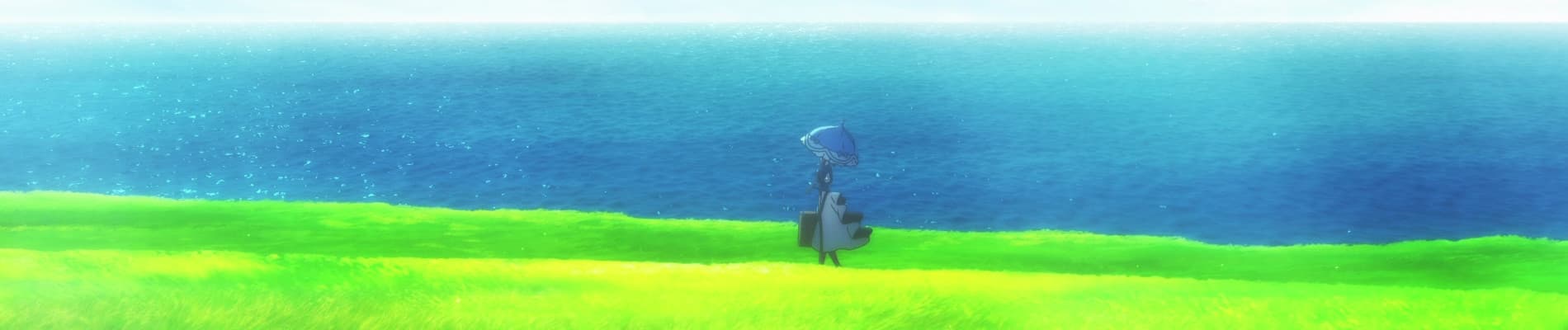
Even with all the grievances I have laid down against you, I cannot deny your beauty. Kyoto Animation worked diligently to craft every scene with luscious detail, with gorgeous, intricate designs, subtle animation movements, and so much more. Even when the light saturation becomes intense at times, those moments have a distinct purpose. Even with the occasionally awkward CGI, it is barely present, so it barely detracts from your beauty. They may have gone overboard in terms of blurring backgrounds for the sake of depth of field, but it does not detract too heavily from what a sight you are to behold. The metallic hands, with all sorts of wonderful coloration, really feel as detailed as a fantastically animated anime film. Even with men that often look far too similar in face, the designs are as beautiful as the women you showcase. It is more than obvious that an immense amount of effort was put into the intricate craftsmanship of your appearance. The directing in some scenes, such as the graveyard scene of episode 8, or the first scene of the first episode, only strengthen the raw emotion being poured out in some of your best scenes. Even with the fight scenes that can only be described as competent, I can barely do justice to how gorgeous you are. Rest assured, as barring borderline insignificant moments and relatively understandable decisions and whatnot, you are one of the best-looking television productions I have ever laid eyes on.
In some ways, one might consider the hype surrounding you to have been incredibly excessive. In others, many seem to have been truly fulfilled by what you presented. Even with emotionally stunted and borderline laughable moments throughout the early half, in particular, you succeeded at being impactful. Apologies are in order, as I cannot give you my happiest regards, regardless of your beauty and wonderful intentions. To the team that crafted you, I wish them luck in future endeavors, and on the prospect of making even better shows in the future. Enjoy the feelings you’ve invoked, and the fleeting moments you showcased to the world, for you’re under the service of many for now.
Sincerely,
Cattleya's secret admirer
63 out of 103 users liked this review