Perfect Blue
a review by AndoCommando
a review by AndoCommando
“Excuse me… Who are you?”
Perspective. Works of fiction such as TV and film are all about perspective. Fiction in general is the classification of imaginative stories, these stories having the ability to convey themes to give stories a deeper meaning. But with TV and film, these stories are presented visually, allowing for a whole new experience and perspective on a story. The perspective provides new ways to justify character actions, events and even reality itself, questioning if what is being show is, in fact, real. This is a movie that focuses on the latter specifically. A movie that not only shows someone losing control over what is real and what is not, but also a movie that lets viewers see the journey to madness first-hand. This is Perfect Blue: a movie that is anything but what the title seems.
Perfect Blue is a psychological thriller anime film based on the novel of the same name, made in 1997 by Studio Madhouse and was the directorial debut of Satoshi Kon; the genius mind behind other great animated works such as Paranoia Agent and Millennium Actress. The film follows Mima Kirigoe, a singer for J-pop idol group CHAM! who decides to leave the group after moderate success and financial limitations to pursue a more profitable career as an actress, much to the dismay of her fans and management. She manages to land a role in a crime drama, however at the same time she starts receiving anonymous threats and even finds a blog called ‘Mima’s Room’ that details her life in intimate detail without her knowledge. This is soon followed with a chain of mysterious murders taking place to the people around her, all while she is being stalked by an obsessed fan called “Me-Mania” and her very own pop idol self in the form of a ghost, haunting her and insisting that she return to singing. Throughout the film Mima questions her decisions as an actress and due to her experiences and events, loses her sense of reality. And all of this correlates to create this dark, enthralling mindfuck that will have you on the edge of your seat like no other.
The story of Perfect Blue does take it’s time to get rolling as it has a rather simplistic setup whilst focusing on the inner turmoil Mima is facing. In other words, do not expect it to be epic from the get-go with action-packed scenes throughout. Perfect Blue is not a thriller in that sense. Rather, the thrills come from Mima’s disfigured perception of reality experienced between her personal life and the TV series she stars in, Double Bind. The film plays with this dilemma extremely well, blurring the lines of reality and psychosis to the point where viewers won’t even know what is really happening anymore. Some scenes with Mima in them were nicely acted and well-shot that at first looked real, only for the film to reveal that she was acting the entire time. Yet she is giving more emotion in these takes than any of her fellow actors, because these scenes reflect on her life. Later in the movie, we are given details of what is initially believed to be Mima’s life and mental health issue, then suddenly the camera pans out and the details were revealed to have been in the script read out by one of the actors in the show. There were so many times when I thought I understood what was happening, only for the film to trick me, to the point where you would think to just give up piecing together the puzzle of Perfect Blue until the end. However, the dichotomy between reality and fiction is weaved so well it compels viewers to continue on.
There is no doubt that Perfect Blue is confusing, especially on first watch. But that is no flaw, it was made purposely to allow us to go through the same experiences that Mima does, and it only gets more intense as it goes on. Each scene is somehow more disturbing than the last, keeping everyone watching in suspense as the rather simplistic thriller in the beginning turns into a psychological nightmare towards the end. And as the scenes get more disturbing, so does the editing and overall cinematography. Satoshi Kon was a genius of editing, knowing exactly when to cut to a different scene for the maximum effect. The film transitions used here are as magnificent as you would expect; in several scenes, the narrative and music builds to its peak before suddenly cutting to the next scene. The film is very much made in the style that you would expect from an Alfred Hitchcock, only here it adds to the confusion of fact and fiction. It provokes viewers to think about the limitless outcomes of how the movie could end, but the movie knows this and continuously swerves the story around movie clichés. The movie even goes so far as to place scenes out of chronological order and some scenes cut before characters can finish their sentences. Everything was done to further put the viewer in Mima’s position; you feel and see first-hand what she is going through. With Perfect Blue, Kon was able to showcase his understanding of the human mind and his ability to further heighten these feelings of isolation and fear.
As you can see, Perfect Blue is primarily concerned with the psychological breakdown of Mima as a result of her transition from a pop idol to an actress, but through this the film strive to find out who Mima is. Numerous times the film shows Mima as a timid person that does not have a strong sense of who she is, preferring to rely on those around her to define her identity. Even if the beginning the film defines her through the perspective of her fans, and from there it is her management that controls her image for their own wishes, going so far as to put her in a rape scene in order to get more eyes on the TV show. While the rape scene is staged, Mima is still traumatized by the experience. The film provides an authentic commentary on the exploitation of woman in the entertainment industry, especially in Japan’s case as Mima’s development shows change internally and externally, from the innocence pop idol perceived by fans of her former self to where she feels as though she needs to be sexually exploited if she is ever going to be able to advance her career, causing further damage to her psyche. These kinds of actions make you think that the price of fame may not be worth the cost of identity.
Perfect Blue also tackles the issue of technology and how easy it is to create, maintain and lose control of one’s own public avatar. Before insanity takes over in full force, Mima finds an internet diary of sorts dedicated to detailing her experiences, feelings and life in general to even the most minute detail without Mima’s knowledge. While finding it humorous at first, her emotions quickly turn to fear as she figures out that she is being stalked, endangering her former sense of seclusion. She is never seen as a hero in the film, rather she is seen more realistically as a victim of lost privacy. Mima’s case becomes worse as the films goes on, with the site publishing false statements under the guise of Mima despite not reflecting her true feelings. Bear in mind that this film started production in 1994/1995, a time where stalking and the internet itself were barely understood, making the film prophetic in its use of the internet. Privacy is an increasing issue in society today, making the dilemmas faced in this film more relatable and realistic, and along with the unclear distinction of what she perceives to be real, makes this tale that much more terrifying.
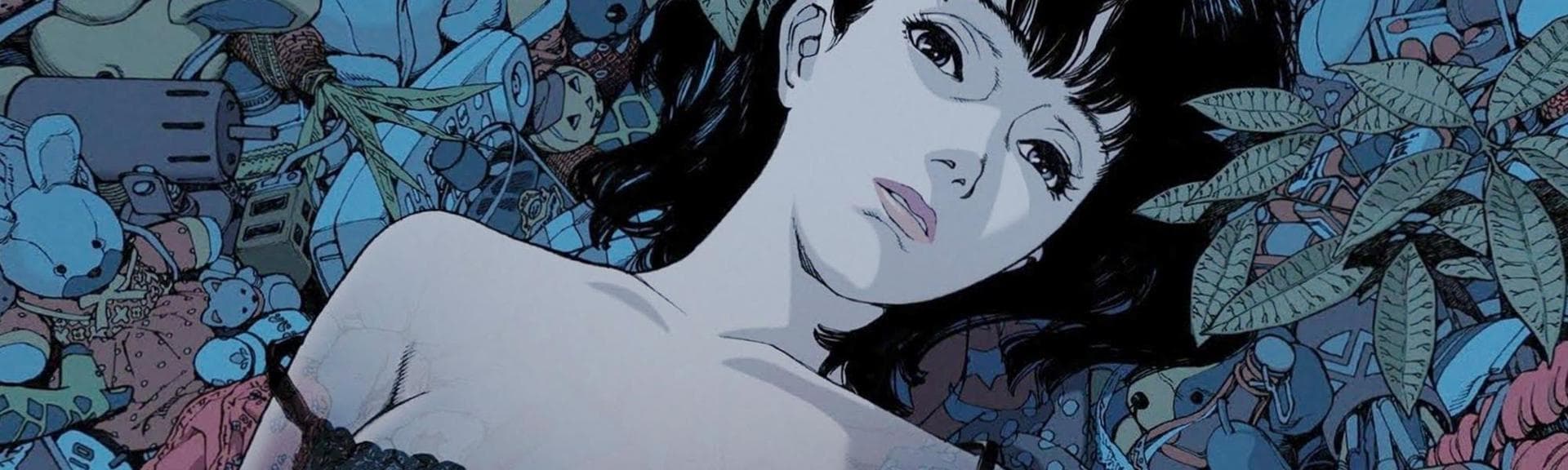
While Perfect Blue is a complex film, it does have an artistic side to it. There are several scenes throughout that while own their own look stunning, but with context signify Mima’s fall from grace and descent into madness. Some of these scenes were so well done that they have been recreated in live-action films like Requiem of a Dream and Black Swan. Despite the film’s title, the colour red is very symbolic as it represents Mima’s madness growing. As the movie goes on, red becomes more and more prominent, from brief items to completely encompassing Mima in some scenes, mirroring what happens in the narrative. Yet the colour never feels out of place in the film; if anything, it heightens the suspenseful nature that the film has. In contrast, white is used with the ghost of Mima’s mind, indicating the former innocence she once possessed in her pop idol career, back when she would have been considered too pure to go through with what is now expected of her as an actress. Reflections are also used prominently to not only foreshadow issues such as stalking and sexualisation, but as an effective way to explore the duality Mima faces throughout the film, further highlighting the identity crisis she faces. The brilliant imagery in Perfect Blue holds within it incredible thematic depth, hidden details and more, all while telling a confusing yet compelling story with seemingly unlimited replay value.
The only glaring weak point that Perfect Blue has is in the sound, specifically the English dub. The cast and acting are both fine albeit some pronunciation issues here and there, but the script for the English version is weaker than its Japanese counterpart and it is apparent. Voice actors for the English dub were recorded one at a time and the depth of voice is off in some scenes, but overall it’s still a fine dub. The Japanese acting however the excellent all around, adding to the creepy and unsettling vibe the show already gives off. The soundtrack is varied, ranging from generic J-pop idol songs to the eerie themes that fit the tense atmosphere. There are even themes that change tone halfway through (for example, a J-pop tune that gets purposely distorted) in order to fit scenes that transition to Mima’s hallucinations, keeping the film unpredictable at every moment. It is complex, melancholic, surreal and beautiful all at the same time.
Perfect Blue is an absolute masterpiece of a psychological movie that feels more real than what we wish to see. Satoshi Kon uses hallucinations, imagery and even a doppelganger within this multi-layered narrative to draw the audience into Mima’s world; a place where her identity and sense of reality is broken more and more as time goes on. The ending of the film revolves around how Mima answers the iconic question from the beginning of this review: "Excuse me... Who are you?". In that sense, Perfect Blue can be considered Mima’s coming of age story, where she began as a character defined by others, and over the course of the film loses everyone around her until she is all alone. In these kinds of moments, the only option left for Mima is to find herself. Nobody can help her through this; she is ultimately the only one who can truly find a place where she knows she belongs. And in the end, she does, but not in a way you would expect. The last scene shows Mima in a car underneath clear blue skies. She looks into the rear-view mirror; looking directly at the audience and smiles, then in cryptic fashion declares:
“No, I’m the real thing”.
33.5 out of 36 users liked this review
