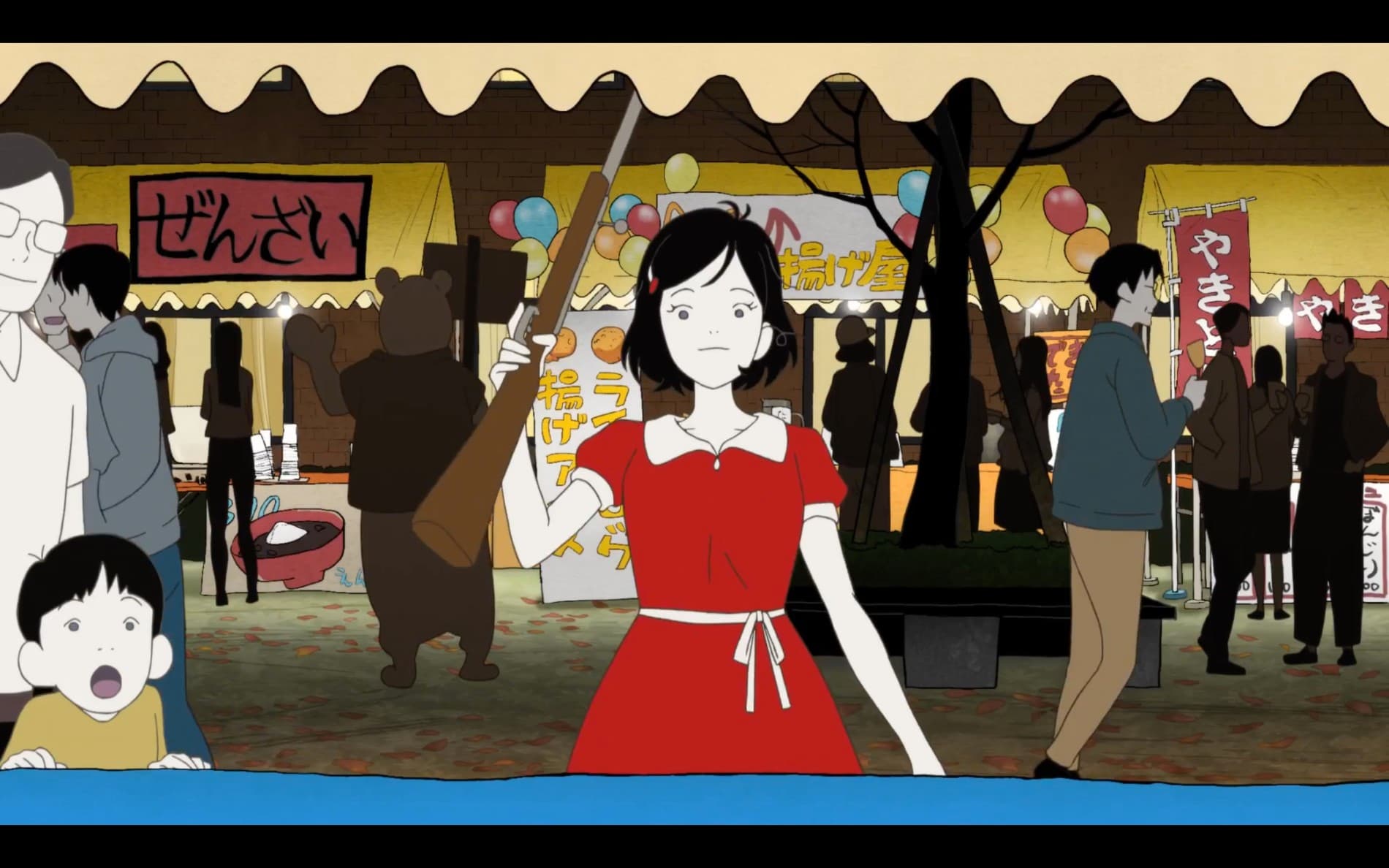
A lot can happen in a night, a night where time moves so fast.
For someone, it might just be a night of humiliation. For someone else, it could be a night that ended gloriously with your dreams come true. For many, it can be a night of adventure. Reality works in some contorted ways. This is further exemplified by the fantastic, reality-bending visuals employed by director Masaaki Yuasa and his team over at Science Saru. The visuals are chaotic, imaginative, and bursting with life everywhere. Everything moves wonderfully and the wonderful designs lend themselves over to both this and the ability to simply expand as they please. Flowers, hallucinations, flames spewing from blazing hot meals, everything is a sheer spectacle that is incredibly difficult to do justice towards.
Of equal spectacle is the narrative. Everything builds off of one another, from small comments in one’s past to events currently happening, and characters you might have not expected to be so reoccurring once their story seemed to have concluded. No matter how absurd, like a tornado blowing fish or a literal literature god who takes book tags and appears out of a book like a pop-up, everything from the first 3 acts pile into one another as one seemingly disconnected story arc weaves brilliantly into another and into the final act once the night has passed. Whereas many bad narratives have the complaint levied on them about how reality seems to bend to the whims of the narrative for no reason, here, that is a physical aspect of the film that brings everything into relevance in completely unexpected and equally glorious ways. It's an incredibly tight circuit of knots of love, alcohol, plays, betrayal, sickness, literature, and world views.
The characters are all as lively as the visuals and bring the chaotic story to life with pinpoint precision. From the raven-haired main girl just strolling and taking challenges throughout the night with friends, to the coincidence-manipulating young, hopelessly romantic lad who takes each opportunity to seize his opportunity with beach task ahead, only for it to not pay off as intended until much later than he expected, we see all sorts of colorful characters tie into each other as time moves differently for everyone, sicknesses and a play are passed down to everyone, and we see both the joy of taking risks in the name of fun and love, and the idea of how everyone is connected in some way in any community. It is glorious to absorb, even if it moved at a daunting pace that matches how short the night is and how much time can really fly.
The music, composed by Michiru Oshima, is wild, carrying a sort of gung-ho attitude to it. It's a fairly good soundtrack, with some equally well-done musical songs for the play that takes center stage in the third act of the four act film. The only decisively weak part would be the ending credits theme, "Kouya wo Aruke (荒野を歩け)" by ASIAN KUNG-FU GENERATION, which, while not bad, is a forgettable track with vocals that feel weak; it is arguably one of his weakest tracks.
Ultimately, this film is a bombastic joy that exemplifies the wonders in life, in one night and a day of aftermath. This film encourages you to not always dwell on how everything can go wrong and sometimes just take the leap of faith, and it encourages you to look back on not just your life, but on the small, fun adventures you take in a day or an evening. On that same vein, you should jump into this film head first and reminisce on its brilliance, messages, delivery of those messages, and its wonderful method to madness. And once you’re done, be sure to join me as we dance the dance of the sophists.
55 out of 56 users liked this review