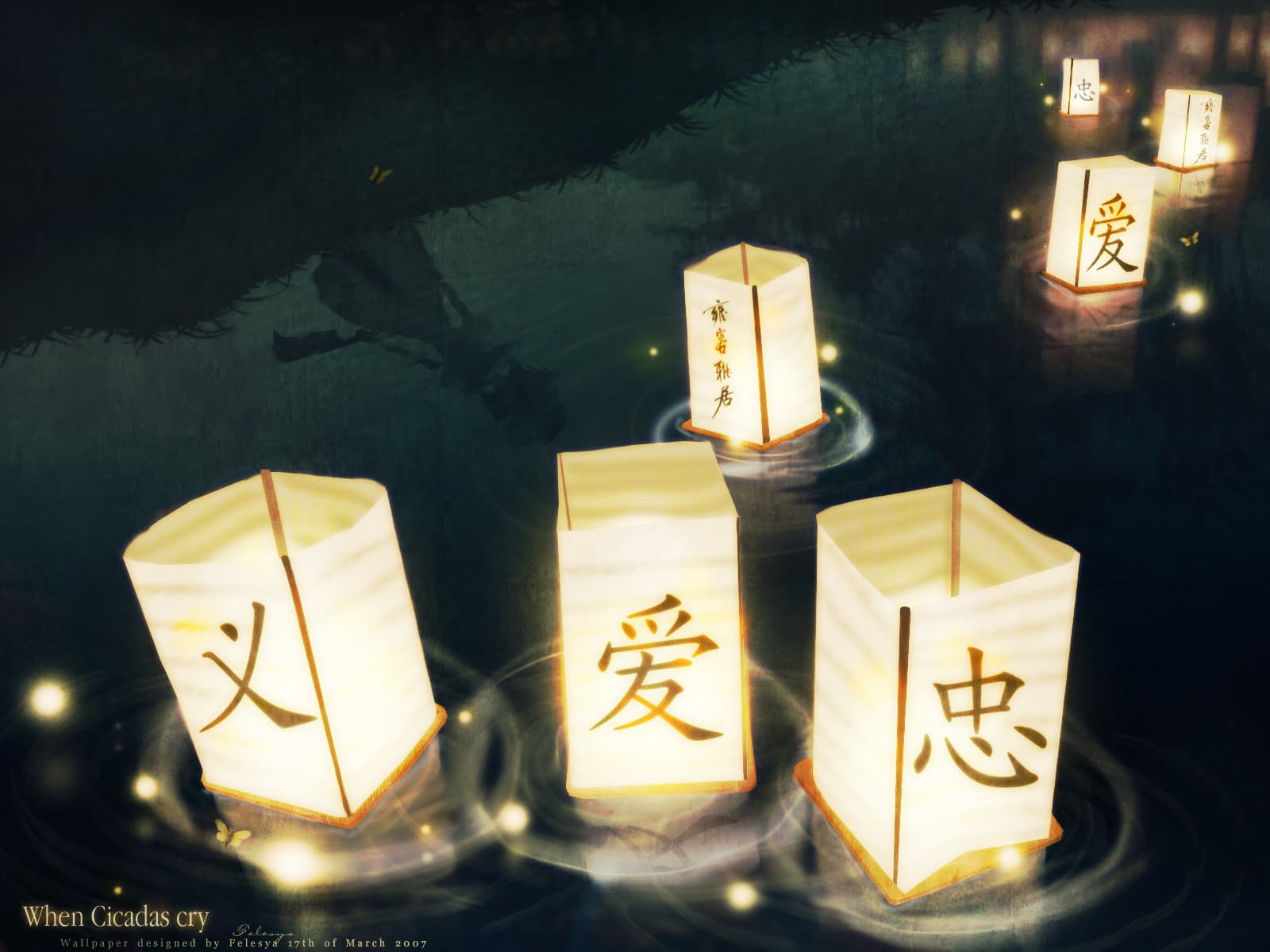
When They Cry
a review by TheRealKyuubey
a review by TheRealKyuubey
Hinamizawa is a village frozen in time, and I’m not just talking about it’s isolationist principals. It’s the kind of small town where everyone knows everyone, and most family names can be traced back for centuries. Despite belonging to a family of outsiders, new resident Keiichi Maebara has had no problem fitting in with the community. In less than a year, he’s already amassed a close circle of friends who are just as snarky, competitive and weird as he is, and his days playing games with them are pure, peaceful bliss... Right up until a chance encounter with a transient photographer leads him to a glimpse into some of the town’s darker, more disturbing secrets. As it turns out, Hinamizawa was almost destroyed to make way for a dam a few years ago, and the conflict eventually resulted in a gruesome murder... And to make matters worse, mysterious deaths and disappearances have literally become a yearly thing in this quiet village, and the deeper he digs, the closer it takes him to the very people he’s becomes close to. With every new discovery leading to more questions, will Keiichi even survive long enough to untangle this vast, intertwining spiderweb of a mystery?
Studio Deen has a pretty dodgy reputation, but they’ve been getting better in recent years. Obviously, 2006 is not a recent year. Well, maybe that’s not entirely fair, because they did release titles that were okay looking, and that’s pretty much the camp that Higurashi no Naku Koroni, also known as simply When They Cry, belongs to. It’s not too bad looking over-all, nor is it the worst thing I’ve ever seen from it’s studio, but it has a hard time not tipping it’s hand as to the fact that they didn’t have a great budget to work with when they were animating it. It checks off most of the boxes for responsibly managing this issue, though... There are a lot of static images and key frames, but the backgrounds are well drawn and highly detailed, and they’re edited in such a way that they never get boring, what with sharp cuts, dramatic panning in all the right places, intense close-ups, and heavy support from the soundtrack and dialogue to keep you on the edge of your seat while it milks the scenery.
It doesn’t always work, however, and you’ll still get the odd moment when two people are having a conversation while walking, and their pictures are basically just being bounced up and down in time with each other while their lips move, which is kind of an ugly exception to make, considering all the other areas where the visuals were able to successfully compensate for their shortcomings. I’m also willing to bet, although I haven’t really looked into this, that having the series largely take place in the same village means a lot of the backgrounds and scenery get reused, which might be why they were able to splurge so hard on background art. I know that at the very least, the repetitive nature of some stories has allowed animation to be reused, although I can’t say for sure whether or not it happened in more than one obvious instance. I will say that for a village we never leave, the range of settings that it lends itself to is surprisingly diverse, even if most areas get revisited a ton of times.
One area where it does come up short a lot of the time is with character animation. Now, in regard to the character design, as cartoony and over-designed as the characters may look, it turns out that they’re just as malleable as the setting, with each one of them having quite a few more outfits than their basic, everyday anime attire. Yes, I say everyday meaning that the characters do generally wear the same clothes everyday, but they have other outfits too, and the switch between them does feel natural with the way it’s all used throughout the story. The repetitive outfits do help in some cases, like in one story arc where outfits being exchanged between two characters is very important to the plot. The area where the animation falls short is in some instances where we get the aforementioned dramatic close-ups, and the artwork gets so distorted that even if it works in the moment, they look really weird when paused. The characters also unfortunately stray off-model more than once, with some shots showing their legs looking about an inch thick, and some truly derpy expressions for anyone willing to search for them.
The character designs do manage to shine where it counts, though. This is meant to be a horror title after all, and while their outfits and hair colors may be a bit on the goofy side, they’re still designed to be extremely expressive, and instead of the sweet doe eyed smiles and waterfalls of tears that you may expect from similar moe-inspired characters, their faces can contort in very frightening ways, showing off a range of emotion that can convey paranoia, fear, exhaustion, full-on batshit insanity, and in some cases, the cold dead eyes of hopelessness and resignation. Keep in mind, some of these characters are still little, like, literally little. A couple of the female characters have very generously endowed figures, which you’re probably no stranger to if you’re into anime, but even when they are showing cleavage or baring skin, they’re never sexualized, either by the story or the camera. If anything, some of their most revealing moments take place in scenes where you’re meant to be more worried than titillated, with their exposure linked more strongly to their fear and vulnerability than to your pleasure.
The music in this series, for the most part, is very subtle, and used almost exclusively as support for the story. Aside from the obligatory fun with friends music, of which there are a few generic sounding tracks, the composers knew exactly what they were doing whenever it came time to accentuate the tension of a scene, which they can do with nothing more than a few well-picked notes to drone on while these pivotal scenes build up to their inevitable conclusions. One of my favorite tracks is Michishirube, which they play during a lot of the more sad or depressing moments, making it instantly recognizable not just for the feelings it evokes, but for it’s attachment to some genuinely heart-wrenching moments. There’s also a lot to be said for the sound design, which takes the place of the music in a lot of instances, with such effects as concurrent thuds and especially with the shrill cry of cicadas, or Higurashi in Japanese,which the series was of course named after. Sounds like these are way more memorable than the music, which feels like it was kind of the point.
As subtle and forgettable as the music may be... And I have spoken to some people who didn’t realize the series had music at all, which speaks to how good a job the legendary Kenji Kawai did... The opening to this portion of the series is my favorite of all time, and no, that’s not me using hyperbole. The song captures all of the tension and drama of the series, with almost all of the more chilling sound choices taking place in-between the actual verses, and it’s easily one of the only anime songs that I feel gets better when you listen to the original, uncut version, which opens on a more creepy, demonic sounding gasp of a note that wouldn’t feel out of place in a Fatal Frame game. The actual video is filled with imagery that carries the themes of the series as well as clever foreshadowing as to the fates and pasts of the characters. It’s hard to decipher what they all mean without seeing the entire series, so you can’t really appreciate how brilliant the image of Rika taking off a mask really is until later on.
Having said that, I think most audiences will be able to grasp the significance of all the flowers and kaleidoscope imagery, at least as far as it’s representation of twisted, distorted innocence, and while that’s not the central theme of the story, it does support it’s more important themes quite nicely. They're performed by a woman named Eiko Shimamaya, a Japanese singer who’s best known for her work on this series, because she sings the opening and closing song for both seasons... And yes, this means she also sings the English language closing song, Why or Why Not, which is sung from the character Rena’s point of view as blood flows over a black background. This, as well, is really awesome.
The English dub, like the animation, is okay. It start s out on a really weird note, with the actors using voices that were obviously directed with the intention of matching their Japanese counterparts, but this is usually a really bad idea. Considering this was a Geneon effort, it’s also not a surprising choice, as a lot of their dubs towards the end of their existence were plagued by screechy, unnatural sounding performances of women trying their best to sound like moe characters, which there really isn’t any English language equivalent to. The problem is just as bad here, but the actors did the best they could with it, and it does get mostly better over time. The voices almost all sound unnatural and awkward, but the actors do settle into their roles fairly quickly, if you manage to stick around long enough for them to do so. The acting, in spite of this unnatural quality, is largely competent, but the performances are just about as inconsistent as the moods swings of the cast.
Grant George, who has a very long resume in both Japanese and American productions, does an admirable job as the lead role Keiichi, even if the voice he has to use sounds like somebody doing a really bad impression of Bob Dylan. He shares a similar quality to most of the rest of the main cast... He sounds weird and awkward during his down-time, but shines really effectively when he has to push the character to more intense material. The same thing goes for Rebecca Fortstadt as Rika, Jennie Kwan as Satoko, and Mela Lee as Rena... They sound almost unbearable most of the time, and rarely ever sound like actual people, but when they have to freak out, scream, or, you know, act at all, you’d practically forget any complaints you may have had about them before. There are two exceptions to this,. and the more bizarre one is Megan Hollingshead, who you may know as both Officer Jenny and Nurse Joy in the earlier seasons of Pokemon, who plays Mion Sonozaki, among others.
With her, it’s the opposite situation. She sounds great normally, matching her Japanese counterpart beat-for-beat, even improving faster than her peers after the awkward beginning, but it’s during the more intense scenes where she has more trouble, sounding over the top and hammy instead of genuinely insane. The other exception is with the supporting cast, most of whom actually used their real names in the credits(the only main actor to do this was Grant George), and while Kyle Hebert and Karen Strassmen do some pretty solid jobs as the ill-fated Jirou Tomitake and Mio Takano, the actor who most impressed me was John Snyder in the role of Detective Oichi, a character who’s personality seemed to change depending on each story arc. Aside from these names, The English dub may be serviceable enough for hardcore dub fans, but it doesn’t hold a candle to the original Japanese. Back when this series was still new, the terrifying performances of the female seiyuu were legendary, and kind of turned the series into a viral hit. The sub is highly recommended in this case.
Speaking of those performances, Higurashi’s popularity in the states is very similar to another title that came out around the same time, The Melancholy of Haruhi Suzumiya(It’s eerie how many discussions lead to her, isn’t it?). Both shows slowly gained an audience through viral exposure... Replace the Hare Hare Yukai with videos of over the top death scenes and scary Japanese laughter... And soon took the nation by storm, becoming one of the most popular and well known titles, before the diminishing returns of it’s franchise caught up with it and it faded back into obscurity. These days, it’s easy to find people who’ve never seen either title, which used to not be the case. The difference is that unlike that famous moe nerd comedy, the original Higurashi series has aged really well, at least in terms of story and content. However, since it’s been largely forgotten, I can’t stress enough that this is a show you really need to go into blindly, so before I go any further, I have to ask that you at least watch up to episode 5.
Did you do it? You promise? Good. Rena hates liars.
Now, if you’ve gotten that far into the series, you’ve probably noticed a few peculiar details, some of which you may have questions about. Yes, the story escalates very quickly, but more importantly, if you’re like me on my first viewing, you might be confused as to why and how the series reset itself. That’s something you’re going to have to get used to with Higurashi... Rather than one long continuous story, it’s made up of several smaller arcs, which occupy completely different timelines that focus on their own unique situations and perspectives. Setting aside the how, as I promise there is an in-universe explanation for it, the reason why is because this anime is based on a series of visual novels, and if you know anything about those, you’ll know that VN’s and dating games present a tricky challenge to anyone who wants to adapt them... How do you make a coherent series out of a story that has so many branching and unique paths to explore? There are many answers to this dilemma, most of them bad, but Higurashi luckily had the perfect solution ready and waiting in the source material.
I won’t spoil what the secret behind it is, especially because you won’t officially learn it until the second season, but there is a reason that time is always rewound after a huge disaster, and it has several effects on the story, both positive and negative. On the positive side, the pacing is unusually tight, and while the series does have a tendency to goof off in the early stages of most arcs, none of it ever feels like wasted time... Not even the Time Wasting Arc, which, yes, is a thing. Another benefit is the lack of plot armor, as any character can die at any time during a story, and they’ll be there again in the next arc. You would think this would take away the tension and stakes of any given scenario, but you’re wrong, because some seriously strong writing gives each arc a healthy dose of gravity and stakes, which they go out of their way to make you care about, resurrection be damned. Of course, then you have one of the biggest drawbacks of the series, which is the heavy amount of inconsistency between each arc.
First of all, while we’re supposed to believe this is just the same period of time repeating itself, there really isn’t any clear divergence point. Rather, most stories, save for two that work as mirrors of each other from different perspectives, follows a totally different series of events, which feels less like a proper Butterfly Effect story and more like the writers just doing whatever the hell they want. There are some details that never change, such as Hinamizawa’s history and certain events taking place at the Cotton Drifting Festival, but aside from that, some of the changes can be baffling at best and stupid at worst. Like, you’ve seen episode five, right? Notice how easy Mion gave up the fact that she had a twin sister? In the first story arc, she was tight lipped about a lot of her personal details, but she doesn’t even question how Keiichi met her sister, or what he thought of her. I can only assume this was done to service the reveal at the end of the episode, but it feels like a full-on betrayal of her character.
There are a lot of inconsistencies like that, and while I’m glad that certain details that were meant to be reveals and mysteries in previous arcs become common knowledge in future arcs... It does, at least, keep the story from becoming repetitive... It has another element working in it’s favor. Higurashi likes to play around with the concept of an Unreliable Narrator... You know, that literary trope where you don’t know the truth of a story, because it’s being told from the perspective of someone who’s too biased or unstable to give you an accurate recounting of events? There’s more than enough evidence in this story to suggest that it’s narrators don’t always see things as they are, and there are times when you can’t really guarantee if entire events are really going down as you’re seeing them. you can’t trust what’s real and what’s not, which works as an excuse for Higurashi to do plenty of things that I’d call shenanigans on with any other anime. You don’t know whether characters are really living, dying, or even present when you’re told they are, so of course some personality based inconsistencies are going to happen.
Besides, even with those inconsistencies occasionally working against them, the cast of characters in this series is still absurdly strong. They’re all complex and layered, with their own unique flaws and motivations, and these play very well into their own individual stories. To be fair, they don’t all get their own perspective stories, at least not in this season, but they’re still at least explored thoroughly in other character’s stories, either as antagonists or in supporting roles. The issues these characters go through are unbelievably relatable, as well. Even though most of us have never had first hand experience with the more horrifying elements of the stories... Let’s face it, most people don’t wind up involved in the middle of conspiracies or murder cases... They do have to deal with real world issues, like divorce, child abuse, watching loved ones suffer and get taken advantage of, family drama and forbidden love, and while the way they approach and resolve their issues may be extreme, it never feels melodramatic or cheap, because of how well we know and care about the characters.
If I had to group all of these situations into one theme, which would admittedly be a huge stretch, I’d have to see that this is mostly a show about secrets. It’s about the dark secrets you keep from others, secrets you know are being kept from you, what you should and shouldn’t tell your friends and the possible consequences of digging too deeply into someone else’s affairs. This theme is explored thoughtfully, and from many angles, and to be honest, I can personally relate to it, because I’ve been on some very distinct sides of it. I’ve been left in the dark plenty of times in regard to issues directly effecting me. My whole family keeps secrets from me and other people just for the sake of convenience, using obvious strategic lies that I felt alienated by. I used to have friends who I thought I could trust, but who dug up dirt on me behind my back and spread it all to pretty much my entire workplace. I don’t know if you can find all this relatable, but for me, it hits really close to home.
Of course, there are some problematic elements. On top of other issues, there’s some really outdated gender politics on display, with more than one instance of female characters basically being told to smile more, and there’s one really awkward moment where a grown man expresses a genuine interest in romantically pursuing and eventually marrying a preteen, but considering the fact that this is supposed to be 1980’s Japan, we should probably just be grateful that it isn’t worse. Also, while I’m glad there isn’t any obvious romantic sub-plot among the main cast(aside from some flirtatious banter and a couple of hinted or confirmed crushes), which I understand is accurate to the non-H VN, but there is one story arc that could be described as a yandere-type situation, with a character’s psychotic behavior tied directly to her unrequited love for another character, but I’d also argue that her circumstances are much more forgivable than they would be in most similar titles.
Higurashi , or When They Cry, is available from Sentai Filmworks. The original Geneon DVDs are out of print, but the new format is way superior, because there’s a Bluray option, and the disks are divided so that each one carries a different arc, so it’s easier to watch whatever individual story that you want without having to change disks. Sentai also released the sequel, Higurashi Kai, and one of the OVAs, Higurashi Rei, in the same format. Three other OVAs have not been released stateside(but you should totally check out Outbreak), neither have the awful live action movies. The light novels and a live action TV show haven’t been released either, but the manga has been released stateside by Yen Press, and it contains some crazy details from the games that the anime omitted. I don’t know any specifics about the games, but I’ve heard some of them are available online. There’s also a spiritual successor called Umineko, which I’ve seen, and it’s honestly pretty awful, but it’s still kind of interesting with some of it’s choices, so give it a watch.
Higurashi might just be one of the most effective horror titles in anime history. It’s MO is to keep it’s focus on suspense, building up scenes of simple conversations and interactions with tense music and creepy, unsettling direction, leading to pay-offs so abrupt and shocking that most of them have become memes or AMV Hell jokes in the years since. It avoids using jump scares like the plague, and keeps it’s horror elements centered firmly on the story and plot, and while it doesn’t go out of it’s way to be edgy or disturbing, it still never shies away from showing the gory details of any given scenario when the time is right. The mystery is tightly woven and full of red herrings and unanswered questions, and while it lays out several details at a decent pace, it still leaves enough loose threads to leave you wanting more, even if the second season winds up being a bit of a disappointment. It’s not perfect, though, and even if you were to excuse the lackluster visuals and spotty dub, the writing itself still leaves enough holes to tarnish what could have been considered a masterpiece. I give Higurashi: When They Cry an 8/10.
82 out of 89 users liked this review
