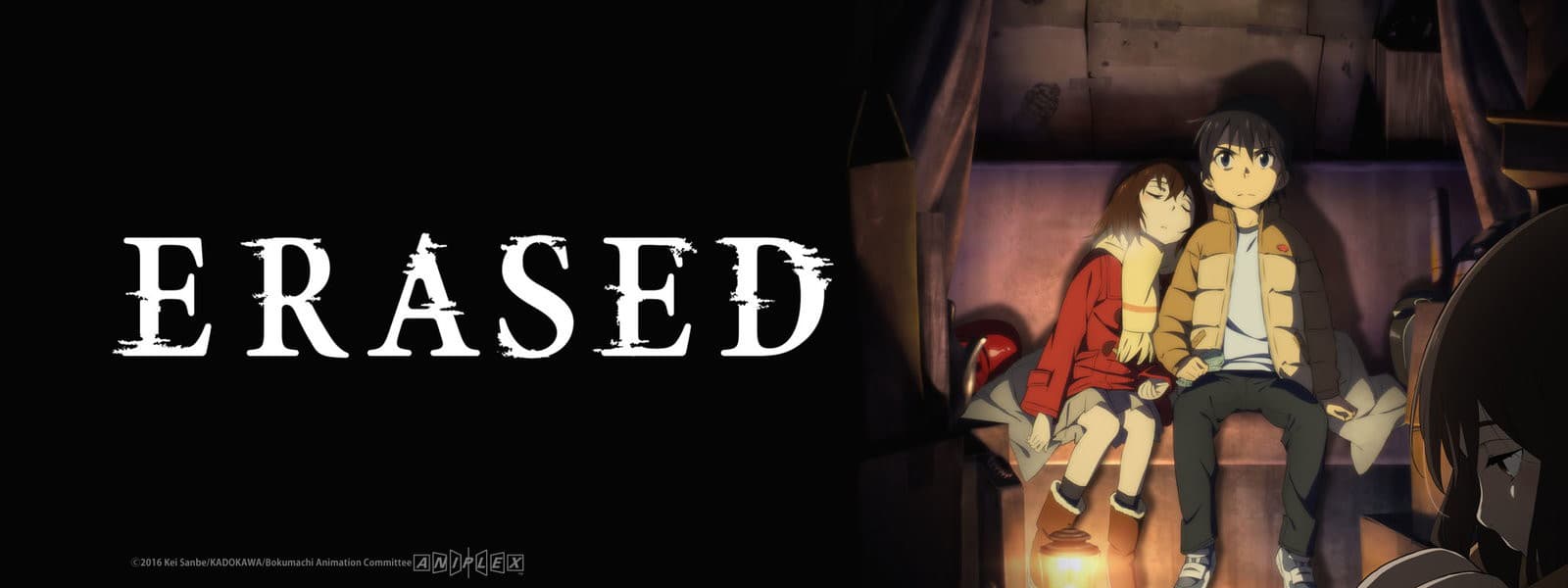
ERASED
a review by AndoCommando
a review by AndoCommando
Hype can be a fickle thing when it comes to seasonal anime. At first it allows fans to get excited and anxious for the next episode, but majority of the time it ends up with many feeling somewhat disappointed with what they had been watching. This can be attributed to the fact that only one episode is released per week, and this week-long wait between episodes is a breeding ground for die-hard fans to praise a show as one of the best anime after only having seen a couple episodes. You only have to see the ‘Top Anime List’ on MAL to see that whenever you’re reading this, there’s probably at least one show currently airing that snuck its way onto the list, only to slowly drop off once hype dies down and reality sets in. At one point I was a victim of this mentality, but now after experiencing disappointment as a result, I see hyping up a show like this as asinine, often leading to impairments in judgement. Erased, a Winter 2016 anime produced by A1 Pictures is one of the best examples of this: before the halfway point of its runtime, Erased had managed to capture the #4 spot on MAL’s Top Anime List, a feat I have never seen any other weekly seasonal anime do. And as I am writing this it isn’t even in the Top 50 anymore, with many of its top reviews being negative; truly a fall from grace. So, looking back at show over a year since it ended, here are my thoughts on Erased:
*EDIT: SPOILERS ABOUND, BEWARE IF YOU LIVE UNDER A ROCK AND SOMEHOW HAVE NOT WATCHED THE SHOW YET*
The story of Erased follows Satoru Fujinuma, a struggling manga artist in his twenties living a rather dour life, having to work a pizza delivery day job to make ends meet. However, Satoru has a supernatural ability called ‘Revival’ that causes him to travel back through his own time, usually only by a couple minutes, allowing him to stop any accidents or disasters nearby. The catch is that Satoru’s time-travel ability works out of his control, being the setup for the premise of Erased. By the end of the first episode Satoru finds his mother murdered at his house, and is quickly framed as the prime suspect. This chain of events causes Revival to activate, sending Satoru 18 years into the past and back to his 10-year-old child self. Seeing this as a sign, Satoru uses this opportunity to prevent the abduction and murder of three young students at the hands of a serial killer, starting with the first victim, Kayo Hinazuki. The premise alone is nothing special and somewhat contrived from the start, but the way it is presented through great visual direction along with setting up an important mystery element in the murderer/serial killer leaves viewers eager to see how things will unfold.
Episodes 2-4 are what I consider to be the highlight of the entire show. It’s in these episodes where we see Satoru attempt to save Kayo’s fate through befriending her when no one else would. Kayo is cold towards everyone due to domestic abuse from her mother and her overall troubled life at home, so it’s no surprise that she does not care about Satoru’s attempts at friendship initially, but Satoru remains committed and continues to pursue her. The process takes some time but she slowly opens up to Satoru and sees him more like a real friend as time goes on. The 4th episode also leaves us with a cliff-hanger regarding Kayo’s safety; was Satoru successful in stopping Kayo’s fate? Or was all his effort still not enough to change the past? The character interactions, atmosphere and overall direction all worked well here, drawing more viewers into the world, the relationship between the two leads and Satoru’s goal. The supporting characters also get some shine on screen, with Satoru’s mother Sachiko and his teacher Gaku slowly getting more involved in the main plotline, as well as his friend Kenya who seemed to know more about the story than what a boy his age should have. Characters still need more development, questions still need answering and they could use some more exploration overall but from the great setup so far, it’s not surprising that fans were excited for the series and what would happen next. Sadly, this was the highlight of the show, meaning what would happen next would be when the series starts to fall.
It’s revealed in episode 5 that Kayo did in fact go missing, and Satoru having failed to change the past is brought back to his own time, still under suspicion of Sachiko’s murder and goes into hiding. He encounters Aira, his co-worker who believes him to be innocent and allows him to stay at her place. Aira was on screen with Satoru before the time-skip, even admiring him after seeing him save a child from being hit by a truck, but it’s here where her overall character is explored and, unfortunately, there’s not much to go into. Airi and Satoru have a conversation about how she can trust him and she reveals how her parents divorced over the theft of a chocolate bar, this being one of the dumber explanations in the show overall. Regardless, from using that awful example she states how she has conflicting thoughts when it comes to believing in people and their motives. This could have been an interesting concept if explored into, but that never happens, and that seems to be a common nuance I have with the show overall. It has these interesting concepts and elements that could have the series more interesting and deep, but they all end up being undeveloped, underwhelming and a waste of potential.
The writing only gets worse from here. Satoru activates Revival through sheer willpower and reverts back to his child form soon after he is found and arrested by police, and with this second chance he intends to do everything he can to stop Kayo from being kidnapped. His actions go so far as to ‘abduct’ her himself and attempting to murder her mother. Both of these actions are pretty ridiculous, especially when you consider that it’s a 29 year old man that’s doing this, not a child. Eventually he returns her to her mother, who reacts violently towards Satoru and Sachiko, going so far as to try and kill Sachiko with a shovel. Now it is obvious that Kayo’s mother is a loon that needs more than just counselling, but I find it annoying how she was previously shown to have gone through all the trouble of making sure her abuse wasn’t noticeable, given that she was shown to have almost struck her daughter while in the company of other people. Through poor writing as the plot progressed, she proved to only be a one-dimensional villain; a mere caricature that ultimately holds no merits. Unfortunately, she’s not the only one who turns out like this.
It is at this point where I see the story start to turn into shambles. Because of her mother’s actions, Kayo moves away to live with her grandmother and away from Satoru, and with that subplot finished, Satoru begins on working to save the lives of the other two abductees. So far the show was loved by many at this point because of the progression of Satoru and Kayo’s relationship and their individual development; Kayo learning to open up to others and Satoru never giving up on others. It was a cute friendship with hints of romance that swooned the anime community with its cute charm and visual guise. So when one half had left the show, it made many viewers feel like their investment had been somewhat wasted, myself included. However, there are more problems that stem from this change of focus, mainly in regards to the characters. The other two victims are Hiromi Sugita, one of his classmates, and Aya Nakanishi, a student from a neighbouring school and viewers learn next to nothing about either character. While Kayo was never the pinnacle of character development by any means, she mattered so much more to the overarching plot than Hiromi and Aya. It is so obvious that they are nothing more than replaceable characters to make Satoru look more heroic and likeable. Other supporting characters are also left lacklustre, with much of their rationale turning out to be, ironically, irrational. Kenya, one of Satoru’s classmates, is perhaps the biggest example of this, seeming to be a character that was far more intelligent than he initially led on. But he just ended up getting shafted by poor writing, like most of the other characters in the show. The best character by far is Sachiko, and the reason why is because all of her actions are completely logical as well as the fact that beyond episode 1, she is never really explored, thus never even having the chance to get screwed up unlike everyone else.
But there is one character that stands out from the rest by just how awful he was utilized, and that is the real culprit; the man that abducted Kayo 18 years ago, and in present-time killed Sachiko. That man was revealed to be none other than Gaku Yashiro, Satoru’s homeroom teacher. This revelation is made in episode 10 to Satoru minutes before his apparent death by being trapped in a frozen lake. This moment had any sense of shock or suspense completely absent because no one who watched this show was even surprised! The killer’s identity is so obvious that it destroys any element of mystery – which it was initially marketed as – and does not help the show in any possible way. It only takes a couple episodes to figure out who the killer is with the blatant foreshadowing, and even if by some chance you don’t realise it then, it’s simple process of elimination. Just ask yourself “Which characters look like the killer?” and there’s probably only one person that comes up. Another issue I have with the character is how he is presented as a mastermind for half the show, seemingly omnipresent and always throwing the blame to someone else. But towards the end, he turns into this incompetent idiot so drastically that it’s laughable. Gaku being caught as the killer is also incredibly stupid to the point where you legitimately cannot take the series seriously anymore. It’s as if his entire development jumped off a building ala Satoru in the last episode. Terrible
Matter of fact, the entire ending is terrible and leaves a sour taste in the mouths of even the most die-hard fans. From the lead up with Satoru being in a coma for 15 years, to the final moment where Satoru and Airi meet again, it is all so contrived and full of plot holes that makes me wonder just what the original writer was thinking. Satoru becoming a successful manga artist afterwards because he ‘found himself’? I call bullshit! It left so many questions unanswered and decided to go for a “happy ending” than anything realistic, sacrificing what was left of any good writing and revealing its true colours as a show that at its core, was just emotionally manipulative. Its comparable to a slap in the face to those who wanted to know more about the world and the people in it, but perhaps the biggest problem I had most of all was how it completely ditched the concept of Revival.
The very first thing that intrigued me about this show was the Revival ability. While I did care about other features of the show later on, I was always thinking about the concept of it and how it could be explained. Time travel is in no way a new concept when it comes to anime, and the notion for it in this case seemed to just be a simple plot device to move the narrative along, but with time, effort and proper focus, could have developed into something more substantial. But as the show went on, the potential for this slowly dwindled down to false hope. At first, Revival only activates when an accident happens nearby, but on the fourth reset he was able to trigger it by yelling “Go Back!” with no accidents nearby him (of course, this had to happen the minute after the police had found him). And then they have the audacity to say Revival no longer activates once the real culprit is caught. What was even the point? The time resets were only used when it was convenient with all kinds of ways to trigger them, losing any sense of consistency by the end.
When it comes to the visuals, Erased is consistently good with some breakout scenes here and there. The animation was done by A1 Pictures, a studio well known for their shows having a similar art style and while I can see many similarities to shows like Sword Art Online and GATE, Erased’s style feels more refined and unique. This is probably due to how the show tries to go for a more cinematic look; the animation techniques used really helped to intensify the plot and overall atmosphere. It has the kind of visual look similar to that of Mamoru Hosoda films, a kind of spectacle uncommon among the medium. The way Erased was also able to present character emotions, specifically Satoru’s internal conflict is certainly commendable; the kind of detail that is rarely seen in anime. However I do think the overall animation is somewhat overrated when it comes to symbolism. Both their handling and utilization of ‘red is dead’ and spider threads are rather poor, adding nothing to the actual narrative. When these literary devices are dumbed down so much, it should not be praised. Spoon feeding symbolism to viewers like they are all children is just lazy.
Thankfully, Erased does manage to excel when it comes to its music. The soundtrack was composed by Yuki Kajiura, known for her great work on the music from Sword Art Online and Fate/Zero, but here her work feels somewhat unimpressive. Many of the tracks complement the variety of scenes they are in, but overall are fairly typical and generic, with one OST in particularly – Only I Am Missing – sounding more like a classic Ghibli track than otherwise. The OP and ED however, were definite standouts, with Re:Re being an upbeat catchy opening that was never skipped and the ending fitting the mellow undertones quite well. Both were well crafted and made the experience more enjoyable. The English dub overall was well done, with extra compliments for having Satoru sound the least anime-like of all the characters; a rare yet wise decision from the director. Not only was this choice helpful in making the story feel more special, but also helped make Satoru a more likeable and relatable protagonist. The sound effects were the most admirable part of the entire show, as throughout all 12 episodes it has some of the most technically proficient use of basic sound that A1 Pictures has ever produced: from the footsteps in the snow to the whistling wind. These little things made the most impact in my opinion as it further immersed myself into the story and overall experience.
And thus, these are my thoughts on Erased. It set the standard quite high in the beginning, but this turned out to do more harm than good in the long run. I would still recommend the show as it is an enjoyable watch and tells a heart-warming tale of a man trying to save those he lost in the past. But that in no way correlates to a good show. For every aspect about how visually stunning the show is, lies a handful of issues and problems in the writing. And when it slowly exposed these flaws it was as if the show was a snowball rolling down a hill, gradually picking up more plot holes and contrivances overall. But when it hits the ground, it breaks apart under its own weight, leaving hunks of snow in its place. Children still play with what is left, until it slowly vanishes and disappears from the ground. They’re all sad the snow has left but only for a short time, as they all see right on the horizon another snowball starting to make its way down the hill. And just in time for the next season too.
27 out of 41 users liked this review
