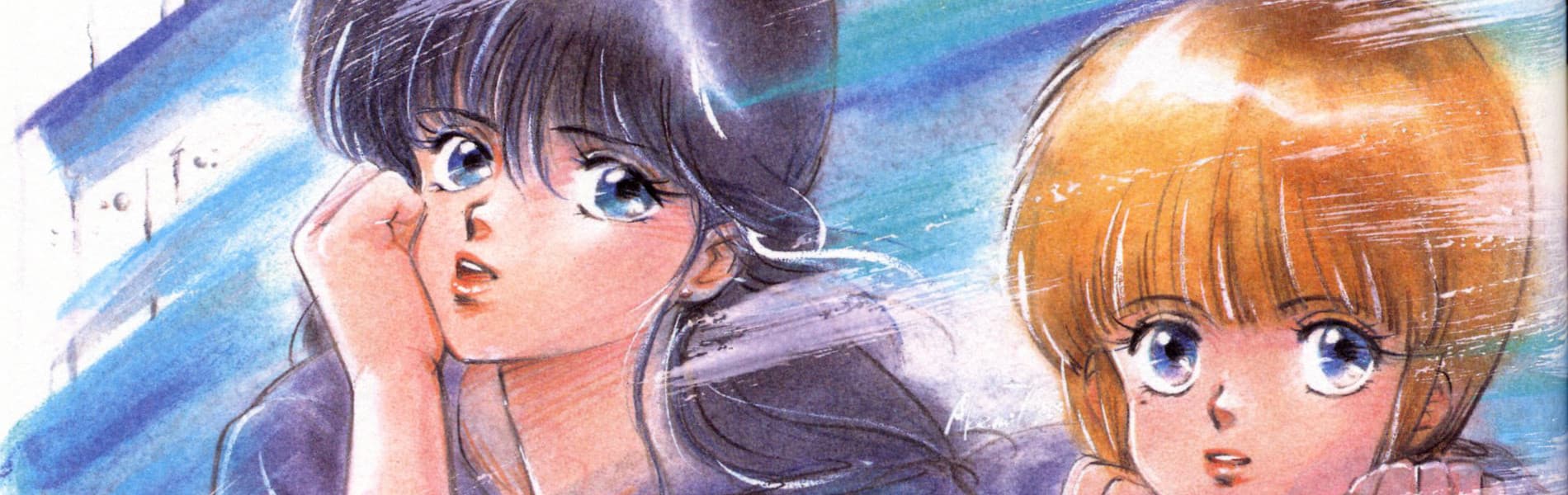


Kimagure Orange Road, if you thought a romcom like Nisekoi is peculiar in a magazine like Shounen Jump, then Kimagure Orange Road did it decades prior. Abbreviated as KOR, it was popular during its run in the 80s with a 48 episode anime, 8 OVAs, a movie in 1988 and another movie in 1996. KOR was one of the first, if not, most early famous examples of trying to spice up the romcom genre by incorporating supernatural elements. The setting doesn't get wacky either, everything takes place in a normal everyday town like the one you and I live in, but there is a tinge of otherworldly-ness that aids to the circumstances of the gag comedy format. In my viewing of KOR I've come to realize how much of a pioneer it was for a lot of popular modern anime, as I'll explain throughout the review.
KOR stars Kyousuke Kasuga, a teenager with esper powers. He can teleport and make things levitate, among other things. He has a love-at-first-sight encounter with Madoka Ayukawa, an attractive female student in the same grade and school as him. Her friend and underclassman, Hikaru Hiyama, falls madly in love with Kyousuke, and with that you have the basic love triangle setup.
Spoiler, click to viewclick to hide
(which is sadly and predictably one-sided, and it's painfully obvious even early on, a major flaw of KOR.)KOR then follows an episodic formula, putting Kyousuke and his friends in wacky situations, where it usually comes down to Kyousuke trying not to make Madoka mad or scoff at him, or him trying not to make Hikaru sad (or both, a lot of the time). Usually Kyousuke has to try to make things right using his powers, and in a way where his friends won't find out, because if everyone discovers that he has powers, then his family will have to move again. This might sound painfully typical, but in the mid 80s, the romcom genre was still in its infancy, archetypal romcom love triangles like Touch were still the norm.
Now throughout it's 48 episodes... it's extremely hit or miss, probably right down to the middle. There are many great, enjoyable, heart-warming and heart-gripping episodes as there are duds. Believe it or not but I've read that the anime actually alleviates the inconsistent quality in comparison to the manga, which is much longer. This is probably the aspect that makes it harder to recommend, and why KOR flew under the radar throughout the 2000s and early 10s.
I found out about KOR mainly because of the rise in popularity of future funk, a branch genre of vaporwave. If you don't know, future funk is a music genre that repurposes 80s and 90s pop music (both US and Japan, mainly) into creating upbeat, synth-driven electronic dance music. A lot of YouTube channels like ArtzieMusic use gifs from older anime, like Ursei Yatsura or KOR. Some popular examples for KOR:


This context adds nor detracts from the quality of the KOR anime, but its important to know in terms of why KOR is more culturally notable today than it was earlier in the millennium, since the popularity of these music videos have garnered interest in the gifs used, leading more people to want to watch KOR.
In a more anime historical context, the plot elements of KOR will be seen in a lot of modern anime today. I think probably the biggest thing it influenced is The Melancholy of Haruhi Suzumiya, though the comparison is a bit spoilery to explain. The dichotomy between everyday life and the supernatural though is definitely something the two have in common. The sequel film, which I might not cover, is very along the lines of highly tense love triangle climaxes such as True Tears and White Album 2. A lot of big modern industry figures have worked on the anime series / films as well, such as Tatsuya Ishihara (which I personally see a lot of the stylistic influence on Kyoani works), Shinji Hashimoto, Hiroyuki Kitakubo, Shiro Sagisu and Yuki Kaijura to name a few.
Cultural importance and isolated quality are two different things but not exclusive of each other in my opinion. If I watched KOR at my age in 1985, I might think differently about it the way I do today, because the way you see an airing anime that came out yesterday is different the way you might see it 10-20 years later. However, there is a reason why KOR stood the test of time for me to be interested in watching it in 2018. Partly because of memes / internet culture, but... there is quality there, as well as influence. It might be inconsistent sure, and if I were recommending this to someone, it would be someone who is interested in anime historically, or someone who can appreciate the older aesthetic even when the writing quality is lackluster. Even then, I think the films make watching the TV anime worth it. Excluding the films though, and rating only the TV anime, I give KOR a