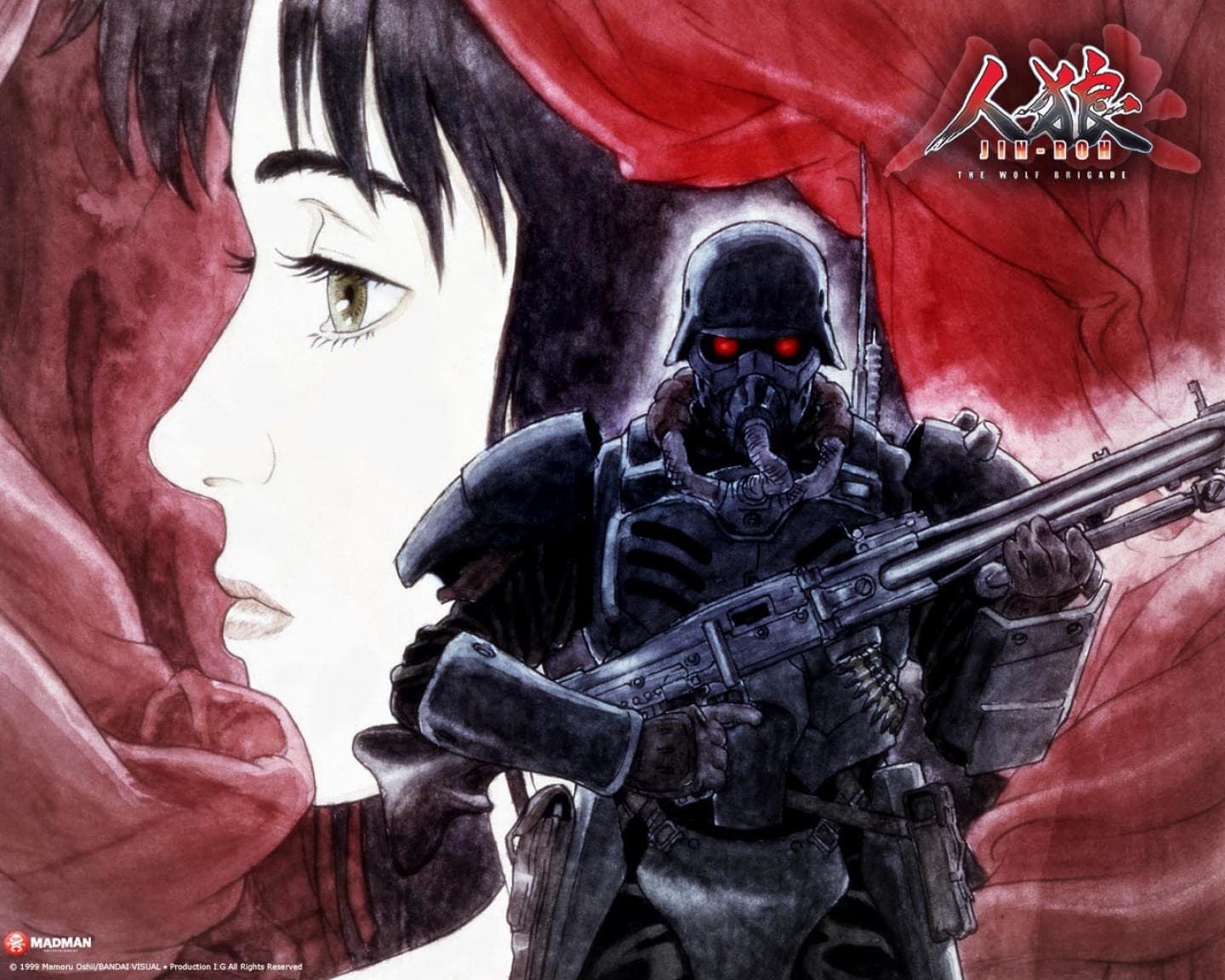
Sometimes while consuming media you find something that you can only profoundly respect. For me, Jin-Rou is exactly that. It honestly transcends the muh anime deal and elevates itself to cinema levels, good cinema. This IS a must-watch and I feel like saying some stuff about it, spoilers included.
First things first, this film is visually lovable. Some might find its worn presentation tiresome and bland, but it captures so strongly the feeling of hopelessness and wasted people living in a wasted world of wasted politics and wasted happiness, it's amazing. It's directed by the guy who made character design for Ghost in the Shell, a big friend of Oshii, and his ultra realistic character designs find perfect place in a narrative that is all about how reality functions. It's not easy to use those to their fullest, but whenever you have characters getting frantically holed by huge ass bullets, summarily executed without a blink for pity, you believe in it. It's heavy, and you feel the weight of those individuals dying for a cause. That is without mentioning its attention to detail, and how there is an entire else world going on while our characters casually live their lives. There is always something there, moving, existing, at any given moment. And that is shared with the audience in the sense we are also clueless of stuff that is just heavily implied. Facial expressions, moments of silence, of apparent discomfort, sadness, disillusion, hopelessness. All captured like it should, adding barely more than needed and leaving nothing to be desired. A balanced directing, aware of the perfect timing to cut scenes and progress things, so they can sink in without losing focus and grip on what the film is about. Lightning deserves its own mention. If you don't know what it looks like to have bullets being shot in a shady ambient and hitting their targets, be it metal, concrete or flesh, these guys did their homework to make it as realistic as you can possibly get, and cool as fuck to witness. So yeah, that is all on the visual end. Don't let me get into sound design. If you are into gun porn and gun sounds and steps from troops relentlessly marching towards their prey, oh boy, enjoy it.
But what honestly separates Jin-Rou from a cool looking flick about cops doing cops things is definitely the screenplay. Again, this is great cinema, and if there is one thing that is common to great films is their writing. An inattentive watch for this picture can cause the feeling of indifference, also known as, "is that it?". Well, yeah, it has a hell of a slow pacing and its plot is considerably small and simple. But the thing about this movie is that it's a piece of expression, and most people won't bother to know what Oshii was trying to say. He wrote all of this world and characters, characteristic of his worldview, and knowing the guy helped me a lot comprehending all the subdued things that could easily pass unnoticed. At the very beginning, we are introduced to the world of Jin-Rou through an expository documentaryesque sequence that closes with:
"As they were about to join the pages of history, the changing times were about to give them a new and final mission", referring to the Special Unit. Let's go from there.
Jin-Rou begins by exploring the idea that big shifting moments in our history were determined by small actions, or in this case, small inaction. By not pulling the trigger at the beginning, Fuse becomes a chess piece in a dangerous game of interests that could only end in tragedy for one side. There is also the idea of entering the pages of history in a way most people often don't take into consideration, which is of entering subtly by not being there. History isn't necessarily known, though it's always there, crawling in the corners of our lives. Unknown heroes, unknown villains, unknown victims: that is our history, filled with blood-stained pages. And that is all because what the pack wishes to achieve is the perfect status quo, fighting hard to maintain its existence, always hiding their plots from public knowledge. So this might leave watchers wondering if the ride is worth it, because shit seems not to happen. Well, that is the point of the film. All it's done is an act of regression, to represent post-war Japan's mindset and spirit of never actually changing. Things come and go, movements arise and disappear, blood is shed, and people remain the same. In our world, Japan grew to be what is described in Oshii's masterful Patlabor 2. In Jin-Rou's world, where Nazi Germany won the war and methods of oppression were of common use, the society ignores the Sect's revolutionary acts, as well as the Special Unit's crude repression. It achieves minimal stability and already throws in the towel, being only a section of the government interested in changing things. That change is, however, only interested in shifting structures of power from one side to the other, while remaining ultimately corrupt. Just look at the methods these bureaucrats utilize to get there.
So there is an evident pessimism to the film's political backdrop and message, not a surprise coming from Oshii. But there is more than just that to Jin-Rou. It's also the story of people, and of how much they are worth: nothing. There is a cut in the last minute that I must say, it's one of the best cuts I've seen in all of anime. The idea of cutting to something else is of separating two realities that just couldn't be recorded as the same. There could be a moving camera shifting from one place to another, but only a cut can convey that feeling of 'wow, look how different these two perspectives are'. It is a meaningful cut, and its meaning is soul-crushing. The tragic tale of death, of finality. After crossing a point of warped morality, there is no going back. Fuse is lost, forever. The last moments of that couple are spectacularly shot. There is a sense of objectivity to the scene, like if it's recorded by superior all knowing beings without a moral compass to mourn upon the cold farewell of two murderers from different sides. Both share a dream of belonging, both die in a sense, one remains human, the other shows its true colors. And, reaching the end of this few-seconds long scene, we cut to a man, a wolf, holding a gun, pointed at the two, waiting for yet another inaction of our protagonist to fire and kill both. It's not necessary, of course, but it shows reality as it is like no other scene had before. This is Fuse's and Kei's value. This is what they truly worth: nothing. She is to be disposed of in some wasteland, and he is, despite his talent and skill, as disposable. By choosing the "right" side, he lives, although dead inside. Had he chosen otherwise, he'd be over too. Dying as a human, becoming a wolf, it's all the same. All about negating humanity, and by cutting from the tragedy to the routine of dealing with internal doubt and risk by the more experienced from the pack, it separates the movie in two. The tragic tale of two souls destined to cease, and the tale of wolfs casually eating their preys, like they always do; nothing special about it. It's depressing, it's sad, it's hopeless. But it ends. It ends and that is all that matters. What is done is done, Fuse is done for, so is Kei. The pack's position is secured for some time, the danger of termination is postponed until further notice, and things ultimately remain the same in the grand scheme of things, like Oshii wanted to say.
It's dark, it's merciless, and it's striking. It might be boring, uninteresting to some, simplistic to others. The film is what it is, a piece of expression that never felt the need to overstate anything that had going for it. The blatant quoting of Little Red Riding Hood is just a tiny fraction of what the anime is about. If you got caught up on that, you may have missed a big portion of its quality. It's like a solid rock. Hard to approach, hard to carry, hard to take something away from, but it's definitely worth it. Every time I rewatch it, I always think just how powerful it is by doing things that way instead of resorting to a more action packed style, which is more Oshii like. I also think it's much more subtle than anything Oshii has ever done, which I attribute to him not directing it, but instead only giving essential advice, and coordinating the production. Truly masterful. Give yourself a watch.